
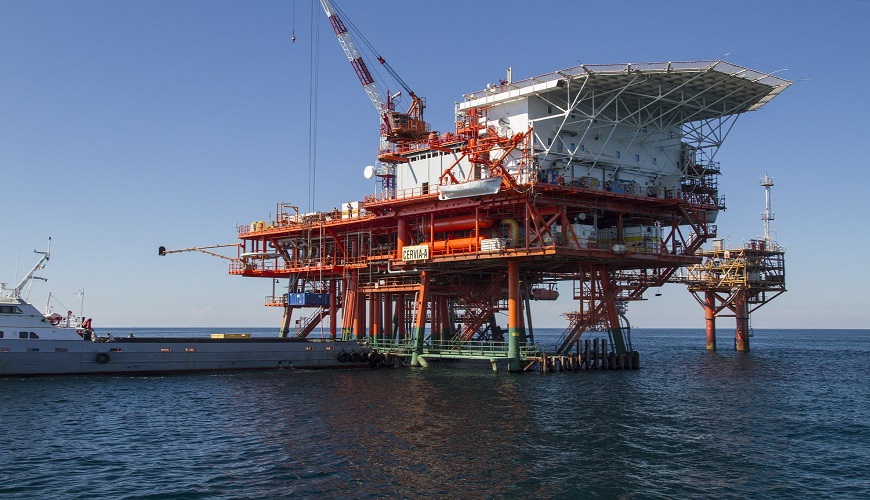
Sulla piattaforma Cervia K si svolge la compressione del gas naturale proveniente dalle piattaforme del campo Omogeneo Rubicone. A tale scopo sono installati: n° 2 turbocompressori a gas da 22.732 kW l’uno, n° 3 motogeneratori principali a gas da 1.488 kW l’uno, n° 1 motogeneratore d’emergenza a gasolio da 550 kW e n° 2 motori a gasolio di azionamento delle gru di servizio da 413 kW l’uno.
Complessivamente si ha una potenza termica di combustione pari a 51,300 MW > 50 MW.
The Cervia K platform is considered a "satellite" of the Cervia A platform, and only the low-pressure production from all other platforms goes to Cervia K and then to the compressor.
A connecting bridge joins the Cervia K platform to the Cervia A production platform, which receives other platforms via the sea line (Cervia B, Cervia C, Cervia Cluster, Arianna, Arianna Cluster, Azalea B, Naide, Anemone B and Anemone Cluster). The Cervia A platform receives the gas in production from the mentioned plants, and then transfers only the low-pressure gas to the Cervia K platform for compression, once the gas is compressed the Cervia K sends it back to Cervia A and then transfers it via the sea line to the Rubicone (onshore).
Cervia K is made up of a 4-legged jacket, an integrated deck on two floors (cellar deck at a height of 13 m and main deck at an elevation of 22 m which including also a mezzanine deck at an elevation of 17.5 m of limited development), and by a bridge connecting with the Cervia A platform.
Description of the Production cycle
As mentioned above, the gas (low pressure) arrives on the Cervia K compression platform and is conveyed into the K190-VQ-001 slug catcher, which is separated from any entrained liquids and then by manifold (equally divided) to the suction of the two Centrifugal Compressors. Each compressor is equipped with two-stage and driven by the gas Turbine.
Before reaching the suction flanges of the individual stages, the gas passes through the respective suction KO drums K360-VN-101/201 (1st stage) and K360-VN-102/202 (2nd stage) which take care of breaking down the smaller drops of possibly entrained liquids (very important for the compressor).
The compressed gas, which comes out from both compression stages, is cooled in the K360-HA-101/102 and K360-HA-201/202 shell and tube exchangers with seawater and then sent to onshore (Rubicone) through Cervia A platform.
The quantity of gas used to drive the gas turbine is taken from the suction of the compressor by the control valve, as long as the available pressure is sufficient to drive the turbine. If for some reason the pressure drops or will be not available, the gas will be provided by the discharge of the compressor (always via the control valves).
Gas compression
This system consists of 2 identical compression lines operating in parallel. The incoming gas is sent to the 1st stage KO drum suction unit, where the residual liquid is removed. Subsequently, the gas is sucked by the 1st stage gas compressors and compressed up to an intermediate pressure value; downstream of the 1st compression stage, the gas undergoes refrigeration via seawater exchangers (intercoolers), up to a temperature of 30°C.
The outlet gas from the interphase exchangers is sent to the 2nd stage suction KO drum, located upstream of the 2nd compression stage, where any condensates are separated.
The gas will compressed and cooled again until it reaches the pressure necessary for introduction into the sealine connecting between Cervia K and the Rubicone plant.
The centrifugal compressors are driven by two Alstom Siemens Tornado K360-MT-101/102 turbines.
The turbines are equipped with a DLE combustion chamber. The launch of turbochargers is carried out with an electric motor.
Gas turbo compressors are also equipped or make use of auxiliary equipment and/or circuits:
- Turbine lubrication oil tanks
- Turbine lubrication circuit
- Compressor oil tanks for mechanical seals, etc.
- Compressor lubrication circuits
- Tote tanks Turbo Compressor lubrication oil
Liquid reception system
The process waters (layer waters) which are retained by the slug catcher, before the gas entry in the Turbocompressor, are sent to the degassing and the calming tank, then by booster pumps, are introduced into the sealine gas towards the Rubicone plant.
Sistema di raffreddamento acqua mare
The seawater cooling system supplies the interstage and final shell and tube exchangers of the compression lines and the plate coolers of the lubrication oil of the gas turbocompressors.
The sea water is taken from a depth of 15 m, with a temperature of approximately 13°C, filtered and then sent to the exchangers to cool the compressed gas.
The water coming out from the exchangers, before being discharged into the sea, is used to heat the lubricating oil (Water discharged into the sea cannot have a temperature higher than 35°C.)
Gas exhaust system
The Exhaust Gas discharges, continuous or emergency, are collected and then conveyed into the atmosphere via through the vent flare.
The system, supported by a single structure, is composed of:
- HP flare which the emissions linked to particular extremely remote and very low probability events converge and whose periodicity is impossible to determine, such as the openings of the PVS for the mechanical protection of the equipment and the depressurization due to system block
- LP flare vent which collects the gaseous waste coming from the degassing of the layer water production. Discharge of gas to the LP flare.
HP and LP flare are designed (calculated) in the event of accidental ignition not to exceed the maximum radiation on the main deck of 4.73 kW/m2.
Fuel gas system
The system is supplied by natural from the production of gas tapped from the suction lines of the gas compressors or, when the decline of the reservoir pressure does not satisfy the conditions required to supply the compressor turbines, the system switches into auto mode via control valve to the delivery manifold and supplies the turbine.
The system consists of an electric heater which raises the temperature of the gas to a value that the turbine requires, with adequate safety margins, to avoid the formation of hydrates during the lamination phase by the pressure control valve.
The presence of a suitable buffer vessel allows the supply of combustible gas to the users for a short period even in the event of a shutdown of the platform, to avoid the simultaneous and immediate general blockage of the system, and also used to separate condensed liquids during the stop the unit.
Conclusion
This is a small and brief description of the Cervia Platforms. Working in this field has been of great personal satisfaction, including the results obtained. Working on the sea far from the cost is not easy for anyone, for this, all personnel who work on board are like a family. This type of platform is dangerous, and for this reason, the personnel must be highly competent.

+(39) 347 051 5328
Italy - Kazakhstan


09.00am to 18.00pm
About
We offer the best and economical solutions, backed by 27+ years of experience and international standards knowledge, echnological changes, and industrial systems.
Our Services
Marketing Materials


Marketing Materials1


