
Principle of operation
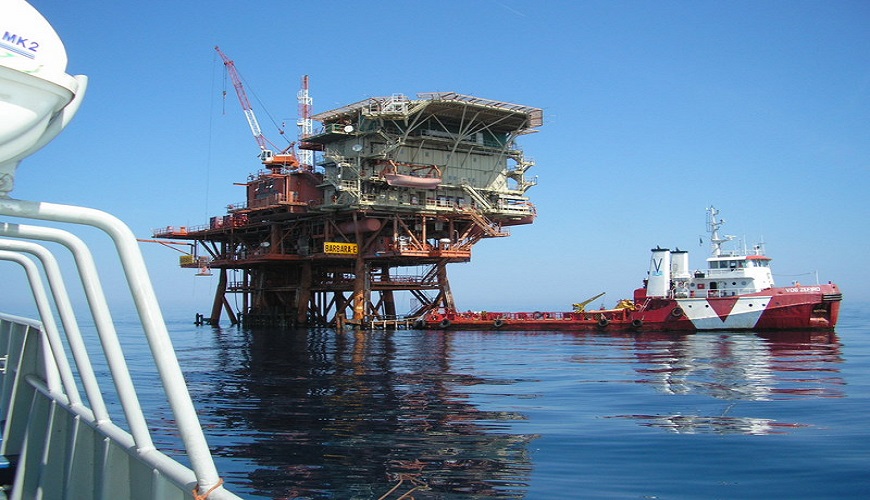
The gas coming from each platform of the Barbara Field converges on the Barbara T compression platform (main one), where the gas initially passes through specially dedicated gas/liquid separators (S1÷S5 S7-S8), placed at the arrival of the lines, thanks to them the gas separate from particles of liquid.
To avoid any slugs that may form in the field sealines, a liquid reception trap (S6) has been positioned under the cellar deck, which collects, by gravity, the condensation water discharged from the separators dedicated to the arrival of the platforms of extraction.
The outlet gas from separators plus that coming from the S6 tank is routed to the Barbara T compressors, while the liquid phase is sent to the layer water treatment plant at the Barbara C Platform.
Upstream of each compression stage, there is a vertical suction KO-Drum (360-VG-01A/B/C) for the final separation of the water particles. Subsequently, the gas is compressed using three compression trains working in parallel.
Each compression train present on Barbara T consists of:
- Gas turbine with SoLoNOX combustor (360-MT-101/201/301), which allows the reduction of polluting emissions compared to those of conventional turbines
- Centrifugal gas compressor (360-KA-01/02/03) single-stage model Solar C505J
The compressors are protected from the surge by antisurge valves, installed downstream of the heat exchangers dedicated to the process gas, which allow the gas to be recirculated towards the suction of the compressors
To further protect the compressors, 3 fast stop valves are installed (1 for each compressor and in parallel with the anti-pumping valves) connected to the compressor delivery (immediately downstream of the heat exchangers, in by-pass configuration of the Anti-Surge valves) and with his aspiration. These valves, installed on each compressor, have the task of protecting the compressors from surges during the transient shutdown phases and are regulating with ON/OFF function.
Both the anti-surge valves and the fast stop valves are managed by the compressor control system (UCP).
Each compression train on the platform features a lubricating oil refrigeration system, consisting of a plate exchanger in which the lubricating oil is cooled with seawater supplied by the platform's seawater pumping system
The outlet gas from the compressors is cooled before being sent to the Barbara T2 Platform, using a seawater cooling system, combined with each turbo compressor, each consisting of two gas-sea water shell and tube exchangers (360-HA-01 /02/03 A/B) that work in parallel.
The seawater, used at the Barbara T Platform, is taken from the Barbara C Platform, filtered and subsequently sent to the shell and tube exchangers for cooling the compressed gas.
The gas produced at low pressure from Bonaccia, Bonaccia N-W, Elettra, Clara E, Calpurnia, Clara N, Clara NW and Calipso platforms is instead transferred via an 18" line, located on the connecting bridge, from the Barbara C platform to Barbara T2, with transit over Barbara T.
The gas, conveyed into the slug catcher (190-VQ-001), is then separated from any entrained liquids.
The gas from the Croatian fields of the Marica and Katarina extraction platforms is directly sent, without first passing through the Barbara C platform, into the slug catcher (190-VQ-002), where it is separated from any entrained liquids, and then conveyed to the compression of the Barbara T2 Platform.
The gas coming from the slug catchers, together with the gas arriving from the Barbara Field, previously compressed on the Barbara T Platform, and from the Croatian Fields of the Marica and Katarina extraction platforms, is equally distributed on four identical compression lines operating in parallel. Each line is made up of a 1st stage compressor and a 2nd stage compressor, called 360-KA-104/204, 360-KA-105/205, 360-KA-106/206, 360-KA-107/ 207.
Before reaching the suction flanges of the individual stages, the gas passes through the respective KO drums of the 1st stage 360-VN-104/105/106/107 and the 2nd stage 360-VN 204/205/206/207, which they take care of breaking down the smallest drops of liquids that may be entrained.
The compressors are driven by four “Solar Taurus T60” gas turbines, designated 360-MT-004/5/6/7. The turbines are equipped with a “SoLoNOx II” combustion chamber, in order to reduce the concentration of pollutants in the natural gas combustion fumes, released into the atmosphere from the chimneys.
At the service of each turbocharger, there is a tank for the lubrication oil (Phase 23-BAR T2). The used oil during maintenance activity is drained into a special tank and brought onshore by a Supply Vessel. The entire gas turbo-compressor system is equipped with auxiliary equipment and circuits in communication with the atmosphere, via permanent vents:
- Venting of the lubrication oil tank of the gas compressors, with mist abatement
- Venting secondary seals of gas compressors
- Emergency venting of gas compressor valve pilots
- Emergency venting of the compressor seal gas recovery skid
The compressed gas, coming out of both compression stages, is cooled in the 1st stage gas-sea water shell and tube exchangers 360-HA-104/105/106/107 (intermediate refrigeration up to 30°C) and 2nd stage 360-HA-204/205/206/207 (final refrigeration) with seawater. The compressed gas is then sent back to Barbara T to be transferred to the Falconara power plant.
The seawater taken at about 30 m depth is filtered and then sent to the shell and tube exchangers for cooling the compressed gas. The water coming out of the exchangers is discharged into the sea.
Conclusion
In the field of methane extraction, this was one of the first projects ever for electro-instrumental maintenance. Complex projects for the equipment installed, and also the weather and sea conditions which are not always good.

+(39) 347 051 5328
Italy - Kazakhstan


09.00am to 18.00pm
About
We offer the best and economical solutions, backed by 27+ years of experience and international standards knowledge, echnological changes, and industrial systems.
Our Services
Marketing Materials


Marketing Materials1


