
|
Inconel 617
Alloy 617 is a solid-solution, nickel-chromium-cobalt-molydenum alloy with an exceptional combination of high-temperature strength and oxidation resistance. The alloy also has excellent resistance to a wide range of corrosive environments, and it is readily formed and welded by conventional techniques. The high nickel and chromium contents make the alloy resistant to a variety of both reducing and oxidizing media. The aluminium, in conjunction with the chromium, provides oxidation resistance at high temperatures. Solid-solution strengthening is imparted by cobalt and molybdenum. They are available in different shapes and contain a number of elements in a variety of combinations to achieve the desired result. There are three groups of alloys namely cobalt-based, nickel-based, and iron-based alloys. All three types can be used at temperatures above 540°C (1000°F). Existing several forms in commerce, the most used are:
Standard Specification
Chemical Composition, %
Table 1 - Physical Characteristics of Inconel 617
Applications of Inconel 617
Physical Properties UNS N06617 has a tensile strength of 1100 MPa (160 ksi) while maintaining ductility even when exposed to temperatures up to 1000°C (1832°F). Its creep rupture strength also remains constant at temperatures up to 950°C (1742°F). The alloy’s thermal conductivity is approximately 11 W/mK (56 BTU/hr ft2 °F) at room temperature, which further increases with rising temperature levels; this makes it suitable for use in heat exchangers and other heat transfer applications. The material also exhibits excellent weldability, with no post-weld cracking or embrittlement observed after welding.
Mechanical Properties UNS N06617 is a titanium-cobalt-chromium alloy with superior corrosion and oxidation resistance. With its increased strength from molybdenum addition and superior creep properties, Inconel 617 makes for an ideal choice for operations up to 2000°F. Its mechanical properties are exceptional as well, with a yield strength of 80 ksi at room temperature and accented by its fracture toughness. Due to its versatility and low cost, Inconel 617 is used in extremely harsh environments that require superior corrosion and oxidation resistance. As such, it is the material of choice for nuclear plants, metallurgical coal-fired boilers, sulfuric acid condensers, gas turbines, airframes and other aerospace components, as well as thermal processing equipment. Table 2 to Table 6 below shows all Mechanical characteristics.
Table 2 -Thermal Properties of INCONEL alloy 617 Note:
Table 3 - Modulus of Elasticity a Note:
Table 4 - Mechanical Properties( Solution-Annealed Condition)
Table 5 - Typical Room-Temperature Tensile Properties of Annealed Material
Table 6 - Mechanical Properties After Exposure to Elevated Temperatures
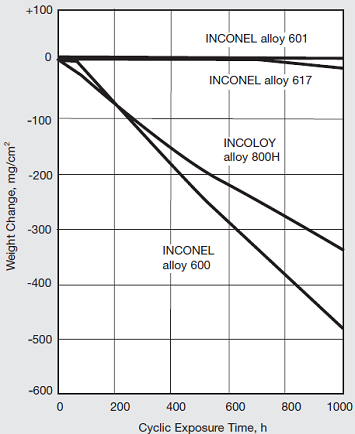
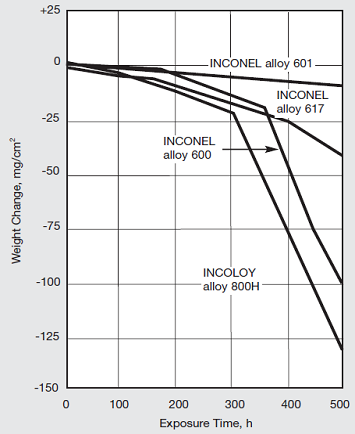
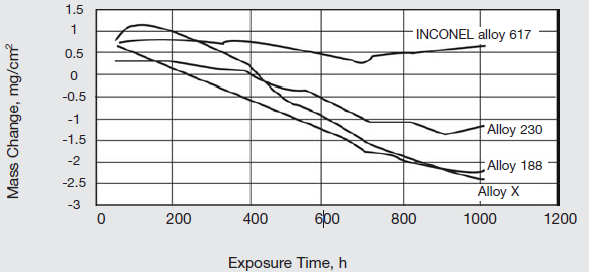
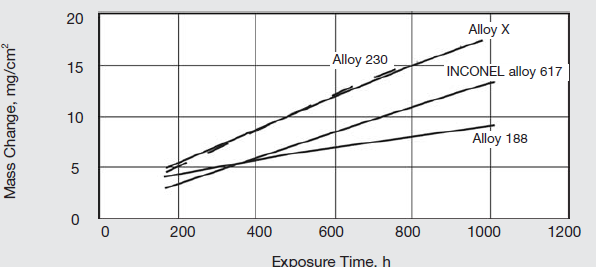
Work condition and Heat Resistance of Inconel 617 INCONEL® alloy 617 (UNS N06617/W.Nr. 2.4663a) is a solid-solution, strengthened, nickel-chromium-cobalt molybdenum alloy with an exceptional combination of high-temperature strength and oxidation resistance. The alloy also has excellent resistance to a wide range of corrosive environments, and it is readily formed and welded by conventional techniques. The limiting chemical composition of INCONEL alloy 617 is listed in Table 1. The high nickel and chromium contents make the alloy resistant to a variety of both reducing and oxidizing media. The aluminium, in conjunction with the chromium, provides oxidation resistance at high temperatures. The cobalt and molybdenum impart solid-solution strengthening. The combination of high strength and oxidation resistance at temperatures over 1800°F (980°C) makes INCONEL alloy 617 an attractive material for such components as ducting, combustion cans, and transition liners in both aircraft and land-based gas turbines. Because of its resistance to high-temperature corrosion, the alloy is used for catalyst-grid supports in the production of nitric acid, for heat-treating baskets, and for reduction boats in the refining of molybdenum. INCONEL alloy 617 also offers attractive properties for components of power-generating plants, both fossil fuel and nuclear. Property values are given in both United States customary units and the International System of Units (SI). The SI unit of stress is the pascal (Pa), which is equivalent to newton per square metre. The approximate relationship between the pascal and the pound per square inch (psi) is 1 Pa = 0.0001450 psi, or 1 psi = 6895 Pa. Oxidation and Carburization The resistance of INCONEL alloy 617 to cyclic oxidation at 2000 °F (1095°C) is shown in Figure 1. The tests were performed on specimens of thin strip and consisted of cycles of exposure to temperature for 15 minutes followed by cooling in still air for 5 minutes. The results demonstrate the ability of the alloy to form and retain a protective surface oxide under conditions of extremely severe thermal cycling. The results of a similar test at 2100°F (1150°C) are shown in Figure 2. The specimens of thin strip were exposed to the test temperature in 50-hour cycles with weight loss determined after each cycle. The resistance of alloy 617 and other high-strength, heat-resistant alloys to static oxidation in moist air at 1832°F (1000°C) is shown in Figures 3 and 4. The excellent resistance of alloy 617 to oxidation results from the alloy’s chromium and aluminium contents. At elevated temperatures, those elements cause the formation of a thin, subsurface zone of oxide particles. The zone forms rapidly upon exposure to high temperatures until it reaches a thickness of 0.001 to 0.002 in. (0.025 to 0.05 mm). The oxide zone provides the proper diffusion conditions for the formation of a protective chromium oxide layer on the surface of the metal. It also helps to prevent spalling of the protective layer. INCONEL alloy 617 has excellent resistance to carburization. Table 9 compares alloy 617 and some other carburization-resistant alloys in a gaseous carburizing environment at 2000°F (1095°C). The weight-gain measurements indicate the amount of carbon absorbed during the test period. Table 6A and 6B shows the superiority of alloy 617 over alloys of similar strength in a gas carburization test at 1800°F (980°C).
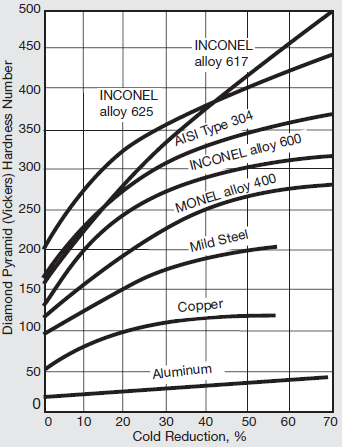
Hot and Cold Forming Alloy 617 has good hot formability, but it requires relatively high forces because of its inherent strength at elevated temperatures. In general, the hot-forming characteristics of alloy 617 are similar to those of INCONEL alloy 625. The temperature range for heavy forming or forging is 1850 to 2200°F (1010 to 1205°C). Light working can be done at temperatures down to 1700°F (925°C). INCONEL alloy 617 is readily cold-formed by conventional procedures although its work-hardening rate, shown in Figure 5, is high. For best results, the alloy should be cold formed in the fine-grain condition, and frequent intermediate anneals should be used. Annealing for cold forming should be done at 1900°F (1040°C).
Corrosion Resistance of Inconel 617 Inconel 617 is an advanced-generation nickel alloy that offers best-in-class corrosion resistance. It possesses superb strength and durability and resists oxidation even in high temperatures up to 1200°C. Thanks to its amazing features, Inconel 617 is extremely popular for heat exchanger components, gas turbine components, structural components, hot valve trim, and rocket thrust chambers. Furthermore, it also exhibits excellent resistance to hot gases and pure hydrogen atmospheres, as well as sulfidation. Inconel 617 is ideal for heavy-duty applications that require extreme pressure and temperature environments. Stress-Corrosion Cracking Superalloys are extensively used at high-temperature applications due to their good oxidation and corrosion resistance properties in addition to their high stability were made at high temperature. Experimental measurements of hot corrosion at high temperatures of Inconel 617 and Inconel 738 superalloys. The experiments were carried out at temperatures 700 °C, 800 °C and 900 °C for different exposure times to up to 100 h. The corrosive media was NaCl and Na2SO4 sprayed on the specimens. Seven different specimens were used at each temperature. The corrosion process is endothermic and the spontaneity increases by increasing temperature. The activation energy was found to be Ea = 23.54 and Ea = 25.18 KJ/mol for Inconel 738 and Inconel 617 respectively. X-ray diffraction technique (XRD) was used to analyze the formed scale. Scanning electron microscopy (SEM) examined the specimen's morphology and scale. The results show that the major corrosion products formed were NiCr2O4, and Co Cr2O4 spinles, in addition to Cr2O3. Generally speaking, hot corrosion is regarded as a catastrophic degradation process because of its serious influence on the properties of the alloy and its characteristic of deteriorating with time extension. The difficulty of forming a stable and dense oxide layer is considered to play a decisive role in this process. There is no doubt that different oxides have different effects on hot corrosion, and this effect is closely related to structural stability. At the same time, however, the presence of NiO in the form of composite oxides and some NiO as the "matrix" of other oxides can still be found. It explains the role of the NiO-stable dispersion phase and bulk spinel phase as the NiCr 2 O 4 mentioned above. This stabilizing effect is especially important when the alloy is subjected to thermal shock. Turbine blades and other high-temperature components of aerojet engines have greatly benefited from the use of Ni-based single-crystal (SC) superalloys because of their superior high-temperature mechanical capabilities. Oxidation is one of the most critical evaluation indicators of the high-temperature performance of high-temperature alloy systems because it can cause de-alloying corrosion, loss of surface strength, cracking, and eventual collapse. Thermal barrier coatings are often used to prevent the oxidation of alloys. Machinability Inconel 617 is a nickel-chromium-based alloy that is ideal for many high-temperature applications. Machining this particular metal can be difficult. However, the right tools, experience, and know-how make it possible. In order to machine Inconel 617, high-speed steel or carbide cutters requiring coolants must be used. Additionally, due to its hardness, it requires slow feed rates and depth of cuts using sharp cutting tools, which helps reduce vibrations as well as minimize heat build-up while machining. With the right technique and careful setup of the machinery, it can produce an excellent finish on Inconel 617 with minimal problems. Welding of Inconel 617 Welding Inconel 617 requires a skilful application of technique. The alloy has an affinity for nitrogen, so welders must be sure to use an abrasive filler metal with a high nitrogen content. This special welding process increases the risk of crack formation, so Welders must exercise caution and take extra care in preparation and technique in order to produce an effective weld. Furthermore, because of its composition, Inconel 617 is best welded with multiple passes instead of risking a single pass-over that may not be enough to maintain good penetration. Knowing these details before beginning will make the welding process much smoother and will save time and resources in the long run. Of course, our suggestion is focused on who will perform the welding, In our opinion, the welder must have a high level of experience patented. Alloy 617 can be joined to itself and to many other metals by conventional welding processes. These include GTAW (TIG), GMAW (MIG/MAG), plasma arc, electron beam welding and SMAW (MMA). Pulsed arc welding is the preferred technique. For welding, Alloy 617 should be in the annealed condition and be free from scale, grease and markings. When welding the root, care should be taken to achieve the best-quality root backing (argon 99.99), so that the weld is free from oxides after welding the root. Any heat tint should be removed preferably by brushing with a stainless steel wire brush while the weld metal is still hot. Standard Specification Of Inconel 617 Welding Electrode
Table 7 - Standard Specification Alloy 617 Welding Wire Price List
Inconel 617 Welding Wire Composition Chart as per AWS A5.14M: 2011 (%)
Table 8 - Welding Wire Composition
Inconel 617 Filler Wire Types
Table 9 - Filler Wire Types
Table 10 - Electrode composition
SFA-5.14, ERNiCrCoMo-1 Welding Electrode Mechanical Strength
Table 11 - Melting Point and Density
Inconel 617 electrode suppliers
Conclusion In conclusion, Inconel 617 is an ideal choice for components that require exceptional strength at elevated temperatures while also exhibiting good corrosion resistance in various media such as acids or alkalis. Its combination of mechanical properties makes it suitable for many different applications ranging from aircraft engines to speciality valves and pumps operating under extreme conditions. If you’re looking for a material that can stand up to extreme temperatures while still providing corrosion protection, then look no further than Inconel 617! |
||||||||||||||||||||||||||||||||||||||||||||||||||||||||||||||||||||||||||||||||||||||||||||||||||||||||||||||||||||||||||||||||||||||||||||||||||||||||||||||||||||||||||||||||||||||||||||||||||||||||||||||||||||||||||||||||||||||||||||||||||||||||||||||||||||||||||||||||||||||||||||||||||||||||||||||||||||||||||||||||||||||||||||||||||||||||||||||||||||||||||||||||||||||||||||||||||||||||||||||||||||||||||||||||||||||||||||||||||||||||||||||||||||||||||||||||||||||||||||||||||||||||||||||||||||||||||||||||||||||||||||||||||||||||||||||||||||||||||||||||||||||||||||||||||||||||||||||||||||||||||||||||||||||||||||||||||||||||||||||||||||||||||||||||||||||||||||||||||||||||||||||||||||||||||||||||||||||||||||||||||||||||||||||||||||||||||||||||||||||||||||||||||||||||||||||||||||||||||||||||||||||||||||||||||||||||||||||||||||||||||||||








+(39) 347 051 5328
Italy - Kazakhstan


09.00am to 18.00pm
About
We offer the best and economical solutions, backed by 27+ years of experience and international standards knowledge, echnological changes, and industrial systems.
Our Services
Marketing Materials


Marketing Materials1


