
|
Inconel 625
Inconel Alloy 625 (UNS designation N06625) is a nickel-based superalloy that possesses high strength properties and resistance to elevated temperatures. It also demonstrates remarkable protection against corrosion and oxidation. Its ability to withstand high stress and a wide range of temperatures, both in and out of water, as well as being able to resist corrosion while being exposed to highly acidic environments makes it a fitting choice for nuclear and marine applications. Inconel 625 was developed in the 1960s with the purpose of creating a material that could be used for steam-line piping. Some modifications were made to the original composition that have enabled it to be even more creep-resistant and weldable. Because of this, the uses of Inconel 625 have expanded into a wide range of industries such as the chemical processing industry, and for marine and nuclear applications to make pumps and valves and other high-pressure equipment. Because of the metal's high Niobium (Nb) levels as well as its exposure to harsh environments and high temperatures, there was concern about the weldability of Inconel 625. Studies were therefore conducted to test the metal's weldability, tensile strength and creep resistance, and Inconel 625 was found to be an ideal choice for welding. Other well-known names for Inconel 625 are Haynes 625, Nickelvac 625, Nicrofer 6020, Altemp 625 and Chronic 625
Standard Specification
Chemical Composition Inconel 625
Table 1 - Chemical Composition Note:
Applications of Inconel 625
Physical Properties Inconel alloy 625 has a density of 8.4 g/cm3, which makes it slightly heavier than other metals such as copper or aluminium, but lighter than stainless steel or titanium alloys. The alloy also has a high melting point of 1350°C and excellent thermal conductivity, which makes it suitable for use in extreme temperature conditions.
Mechanical Properties Inconel alloy 625 is a highly sought-after alloy due to its impressive mechanical properties. It has excellent fatigue strength, tensile strength, and a high degree of creep rupture under temperatures as high as 1500°F. Furthermore, its stress corrosion cracking resistance and oxidation resistance make it suitable for many extreme applications. UNS N06625 also offers superior weldability and formability compared to many other similar materials – making it an ideal choice for parts that need to be deeply formed or complexly joined. All in all, Inconel 625 is an incredibly strong and versatile solution in the competitive world of metal alloys.
Table 2 - Thermal and Electrical Properties Note:
Table 3 - Modulus of Elasticity
Table 4 - Nominal Room-Temperature Mechanical Properties a Note:
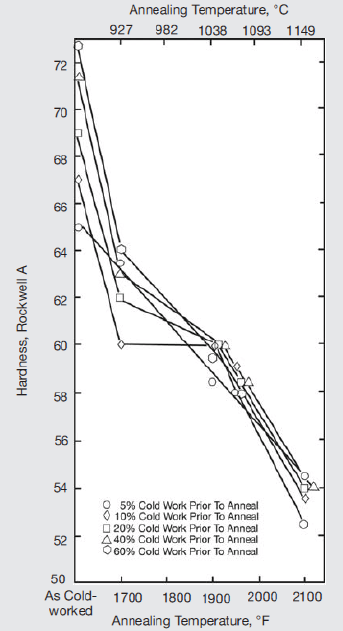
Work condition and Heat Resistance of Inconel 625 INCONEL® nickel-chromium alloy 625 (UNS N06625/W.Nr. 2.4856) is used for its high strength, excellent fabricability (including joining), and outstanding corrosion resistance. Service temperatures range from cryogenic to 1800°F (982°C). Inconel 625 is a titanically alloyed nickel-chromium material designed for exceptional heat resistance. It is specifically protected against crevice corrosion and attack in many acidic environments, making it uniquely suited for use in industries where increased temperatures often lead to a breakdown of standard materials. Inconel 625 has been used in marine engineering, nuclear power productions, and other applications where prolonged exposure to high temperatures can be an issue. So if you need a material that won’t fail under intensive heat, Inconel 625 is the ideal solution. Hot- or cold-formed parts are usually annealed at 1700°-1900°F for times commensurate with thickness; higher temperatures may be used to soften the material for additional cold work. INCONEL alloy 625 is solution-treated at 2000°-2200°F. These temperatures are metal temperatures based on batch operations and may not apply to continuous annealing, which normally consists of short exposure in the hot zone of a furnace set at higher temperatures. The rate of cooling after heating has no significant effect on INCONEL alloy 625. Tables 5 and 6 can be used as a guide for determining the preferred temperature for reducing the stress level of the alloy. Heating cold-drawn material at 1100° to 1400°F reduces residual stress. Stress relief is virtually complete when the material is heated to 1600°F. The effect of annealing on the hardness of the sheet given varying amounts of cold reduction is shown in Figure 1.
Table 5 – Effect of Annealing (1 hour) on Room-Temperature Properties of Hot-Rolled Rod
Table 6 – Effect of Annealing (1 Hour) on Room-Temperature Properties of Cold-Drawn Rod
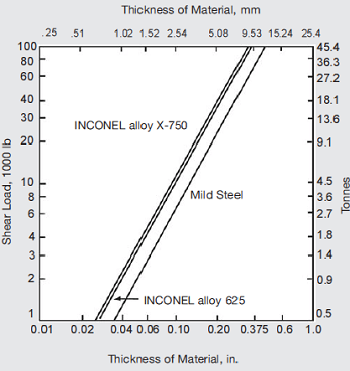
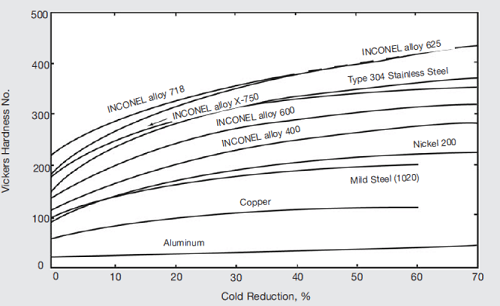
Hot and Cold Forming Because INCONEL alloy 625 was especially developed to retain high strength at elevated temperature, it resists deformation at hot-working temperatures. It is readily fabricated by hot forming, however, provided adequately powerful equipment is used. When INCONEL alloy 625 is hot-formed, it should be heated in a furnace whose temperature is held at (but not above) 2150°F. The work should be brought up to as close to 2150°F as conditions permit. Heavy forging can be carried out from 2150°F down to 1850°F. Lighter reductions can be taken down to 1700°F. To guard against duplex grain structure, the work should be given uniform reductions. Final minimum reductions of 15 to 20% for open-die work are recommended. INCONEL alloy 625 can be cold-formed by standard processes. The force required to shear the alloy in the annealed condition is shown in Figure 2. More indications of its resistance to deformation can be derived from the true stress-true strain curves (see the “Mechanical Properties” section of this bulletin) and the effect of cold work on hardness (Figure 3). Increased tensile properties can be achieved by cold work for moderate-temperature applications. Tensile strengths of more than 300,000 psi accompanied by good ductility have been developed in 0.010-0.020-in. diameter wire after 75-90% cold reduction (See Table 7). The effects of cold work on the plate are shown in Table 8. For further information about hot- and cold-forming INCONEL alloy 625 please contact our technicians. For further details see Tables 7 and 8
Table 7 – Room-Temperature Tensile Properties of As-Drawn Wirea Note:
Table 8 – Effect of Cold Work on Mechanical Properties of Strips Cut From Hot-Rolled Plate (0.372-in.), Solution-Treated 2150°F/1 hr and Cold Worked
Corrosion Resistance of Inconel 625 Inconel 625 is a titanically alloyed nickel-chromium material designed for exceptional heat resistance. It is specifically protected against crevice corrosion and attack in many acidic environments, making it uniquely suited for use in industries where increased temperatures often lead to a breakdown of standard materials. Inconel 625 has been used in marine engineering, nuclear power productions, and other applications where prolonged exposure to high temperatures can be an issue. So if you need a material that won’t fail under intensive heat, Inconel 625 is the ideal solution. One of the chief attributes of nickel alloys is their resistance to chloride-induced stress corrosion cracking. A common solution for assessing the resistance of materials to this extremely destructive form of attack is boiling 45% magnesium chloride (ASTM Standard G 36), typically with stressed U-bend samples. As is evident from the following results, 625 alloy is much more resistant to this form of attack than the comparative, austenitic stainless steels. The tests were stopped after 1,008 hours (six weeks). Stress-Corrosion Cracking Inconel 625 has corrosion resistance to many environments. In mild environments such as the atmosphere, fresh water and seawater, neutral salts and alkaline media there is almost no attack. In more aggressive media nickel and chromium resist oxidising attack, while nickel and molybdenum resist reducing environments. Molybdenum provides exceptional resistance to pitting and crevice corrosion, and niobium stabilises against sensitisation and intergranular corrosion. The nickel content makes Inconel 625 essentially free from chloride ion stress corrosion cracking. Inconel 625 also has excellent corrosion fatigue properties. For further information about 625 please contact our technicians for specific advice on using Inconel Metal for your application. Table 9 and 10 shows the examples.
Table 9 - Chloride Stress Corrosion Cracking Resistance
Table 10 - Corrosion Rates (mm/year) in a Municipal Waste Incinerator
Machinability (Recommendations) Machining Inconelt625 requires special attention due to its tendency to work hard during the cutting process, which can cause dulling of tools if not addressed properly. To reduce this effect, higher cutting speeds should be applied when machining this alloy, along with generous amounts of lubricant, to ensure smooth cutting action throughout the entire process. Additionally, since this alloy does not respond well to shock loading during machining operations, it should only be cut with slow feed rates on heavy-duty machines that are designed specifically for working with difficult materials like nickel alloys. Welding of Inconel 625 Inconel 625 is readily welded by GMAW (MIG), GTAW (TIG), SMAW (manual) and SAW processes. Preheat, post heat and post-weld heat treatment are not required. The area around the weld must be clean to prevent contamination of the weld pool. Argon shielding gas is used.
Conclusion As you can see from this article, there are many benefits associated with using Inconel625 for your next project due to its unique combination of properties, including excellent corrosion resistance at high temperatures along with superior mechanical properties making it ideal for applications requiring components that must withstand harsh conditions over long periods of time. With proper heat-treating processes in place along with careful machining techniques, any project requiring this versatile superalloy will have no problem meeting even the most demanding performance standards required by the industry today! |
||||||||||||||||||||||||||||||||||||||||||||||||||||||||||||||||||||||||||||||||||||||||||||||||||||||||||||||||||||||||||||||||||||||||||||||||||||||||||||||||||||||||||||||||||||||||||||||||||||||||||||||||||||||||||||||||||||||||||||||||||||||||||||||||||||||||||||||||||||||||||||||||||||||||||||||||||||||||||||||||||||||||||||||||||||||||||||||||||||||||||||||||||||||||||||||||||||||||||||||||||||||||||||||||||||||||||||||||||||||||||||||||||||||||||||||||||||||||||||||||||||||||||||||||||||||||||||||||||||||||||||||||||||||||||||||||||||||||||||||||||||||||||||||||||||||||||||||||||||||||||||||||||||||||||||||||||||||||||||||||||||||||||||||||||||||||||||||||||||||||||||||||||||||||||||||||||||||||||||||||||||||||||||||||||||||||||||||||||||||||||||||||||||||||||||||||||||||||||||||||||||||||||||||||||||||||||||||||||||||||||||||||||||||||||||||||||||||||||||||||||||||||||||||||||||||||||||||||||||||||||||||||||||||||||||||||||||||||||||||||||||||||||||||||

+(39) 347 051 5328
Italy - Kazakhstan


09.00am to 18.00pm
About
We offer the best and economical solutions, backed by 27+ years of experience and international standards knowledge, echnological changes, and industrial systems.
Our Services
Marketing Materials


Marketing Materials1


