The Transfer of Heat Energy 

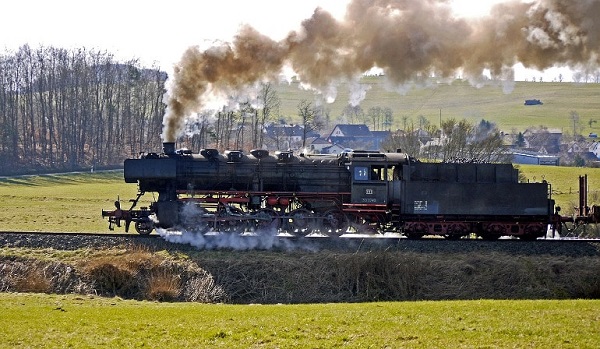
vapour

Thermodynamics was born to convert heat into work (part of physics), it is divided into three principles, sotto tutti i dettagli

1st Principle

Work is energy and energy cannot create or destroy, but is continuously transformed. “Benjamin Thompson and James Joule”.

The calorie is the heat needed to heat 1 dm3 of H2O from 14.5 °C to 15.5 °C.  In the energy field, a calorie is the energy needed to lift 4.186 kg of one meter/second. Energy is:

  1. Understood as a form of energy, when heating an object, and increasing its internal energy, by accelerating its atoms, this internal energy is what we call "heat".
  2. Energy is defined as the ability to "do work" or to exert a force which produces a displacement

2nd Principle

There are 3 ways to transmit heat and they are:

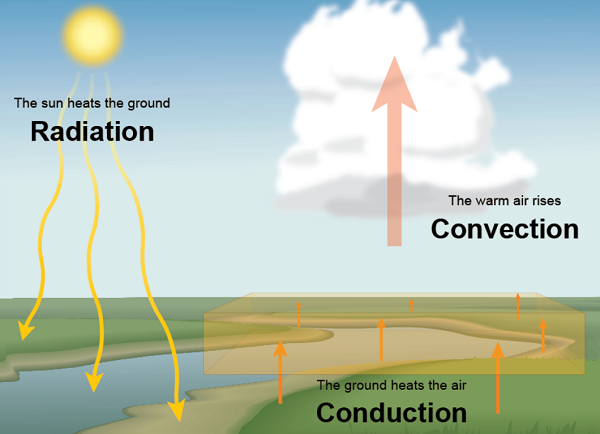
  1. Convection: The hottest parts of the fluid which are lighter, naturally move upwards (regards fluids).
  2. Radiation: Heat radiates all around in the environment
  3. Conduction: Heat is transmitted inside bodies (thermal conduction) or by contact (which is faster in metals)

3rd Principle of Zero

Reaching absolute zero which is impossible. absolute zero is -273.15 °C (Kelvin scale).

Zero Principle: If between two bodies in contact no heat flows, then they have the same temperature and vice versa.

The triple point of water means the temperature at which water, ice and steam coexist in equilibrium. In the mountains or at sea level it is always 0.01C

Thermodynamics studies the heating and is based on 3 principles:

  1. The way in which this is transmitted
  2. The ability to transform into other forms of energy
  3. The way in which it alters the properties of bodies, for example converting a solid into a liquid.

Convection

Figure 1 below shows the Convection system

convectionFigure 1 - Convection system


Radiation

Figure 2  below shows the Radiation system

radiationFigure 2 - Radiation system


Conduction

Figure 3  below shows the Conduction system

vapourFigure 3 - Conduction system


Conclusion

  • It is impossible to transform all the heat into work.
  • The efficiency of the cycle depends only on the difference between the temperatures of the two sources.
  • The efficiency of the real cycle, like that of the car engine, is even lower, because based on combustion (a part of the work produced is used for fuel injection and exhaust) these engines have a real efficiency of 45% max versus 73% of the maximum theoretical efficiency.

favicon bacd

favicon bacd

+(39) 347 051 5328

Italy - Kazakhstan

09.00am to 18.00pm

About

We offer the best and economical solutions, backed by 27+ years of experience and international standards knowledge, echnological changes, and industrial systems.

Marketing Materials

Spring Renovation
Industry
US Gas Company
Construct
Plus Project
Vam Drilling Service
X Project
X Project
Cabrrus Training

Marketing Materials1

Spring Renovation
Industry
US Gas Company
Construct
Plus Project
Vam Drilling Service
ultrasonic sensor
ultrasonic sensor
Cabrrus Training