
|
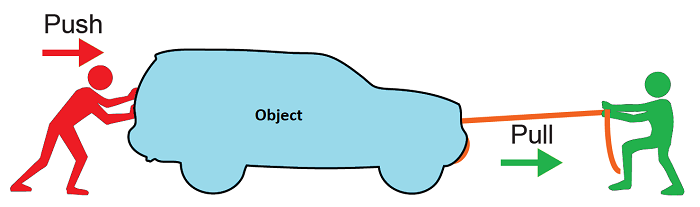
Energy and Power We often consider power and energy to be exact synonyms. Energy and power are closely related but not the same type of physical quantities. Though they are used in everyday life, their difference is fine but significant. Energy is the capacity to do some physical activities or work, such as running, jumping, etc., while power is defined as the rate at which the energy is transferred, or the work is completed. The unit used to measure energy is joules, ergs and calories. Power is measured in watts. In other words, it is ergs per second or even joules per second. Force, Work, Power, and Energy To learn how power is transferred in a vehicle, key terms (force, work, power, and energy) and the relationship between them need to be studied. Force: Simply defined, force is a push or pull interaction between objects. This interaction can occur when objects are in physical contact with one another or when there is an action at a distance caused by magnetic forces, gravitational forces, and electric forces. Figure 1 below shows this
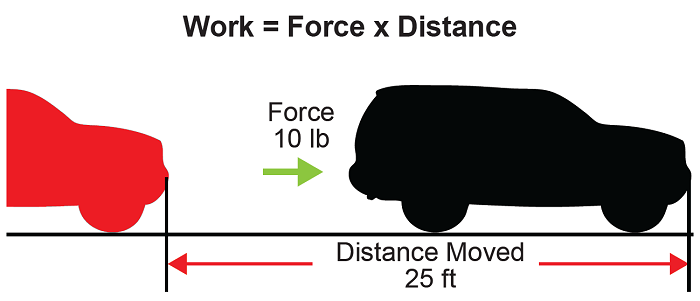
Work: When an object has moved from a force, the position of the object has changed and work has occurred. If no motion has occurred, no work has been done. Work is the transfer of energy from one object to another. For more details see Figure 2 below
Power is the rate at which work is done (the amount of work done, energy delivered, in a given amount of time). Power = Work/Time Energy: Objects have the ability to do work when they have energy. Different forms of energy are classified into two categories: potential and kinetic. Potential energy is stored energy or energy of position. Kinetic energy is the energy of an object from its movement. Energy is required to do work. Gasoline, diesel, electricity, or some other source of energy is needed for a vehicle to do work. Energy and power are linked but are not the same thing. This is helpful to know when looking at battery ratings on hybrid and electric vehicles. These batteries are usually rated in kilowatt-hours (kWh).
For example, an electric vehicle might have a battery capacity of 60 kWh. Think of energy as the amount of “fuel” stored or used to perform work. Relationships between Energy and Power Let's look at some relationships to help you better understand the two terms.
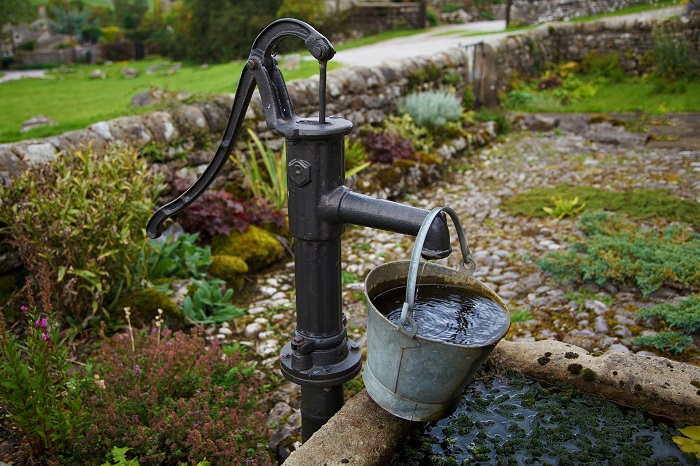
Let's say drive a car, the horsepower is the speed of the car which you drive (miles per hour or kilometers per hour), and energy is the total distance of travel (miles or kilometers). In a fountain which water runs in a bucket, the power is the flow rate of the water (liters/second or gallons/second) and the energy is the amount of water that ends up in the bucket (liters or gallons).
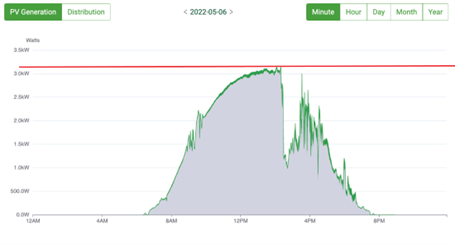
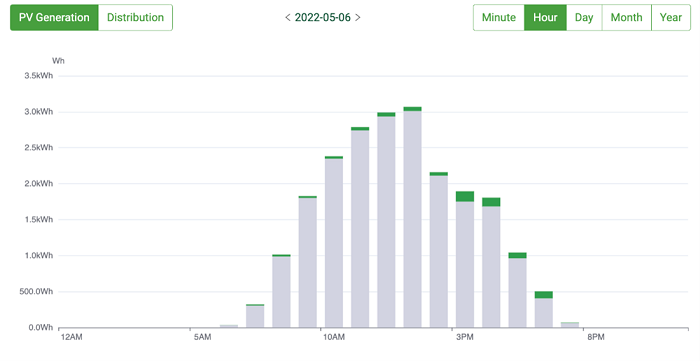
Too boring? One physics professor estimated (with significant assumptions) that a lightsaber requires 28kW of energy to function. So if Luke needs it for a 15-minute fight, requires 28kW x (15 minutes / 60 minutes per hour)= 7kWh of energy. If Luke fought for 3 hours, his lightsaber would consume 28kW x 3 hours = 84kWh of energy. Energy and power in solar Now let's apply our knowledge to solar. Power (kW) is the speed which the photovoltaic system generates electricity, while energy (kWh) is the sum of electricity generated over time. Let's use a visual example from the Tigo EI monitoring portal. This graph shows power (kW) on the y-axis and time on the x-axis. It can be seen that the solar system's energy (production) reaches 3.0 kW approximately 2 pm. Then it dropped rapidly due to clouds and was variable for the rest of the day.
The area under the curve represents the total energy produced
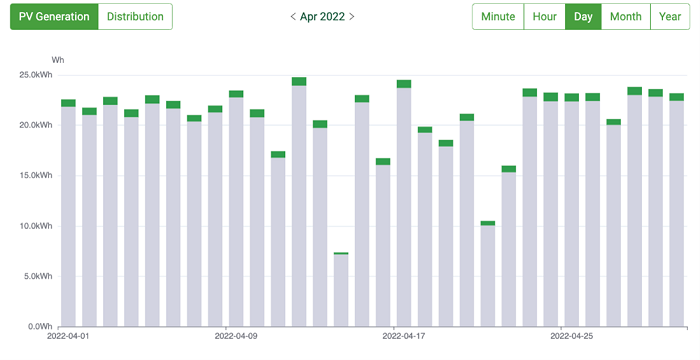
Energy production can also be shown during the entire day, as in Figure 8 below. An easy way to calculate the savings is to multiply the energy produced each day (kWh) x the utility rate ($/kWh) to get the dollar savings. For example, if the system produces 20 kWh in one day and the rate is $0.18/kWh, the savings for that day is $3.60
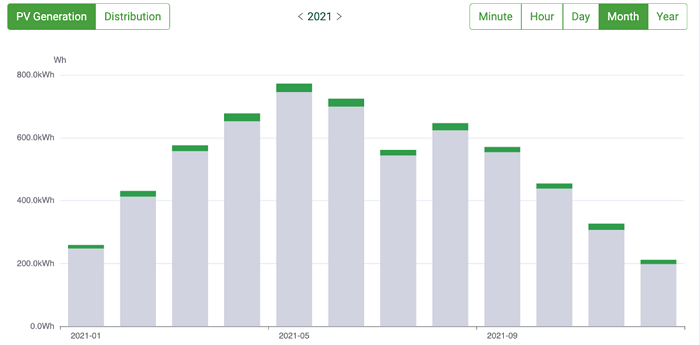
We can view energy production in different time formats; for example, through Figure 9 below we can see how much energy was produced in each month of 2021.
Conclusion Energy is the total amount produced or generated, while power is the rate or amount of energy transferred over time. By understanding the concept of energy and power, you can calculate your savings and determine the energy needs needed to power your home. If you want to know more about the solar system, click here
|




+(39) 347 051 5328
Italy - Kazakhstan


09.00am to 18.00pm
About
We offer the best and economical solutions, backed by 27+ years of experience and international standards knowledge, echnological changes, and industrial systems.
Our Services
Marketing Materials


Marketing Materials1


