|
PICKAT Development Board
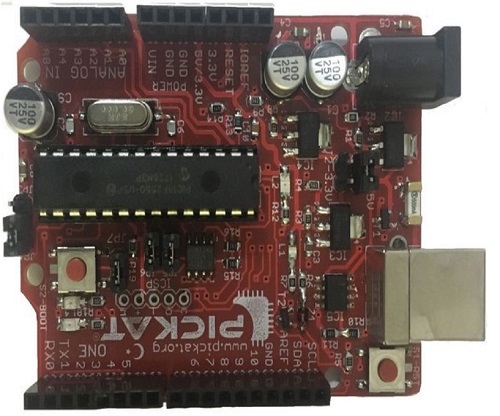
PICKAT Development Board is a Microchip PIC-based Arduino compatible development board for hobby electronics, students, academic studies and industrial prototyping.
PICKAT is a rapid prototyping board containing an 8-bit advanced PIC18F2550 microcontroller, developed to be compatible with all Arduino daughter boards. It is designed to produce projects quickly without the hassle of establishing circuits
PICKAT Features and descriptions
- Speed up to 48mhz with PIC18f2550 dip processor, 32k memory, sram 2048, eprom 256
- External 24C02 eeprom on circuit (2048 bit, 256 byte memory)
- 10 10 bit ADC inputs
- Total 19 I/Os, 2 of which are pwm
- Communication ports: USB, Uart serial, Spi, I2C, can
- Programming port: Option for external programming without programmer via USB or via Standard ICSP. (such as Brenner, pickit2, pickit3, k149)
- Processor and eeprom 3.3V. or 5V. The 3.3 volt module to be connected to the circuit with the operating option does not require a voltage level circuit for the sensor.
- Hid and CDC options with jumper in your USB applications.
- Option to program and prototype processors such as 28 pin PIC18f252, PIC16f876 with the integrated socket on the circuit.
- Since it is open source, it can be repaired by the maker and produced for education/training purposes. (Provided that the production is not commercial, Pickat is a registered trademark)
- 7 to 12 volts DC. Intermediate supply voltage can be provided with adapters. Our recommendation is the 7.5 volt quality adapter, which is the most widely available on the market.
- 3.3 volt and 5 volt regulators for accessories to be installed in the circuit
- Includes 500ma fuse for USB protection. The fuse can be changed.
- When you use an adapter, it does not use USB power.
- When the system supply is set to 5 volts, the blue warning LED turns on.
- Pin usage selection with 3 jumpers.
- Reset and boot buttons. With the reset button, the bootloader mode is switched and the code is loaded without a programmer.
- 2 blink LEDs Portc.0 and portc.1 for test codes and input boot button for input.
- Compatible with Arduino daughter boards and arduino uno boxes. (Same size and same port array as Arduino Uno)
- You can upload the pic18f2550 hex code you prepared with all PIC compilers to the Pickat via USB without a programmer. (such as proton basic, pic basic pro, xc8, ccs c, mikro pascal, mikroc)
- Pickat is designed with 20mhz crystal. But if you want, you can install crystals such as 10mhz, 8 mhz with a soldering iron. Since SMD crystal is used, it can be easily removed.
- Since the bottom case microcontroller is used, in case of failure, you can remove it from the socket and insert a new one.
Use of Jumpers
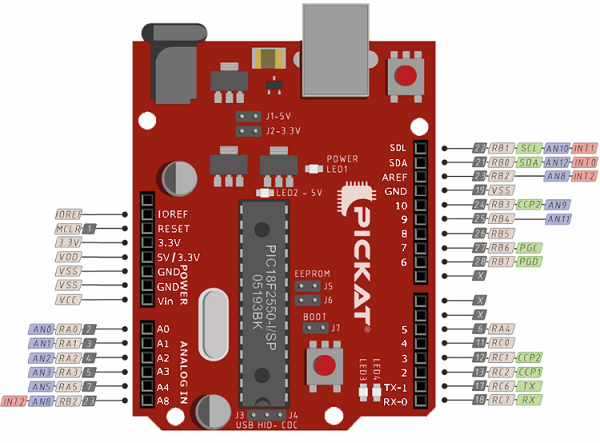
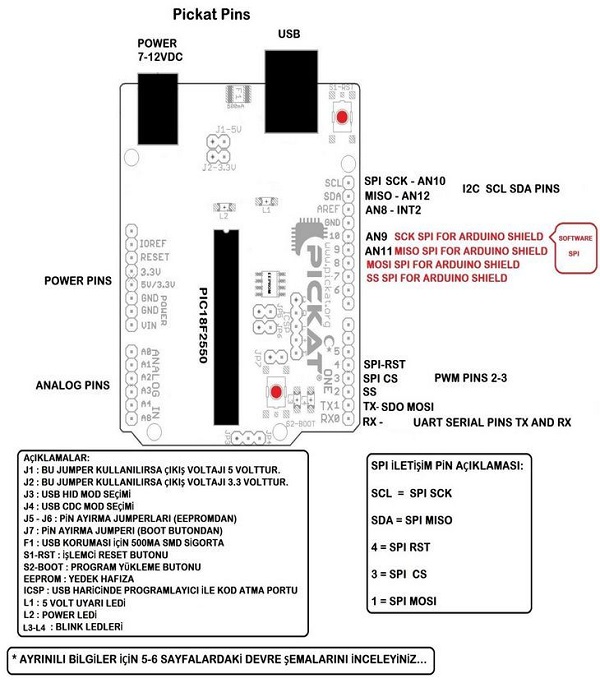
There are 7 jumpers on Pickat 1. Their duties are as follows:
- JP1: If a jumper is connected to J1, the processor and accessory supplies will be 5 volts.
- JP2: If a jumper is connected to J2, the processor and accessory supplies will be 3.3 volts.
- JP3: If a jumper is connected to JP3, it is in USB Hid bootloader mode. By default, pickat 1 is sent this way.
- JP4: If a jumper is connected to JP4, Pickat 1 can be used in USB CDC mode.
- JP5 and JP6: If you want to use the eeprom on the circuit, jumpers must be installed on jp5 and jp6. If Eeprom will not be used, these jumpers can be removed.
- JP7: If a jumper is inserted here, the bootloader switch is activated. If the bootloader will not be used, this jumper can be removed.
Compilers
You can use all PIC compilers with Pickat 1. You can use BASIC C PASCAL languages. The main ones are listed below. You can realise many projects with the library and code examples.
- MPLAB XC8 evolution: It is Microchip's own compiler. You can download it from the link below.
https://www.microchip.com/development-tools/downloads-archive
- CCS C: CCS C INC. Developed by, can be downloaded from the link below:
http://www.ccsinfo.com/downloads.php
- MICRO C: It was developed by Mikroelektronika company. You can download from the link below:
https://www.mikroe.com/mikroc-pic
- MICRO BASIC: It was developed by Mikroelektronika company. You can download from the link below:
https://www.mikroe.com/mikrobasic-pic
- PIC BASIC PRO: Melabs inc. Developed by. You can download from the link below:
http://pbp3.com/
- PROTON BASIC: Crownhill Associates Ltd. Developed by. You can download from the link below:
http://www.protonbasic.co.uk/
- MICRO PASCAL: It was developed by Mikroelektronika company. You can download from the link below:
https://www.mikroe.com/mikropascal-pic
Descriptions
PIC18F2550 DIP prosessor and up to 48 MHz prosessor speed, 32 kb memory, Sram 2048 byte, eprom 256 byte.
External 24C02 EEPROM on the circuit (2048 bit, 256 byte memory)
- 10 each 10 bit ADC input.
- 2 each PWM input.
- Total 19 Each I/O
- Ports per Array USB, UART serial, Spi, I2C, CAN
- Programming port: External programming option with USB without programmer or Standard ICSP. (Such as Brenner, pickit2, pickit3, k149)
- Prosessor and eeprom 3.3 VDC or 5 VDC with the option to run with 3.3 volt modules to connect, sensor for voltage level circuit doesn't needs.
- The jumper and hid and cdc connection options in your usb applications.
- Option to program, prototype 28-pin processors such as PIC18F252, PIC16F876 with integrated socket on the circuit.
- It is open source, it can be repaired by maker, it can be produced for educational purposes. Pickat is a registered trademark, can be done with commercial registration.
- 7 to 12 volts DC supply voltage can be supplied by adapters Our recommendation is the 7.5 volt high quality adapter that is most common in the market.
- 3.3 volt 5 volt regulators for accessories to be installed.
- It has 500mA fuse for USB protection. Fuse can be changed.
- When you use the adapter, it does not use the USB feed.
- The blue warning LED illuminates when the system supply is set to 5 volts.
- Selection of pins with 3 jumper.
- Reset and bootloader buttons.
- Test codes for 2 blink led. PortC 0 and PortC 1
- Compatible with Arduino shields and arduino uno boxes. (Arduino uno with the same size port in the same sequence.)
- With all pic compilers, you can upload the pic18f2550 hex code to pickat via USB without programming.(proton basic, pic basic Pro, xc8, CCS c, micro pascal, microc such as)
- Pickat is designed with 20MHz crystal. But if you want 10MHz, 8 MHz Crystals can be inserted with the iron. SMD crystal is used to remove easily.
- DIP processor is used, you can remove it from the socket and insert the new one in case of malfunction in the processor.
Pickat One Technical Specifications
|
Microprosessor.
|
PIC18F2550
|
|
Operating Voltage
|
5 VDC or 3.3 Volt
|
|
Input Voltage
|
7 - 12 VDC
|
|
Input voltage (limits)
|
6 - 20 VDC
|
|
Digital I/O pinouts
|
19 Pins (2 EA PWM outputs, 10 ADC)
|
|
Analog Input Pins.
|
10
|
|
Current for Each I/O
|
20 mA
|
|
Current for 3.3 VDC
|
20 mA
|
|
Flash Memory
|
32 KB (PIC18f2550) up to 0.5 KB of bootloader
|
|
SRAM
|
2 KB (PIC18F2550)
|
|
EEPROM
|
1 KB (PIC18F2550)
|
|
External EEPROM
|
24C02 - 2 KB
|
|
Clock rate
|
Up to 48 MHz
|
|
USB Mode
|
HID or CDC
|
|
USB Protection
|
500 mA smd fuse
|
|
Program Download.
|
USB Bootloader or ICSP
|
|
Buttons
|
S1 Reset Bootloader and S2 input
|
|
Test Leds
|
2 Each
|
|
Notice Led (Blue)
|
System voltage 5VDC when it is lit
|
|
Ports per Array
|
USB, Uart (serial), Spi, I2c, (Can,
additional modules)
|
|
Height
|
68.6 mm
|
|
Width
|
53.4 mm
|
|
Weight
|
30 gr
|
For those who want to start with PICs, this is a fantastic card, it contains all the basic functions to get you started. For more details click here for the PDF
|