
|
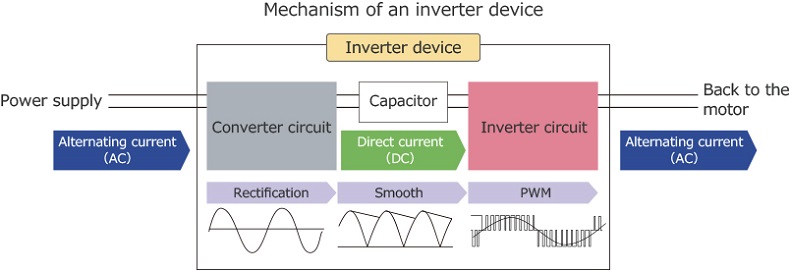
Power Inverter Working Principle Introduction The inverter is a device that converts DC electricity (battery, storage battery) into AC power with a fixed frequency and voltage or with frequency modulation and voltage management (usually 220V, 50Hz sine wave). It is made up of semiconductor power devices as well as drive and control circuits for inverters, The creation of new high-power semiconductor devices and drive control circuits has been aided by the advancement of microelectronic and power electronics technologies. Insulating gates are now often used in inverters, Polar transistors, power field-effect transistors, MOSFET, MOS controller thyristors, and intelligent power modules are examples of advanced and easy-to-control high-power technologies. The control circuit has also evolved from an analog integrated circuit to being controlled by a single-chip microprocessor or a digital signal processor, allowing the inverter to progress in the direction of systematization, full control, energy efficiency, and multi-function. Air conditioners, home theaters, electric grinding wheels, electric tools, sewing machines, DVDs, VCDs, laptops, TVs, washing machines, range hoods, refrigerators, video recorders, massagers, fans, lighting, and other electronic devices use it. Working Prnciple of Power Inverter We'll start the introduction by explaining the inverter device's mechanism in detail. The inverter device's role is to control the voltage and frequency of the power supply and seamlessly change the rotation speed of motors used in home appliances and industrial machineries.
Figure 1 - Power Inverter Circuit Diagram Normally, to reduce or increase the speed of a motor in AC, inverters reduce or increase the frequency of the voltage via the MOSFETs and the control circuit (microelectronic). This is the classic operation of an inverter on a THREE-PHASE or single-phase motor. Let's take the spin cycle of a washing machine as an example. The MOSFETs increase or decrease the frequency of the voltage to increase or decrease the speed. Firstly, the converter circuit used in the front part constantly converts alternating current to direct current. This process is called rectification. The wave’s direction and magnitude changes periodically over time since alternating current is a sine wave. Therefore a diode, which is a semiconductor device, is used so as to pass electricity in a forward direction to convert it into direct current, but not in the reverse direction.
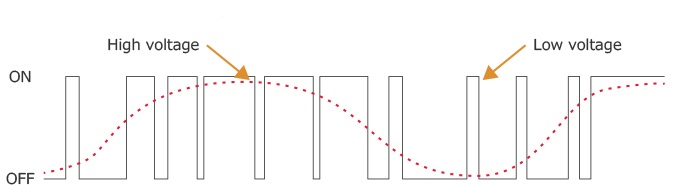
Figure 2 - Sine Wave and Pulse Categorizing use cases of inverter devices and circuits by voltage and frequency Inverter circuits and devices are used in various electrical products such as household air conditioners, refrigerators, IH (induction heating) cookers, fluorescent lights, computer power supplies (including UPS), industrial fans, pumps, elevators, and cranes. They are widely used and have become an integral part of our lives.
As mentioned in the beginning, inverter circuits and devices are used in household air conditioners, refrigerators, industrial pumps, elevators, etc. to adjust the motor's rotation speed. In this case, the inverter is used to change both voltage and frequency, this is called "VVVF (Variable Voltage Variable Frequency)". |

+(39) 347 051 5328
Italy - Kazakhstan


09.00am to 18.00pm
About
We offer the best and economical solutions, backed by 27+ years of experience and international standards knowledge, echnological changes, and industrial systems.
Our Services
Marketing Materials


Marketing Materials1


