
|
How Gas Turbine Power Plants Work
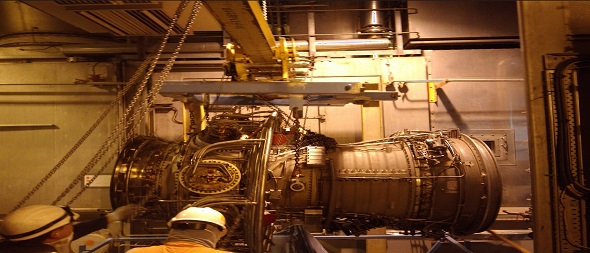
The combustion (gas) turbines being installed in many of today's natural-gas-fueled power plants are complex machines, but they basically involve three main sections:
Land based gas turbines are of two types: (1) heavy frame engines and (2) aeroderivative engines. Heavy frame engines are characterized by lower pressure ratios (typically below 20) and tend to be physically large. Pressure ratio is the ratio of the compressor discharge pressure and the inlet air pressure. Aeroderivative engines are derived from jet engines, as the name implies, and operate at very high compression ratios (typically in excess of 30). Aeroderivative engines tend to be very compact and are useful where smaller power outputs are needed. As large frame turbines have higher power outputs, they can produce larger amounts of emissions, and must be designed to achieve low emissions of pollutants, such as NOx. One key to a turbine's fuel-to-power efficiency is the temperature at which it operates. Higher temperatures generally mean higher efficiencies, which in turn, can lead to more economical operation. Gas flowing through a typical power plant turbine can be as hot as 2300 degrees F, but some of the critical metals in the turbine can withstand temperatures only as hot as 1500 to 1700 degrees F. Therefore, air from the compressor might be used for cooling key turbine components, reducing ultimate thermal efficiency. One of the major achievements of the Department of Energy's advanced turbine program was to break through previous limitations on turbine temperatures, using a combination of innovative cooling technologies and advanced materials. The advanced turbines that emerged from the Department's research program were able to boost turbine inlet temperatures to as high as 2600 degrees F - nearly 300 degrees hotter than in previous turbines, and achieve efficiencies as high as 60 percent.
|

+(39) 347 051 5328
Italy - Kazakhstan


09.00am to 18.00pm
About
We offer the best and economical solutions, backed by 27+ years of experience and international standards knowledge, echnological changes, and industrial systems.
Our Services
Marketing Materials


Marketing Materials1


