|
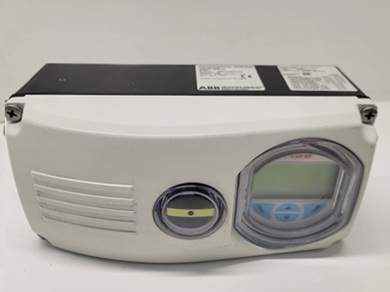
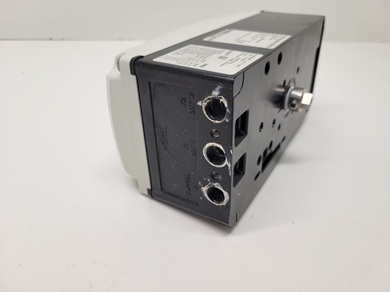
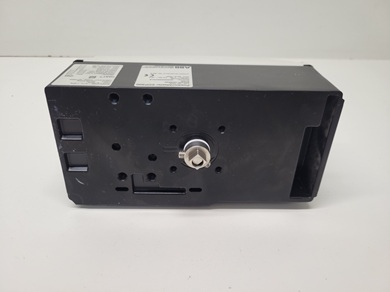
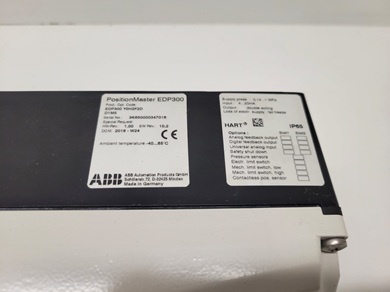
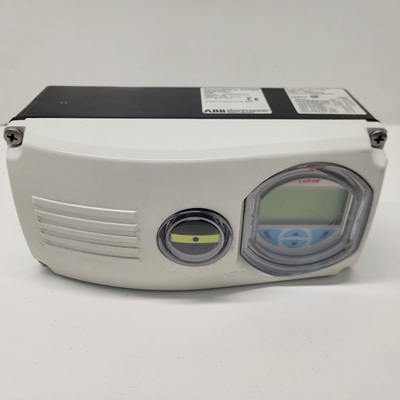
ABB Positioner EDP300 Series - EDP300-Y0H2F2D
The ABB Positioner EDP300 uses a digital control system to convert a continuous electrical setpoint signal into a pneumatic signal that controls a 3/3-way valve. This valve, in turn, controls the airflow to a pneumatic actuator. The positioner's digital electronics, often with HART communication, measure the actuator's current position, compare it to the setpoint, and make adjustments to maintain the desired position while minimizing air consumption.
Step-by-step working principle
- Input Signal: The positioner receives a continuous electrical setpoint signal (e.g., a 4-20 mA signal) and the actuator's current position from a feedback sensor.
- Signal Conversion: A digital control loop (CPU) compares the desired position to the actual position. This comparison generates a setpoint signal for an I/P (current-to-pneumatic) module.
- Pneumatic control: The I/P module proportionally converts the electrical setpoint into a pneumatic signal.
- Valve operation: This pneumatic signal is used to adjust a 3/3-way valve, which controls the air pressure to the actuator.
- Actuator movement: The actuator moves to the position corresponding to the air pressure from the valve.
- Position feedback: The positioner continuously monitors the actuator's position and adjusts the pneumatic signal as needed to keep it at the setpoint.
- Energy efficiency: Once the setpoint is reached, the 3/3-way valve closes to hold the position, minimizing air consumption.
Key features
- Automatic adjustment: The EDP300 can automatically determine control parameters and adapt to the actuator, which optimizes control behavior and saves time.
- Digital control: A digital control system provides advanced capabilities like communication via the HART protocol for configuration and diagnostics.
- Modular design: It has a modular structure for flexibility and is designed for both linear and part-turn pneumatic actuators.
- Diagnostic functions: The device supports advanced functions like partial stroke testing (PST) for valve diagnostics.
The EDP300's closed-loop control cycle
- Receives the setpoint signal: The EDP300 receives a 4–20 mA analog signal from a control system, such as a Distributed Control System (DCS), which represents the desired valve position from 0% to 100%.
- Measures the actual position: A non-contact position sensor measures the actual travel or rotational angle of the valve actuator.
- Performs the comparison: The internal microprocessor continuously compares the electrical setpoint signal with the electrical signal from the position sensor.
- Calculates control adjustments: Based on the difference between the setpoint and the actual position, the microprocessor calculates the necessary control action using a PID (Proportional-Integral-Derivative) algorithm. The EDP300 features an "adaptive control mode" that automatically determines and adjusts the control parameters for optimal performance.
- Adjusts the pneumatic output: The microprocessor sends a command to a low-bleed, high-capacity electro-pneumatic (I/P) converter. This converter translates the electronic command into a variable air pressure signal, which is then sent to the actuator's air chamber(s).
- Moves the actuator: The changing air pressure moves the pneumatic actuator and the attached valve to the correct position. The EDP300 has a high air capacity, allowing it to work with a range of actuator sizes without needing a separate volume booster.
- Continues the cycle: The position sensor immediately detects the new valve position, and the control cycle repeats, ensuring the valve remains at the precise position commanded by the setpoint signal.
Key components and features that enable its operation
- Microprocessor: The core of the digital positioner, which performs all the comparison, calculation, and control tasks.
- I/P (Electro-Pneumatic) Converter: This module is responsible for converting the electrical signal from the microprocessor into a pneumatic pressure signal.
- Position Sensor: A non-contact sensor that provides a highly accurate and reliable position measurement, making the device resistant to vibration.
- Advanced Diagnostics: With optional pressure sensors, the EDP300 can perform advanced valve health diagnostics, including valve signatures and seat tests. This provides data on friction and wear for predictive maintenance.
- Modular Design: The EDP300 has a modular structure, allowing for the addition of option modules for digital and analog feedback, or an emergency shutdown function.
- HART Communication: The positioner uses the HART communication protocol, which allows for remote configuration, calibration, and access to diagnostic data without interrupting active control.
 Full Datasheet Full Datasheet
Positioner Transmitter Feature
- Manufacturer: EDP300
- Product No. : EDP300-Y0H2F2D
- EDP300 - Position Master EDP300 digital positioner
- Explosion protection certification: Y0 - without
- Input Signal / Communication Port: H - HART digital communication and 4 ... 20 mA
- Pneumatic Output Type: 2 - Double acting
- Safe Position: F - Fail-freeze
- Air Pipe Connection: 2 - Thread 1/4-18 NPT female
- Cable Conduits: D - Thread NPT 1/2 in. female
There are several Model of positioner, for more details read the PDF below
Basic Ordering Information
|