|
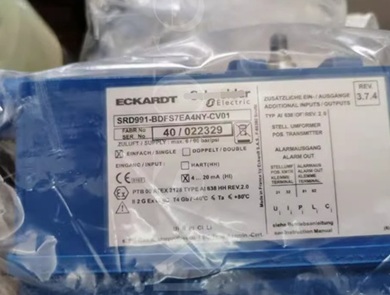
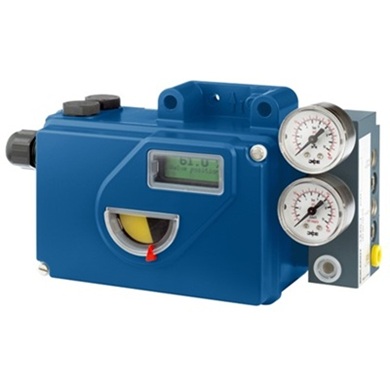
FOXBORO Positioner SRD991 Series - BDFS7EA4NY-V01
The FOXBORO SRD991 is an intelligent electro-pneumatic positioner that precisely controls pneumatic valve actuators. It works by comparing the position of a valve to an input signal (either a \(4-20\) mA analog signal or a digital communication signal like HART or PROFIBUS) and then automatically adjusts the pneumatic supply to the actuator to move the valve to the correct position. It features a digital controller, a feedback sensor, and a pneumatic relay that adjusts the air pressure to move the valve stem
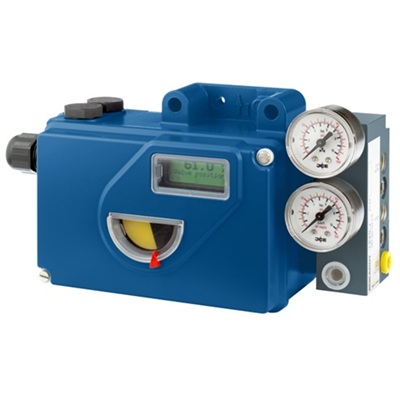
Working principle
- Signal input: The SRD991 receives a control signal from a system, such as a \(4-20\) mA current signal from a DCS or a digital signal via HART, PROFIBUS-PA, or Foundation Fieldbus.
- Position feedback: A built-in sensor, typically a potentiometer, measures the actual position of the valve stem or actuator shaft.
- Comparison: The digital controller inside the SRD991 compares the actual valve position to the desired setpoint from the input signal.
- Pneumatic control: Based on the difference between the setpoint and the actual position, the positioner manipulates its internal pneumatic relay.
- Air adjustment: The relay adjusts the pneumatic supply to the valve actuator. If the valve is in the wrong position, air is supplied to move it to the correct position, either opening or closing it.
- Continuous calibration: The process repeats continuously, with the SRD991 constantly monitoring the valve's position and making small adjustments to maintain the desired position accurately.
Key features
- Intelligent operation: The device can perform an "autostart" sequence to automatically calibrate itself to the valve's stroke and characteristics.
- Communication options: It supports various communication protocols, including HART, PROFIBUS-PA, and Foundation Fieldbus, or operates as a basic positioner with only a \(4-20\) mA input.
- Local and remote configuration: Users can configure the device locally using push buttons and an LCD screen or remotely via a PC with specialized software like VALcare or a Field Device Tool (DTM).
- Modular design: The SRD991 can be equipped with optional components like limit switches, additional input/output cards, and pressure sensors.
Core working principle: closed-loop control
The SRD991's operation is based on a constant feedback loop that compares the desired valve position (the setpoint) with the actual valve position (the feedback) and makes continuous adjustments.
- Receiving the input signal. The positioner receives a 4–20 mA current signal from a control system, such as a Distributed Control System (DCS). This electrical signal represents the desired position of the valve.
- Signal processing. A microprocessor within the SRD991 receives this input signal. It continuously compares it to the feedback signal from the valve's stem position sensor.
- Position sensing. A sensor, such as a rotary or linear potentiometer connected via a feedback linkage, reports the actual position of the actuator stem to the microprocessor. For specific applications, a non-contact magnetic sensor can also be used.
- Electronic-to-pneumatic conversion. If there is a difference between the desired position and the actual position, the microprocessor calculates an error and sends an electronic command to an internal electro-pneumatic (I/P) converter. The I/P converter uses a piezoelectric valve to regulate the output pressure.
- Actuator pressurization. The piezoelectric valve controls a pneumatic power amplifier (spool valve) that regulates the flow of air to the valve actuator. The amplified air pressure moves the actuator, and thus the valve stem, to the correct position.
- Continuous adjustment. This process is a continuous feedback loop. As the valve moves, the feedback sensor updates the microprocessor, which continues to drive the I/P converter until the error is eliminated and the valve is precisely at its commanded position. This rapid, automatic adjustment overcomes external forces like friction and differential pressure that can impede accurate valve movement.
Key features enhancing the working principle
- Autostart function: When commissioning, the SRD991 can automatically identify the actuator type, determine the end positions, and optimize its control parameters for a specific valve.
- Predictive diagnostics: The microprocessor and additional sensors (like optional pressure sensors) allow the SRD991 to perform advanced diagnostics. It can track valve movement, monitor air supply, and provide a "valve signature" that helps predict maintenance needs.
- Partial stroke test (PST): For valves in safety instrumented systems (SIS) that remain idle for long periods, the SRD991 can run a PST. This test partially moves the valve to ensure it is not stuck, confirming its functional integrity without interrupting the process.
- Digital communication: As an intelligent positioner, the SRD991 supports advanced digital communication protocols such as HART, FOUNDATION Fieldbus, and PROFIBUS-PA. This allows for remote configuration, monitoring, and diagnosis from a control system or PC.
 Full Datasheet Full Datasheet
Positioner Transmitter Feature
- Manufacturer: SRD991
- Product No. : BDFS7EA4NY-V01
- SRD991 - Intelligent Positioner
- Version: B - Single Acting
- Input/Communication: D - Intelligent without communication (4 - 20 mA)
- Additional Inputs/Outputs: F - Position Feedback 4 - 20 mA and one Binary Output for Alarm
- Built-In Limit Switch: S - Without Built-In Limit Switch
- Cable Entry: 7- M20 x 1.5 With One Plastic Cable Gland
- Electrical Classification: EA4 - II 2 G Ex ia IIC T4 Gb according to ATEX / IECEx
- Attachment Kit: N- Order as Auxiliary
- Manifold: Y - Pneumatic connection 1/4 - 18 NPT made of an additional manifold
- OPTIONS: V01 - LCD with Menu-Language in English / German / French
There are several Model of positioner, for more details read the PDF below
Basic Ordering Information
|