|
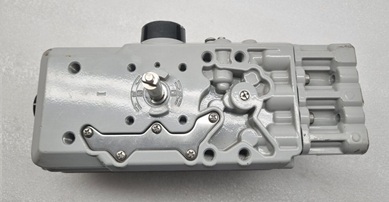
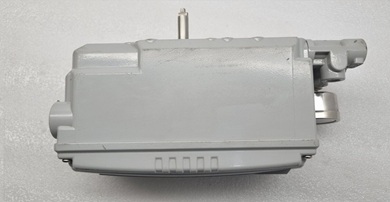
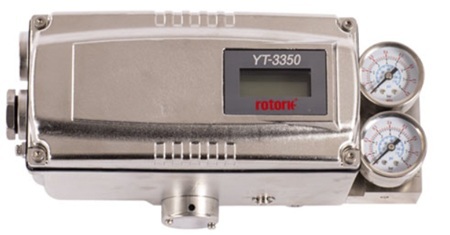
ROTORK /YCT YT-3350 Series - YT-3350RDI6520S
The Rotork YT-3350 is a smart valve positioner that works by receiving a 4-20mA input signal from a controller and using it to accurately control the position of a valve. It uses internal components to translate the electronic signal into a pneumatic output, which in turn adjusts the valve's stroke. The principle involves a closed-loop system where the positioner reads the input signal, moves the valve accordingly, and uses a feedback signal to confirm the position, making adjustments as needed to maintain the desired flow rate.
Key working principles and features
- Signal translation: The positioner receives an electronic signal (typically 4 -20mA from a control system.
- Pneumatic control: This electronic signal is converted into a pneumatic signal to control the air supply to an actuator
- Valve positioning: The actuator then moves the valve to the position dictated by the pneumatic signal.
- Closed-loop feedback: The positioner uses feedback to monitor the actual valve position and compare it to the desired position, making constant adjustments to maintain accuracy.
- PID control: It features a built-in PID (Proportional-Integral-Derivative) controller to provide precise, stable control and automatically adjust for disturbances.
- Auto-calibration: The unit can perform automatic calibration to set the zero and span of the valve's travel.
- Auto/Manual switch: This allows users to switch between automatic control and manual operation for tasks like commissioning or troubleshooting.
- HART communication: It supports digital communication via HART protocol, allowing for remote configuration and diagnostics over the same current loop as the 4 -20mA signal.
- Local control: A local LCD display and pushbuttons allow for configuration and monitoring directly on the device.
Core principle: Signal conversion and position feedback
The YT-3350's working principle revolves around a closed-loop system that continuously compares a desired position with the actual valve position.
- Electronic command input
- The positioner receives a standard 4–20 mA DC electrical current signal from a control system, such as a Distributed Control System (DCS) or PLC.
- This input signal represents the desired position of the valve, with 4 mA typically corresponding to 0% (closed) and 20 mA to 100% (open).
- Microprocessor control
- A built-in microprocessor, or "operator," processes the input signal and compares it to the feedback signal from the valve.
- The microprocessor has PID (proportional-integral-derivative) control functionality, which allows it to make precise, real-time adjustments to achieve the target position.
- I/P (current-to-pneumatic) conversion
- Based on the microprocessor's comparison, a current-to-pneumatic (I/P) converter is controlled electronically.
- The I/P converter uses a flapper-and-nozzle system or similar technology to precisely regulate the air pressure supplied to the actuator.
- Pneumatic output
- The positioner adjusts its pneumatic output pressure to the actuator.
- If the valve needs to move, the positioner increases or decreases the air pressure to the actuator's diaphragm or piston.
- For double-acting actuators (YT-3350R), the positioner increases the pressure to one side of the piston while venting the pressure from the other, causing it to move.
- Actuator movement
- The change in air pressure causes the actuator's stem or shaft to move, which in turn manipulates the valve.
- The YT-3350 is available in both linear (YT-3350L) and rotary (YT-3350R) configurations to suit different valve types.
- Feedback and comparison
- The positioner is physically linked to the valve stem or shaft. As the valve moves, a feedback sensor (such as a potentiometer or non-contact sensor) measures the actual position.
- This feedback signal is sent back to the microprocessor, completing the control loop. The microprocessor continuously corrects any difference between the target position and the actual position.
Key smart features
The YT-3350's "smart" capabilities provide additional functionality beyond the basic closed-loop control.
- Auto-calibration: The device can automatically determine the valve's zero and span points, simplifying the setup process.
- HART communication: This protocol allows for two-way digital communication over the 4–20 mA signal loop. It enables remote configuration, diagnostics, and monitoring of the valve's health and performance.
- User-adjustable characteristics: The positioner can be configured to change the valve's flow characteristics, such as linear, equal percentage, or quick-opening, to better suit the process requirements.
- Partial Stroke Test (PST): It can be programmed to perform a partial movement of the valve to test its functionality without disrupting the process.
- Fault detection: The microprocessor can monitor for and generate alarms for issues like low air supply.
 Full Datasheet Full Datasheet
Positioner Transmitter Feature YT-3350RDI6520S

Order Information
|