|
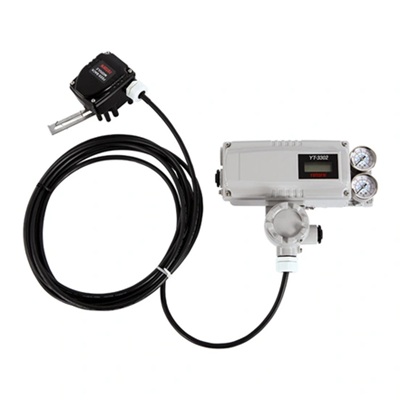
ROTORK /YCT YT-3302 Series - YT-3302LDI222001
The Rotork YT-3302 Series smart valve positioner uses a 4-20mA input signal to precisely control a valve's position by comparing the input signal to the valve's actual position. It features a built-in microprocessor that runs an automated calibration to set the valve's zero and span, executes PID control for accurate performance, and can be controlled manually via front-panel buttons. It also communicates digitally via the HART protocol for diagnostics and status information.play.
Key working principles:
- Signal input: The positioner receives a 4-20mA current signal from a controller, which represents the desired valve position.
- Microprocessor control: A built-in microprocessor interprets the input signal and determines the required position.
- Position feedback: It uses a sensor to measure the valve's current position.
- Pneumatic control: The microprocessor compares the desired position to the actual position and sends the correct pneumatic signal to a diaphragm actuator to move the valve stem.
- Auto-calibration: The unit can automatically calibrate its zero and span points, ensuring it accurately corresponds the 4-20mA signal to the full range of the valve's travel.
- PID control: It includes a configurable PID (Proportional-Integral-Derivative) control loop, which provides stable and accurate valve control by adjusting the output based on the error between the setpoint and the actual position.
- Manual/Automatic modes: It can operate in automatic mode based on the control signal or switch to manual mode for local operation or troubleshooting, allowing a user to move the valve directly using the front-panel buttons.
- HART communication: It uses the HART protocol to digitally transmit information over the same two wires as the 4-20mA signal, allowing for advanced diagnostics, remote configuration, and a position feedback signal.
The ROTORK YT-3302 is a smart electro-pneumatic valve positioner that works on a closed-loop feedback principle. It takes an analog electrical input signal (typically 4–20 mA) from a controller and accurately moves a pneumatic valve actuator to the corresponding position.
The YT-3302 differs from other YT-3300 series positioners in that it has a remote sensor, which allows it to be mounted away from extreme temperature or vibration, and uses a junction box for electrical connection.
Working principle
- Input signal and microprocessor: A 4–20 mA DC electrical signal is sent from a central controller to the positioner's internal microprocessor. This signal represents the desired valve position (e.g., 4 mA = 0% open, 20 mA = 100% open).
- Analog-to-Digital conversion: The electrical signal is converted to a digital signal by the positioner's internal 12-bit A/D converter.
- Position sensing and feedback: The YT-3302 uses a potentiometer-type sensor to detect the current position of the valve stem. Because the sensor is mounted remotely from the main housing, it is connected via a cable. The feedback from this sensor is sent back to the microprocessor.
- Error calculation and PID control: The microprocessor compares the input command signal (desired position) with the feedback signal (actual position). Any difference is the error. The positioner uses a Proportional-Integral-Derivative (PID) control algorithm to calculate the necessary pneumatic output to correct this error and move the valve to the desired position.
- Digital-to-Analog conversion: The calculated output from the microprocessor is converted back to an analog electrical signal by a 12-bit D/A converter.
- Electro-pneumatic conversion: The YT-3302 contains a torque motor and flapper-nozzle system. It converts the D/A output to a proportional pneumatic signal that controls the air flow to the valve actuator.
- Pneumatic actuation: The pneumatic output signal from the positioner adjusts the air pressure in the actuator. This air pressure then moves the valve stem to the correct position.
- Closed-loop repetition: The positioner constantly repeats this feedback loop, adjusting the air pressure to the actuator until the valve's actual position matches the command signal. This ensures high accuracy and stability, even with changes in process conditions like air pressure fluctuations, friction, and fluid dynamics.
Key features enhancing the working principle
- Remote sensor: The YT-3302's defining feature is its remote sensor, which allows the positioner's electronics to be isolated from high temperature and vibration environments near the valve.
- Auto calibration: The microprocessor-based design enables an auto-calibration function that automatically sets the zero and end points of the valve, simplifying commissioning.
- HART communication: The positioner supports HART protocol, enabling advanced diagnostics, remote configuration, and status monitoring over the existing 4–20 mA signal loop.
PID control: The use of PID control allows for precise and fast response times, ensuring accurate and stable control of the valve.
- Selectable flow characteristics: The YT-3302 is configurable for various flow characteristics (e.g., linear, equal percentage) to match the needs of the specific process application.
 Full Datasheet Full Datasheet
Positioner Transmitter Feature YT-3302LDI222001

Basic Ordering Information
|




