|
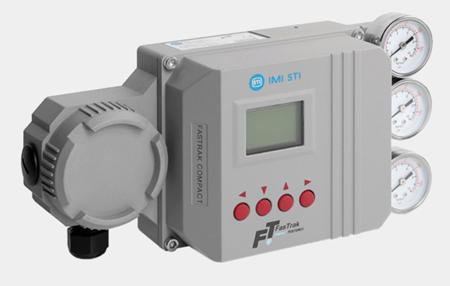
STI Positioner FTC Series - FTC-S00ADRAL
The STI FTC Series positioner works by receiving an electrical control signal (\(4-20\) mA) and converting it into a pneumatic signal to control a valve's actuator. It uses a high-precision digital-pneumatic system with a built-in sensor to constantly measure the valve's actual position and compare it to the desired position. A micro-processor uses this data to precisely modulate the air pressure sent to the actuator until the valve is in the correct position, with the ability to calibrate and configure settings locally or via HART communication.
Working principle
- Receives input: The positioner receives an electrical control signal, typically a 4-20 mA analog signal, representing the desired valve position.
- Converts signal: A built-in electro-pneumatic transducer converts this electrical signal into a proportional pneumatic signal.
- Measures position: An internal sensor, like a potentiometer connected to a shaft, measures the actual position of the valve.
- Processes information: A microprocessor compares the desired position (from the input signal) with the actual position (from the sensor) to determine the error.
- Modulates air pressure: Based on the error, the processor directs the electro-pneumatic transducer to modulate the air pressure to the actuator.
- Adjusts actuator: The air pressure moves the valve's actuator to close the gap between the desired and actual position.
- Reaches equilibrium: This process continues, with the positioner constantly adjusting the air pressure, until the actual position matches the desired position, at which point the system reaches equilibrium.
- Provides feedback (optional): The positioner can also provide a \(4-20\) mA feedback signal to indicate the current valve position.
- Self-calibration: The FTC series includes a self-calibration function for easy setup and accurate performance.
The STI Positioner FTC Series is a digital-pneumatic smart positioner that controls a valve's position by utilizing a microprocessor (μP) to compare a required position setpoint signal with the actual valve position feedback. It then modulates an air supply to the actuator to achieve the desired position.
Working Principle:
- Input Signal: The positioner receives an analog input signal, typically a 4-20 mA current loop (setpoint), which indicates the desired position of the valve.
- Position Feedback: An internal sensor (potentiometer connected to a rotating shaft) continuously measures the current actual position of the valve or actuator stem.
- Microprocessor Control: The internal μP elaborates the input setpoint and the actual position feedback, calculating any deviation (error) between them. It uses a patented control algorithm, which often involves a PID (Proportional-Integral-Derivative) loop, to determine the necessary correction.
- I/P Converter Activation: Based on the μP's calculation, an I/P (current-to-pressure) converter is activated. This device translates the electrical signal from the μP into a proportional pneumatic pressure signal.
- Pneumatic Modulation: The I/P converter modulates the supply of clean, dry, filtered air (or nitrogen) to the chamber(s) connected to the valve actuator (either single or double acting).
- Valve Movement: The modulated air pressure causes the actuator to move the valve stem or shaft to the target position.
- Continuous Loop: This process is a continuous closed-loop control system. The positioner constantly monitors the actual position and adjusts the air pressure to maintain the valve at the precise setpoint, compensating for changes in process conditions or the input signal.
Key Features Related to the Principle
- High Flow Capacity: The FasTrak series is known for its high air flow rate (Cv=0.3 for the FTC and Cv=2 for the standard FT), which allows for fast stroking times and often eliminates the need for external volume boosters.
- Configuration: The positioner can be configured and calibrated locally via an integrated display/keyboard or remotely using HART communication or dedicated software (RemoteControl).
- Adjustable Parameters: Control parameters, including PID loops, dead band, damping factors, and stroking times, can be independently adjusted for both opening and closing actions to optimize performance and stability for specific applications.
- Position Feedback (Optional): The positioner can provide a passive 4-20 mA analog signal (feedback) to the control system, indicating the valve's actual current position.
 Full Datasheet Full Datasheet
Positioner Transmitter Feature
- Manufacturer: STI
- Product No. : FTC-S00ADRAL
- FTC - DigitalTrak Positioner
- Execution: S - IP 65
- Exhaust port : 0 - Standard (to environment)
- Feedback sensor: 0 - Standard (integrated)
- Signal fail behaviour: A - Port OUT2 exhausted
- Local Interface: D - Display and push button
- Type & Connections: R - Standard flow double/single acting CV 0,3 - Electrical ½” NPT (qty 2) - Pneumatic ¼” NPT (qty 3)
- Housing: A - Aluminium
- Operating temperature range: L - - 40°C / + 80°C
There are several Model of positioner, for more details read the PDF below
Basic Ordering Information
|




