|
STI Pneumatic Positioner FCRP-3M Series
The STI Pneumatic Positioner FCRP-3M works on the balanced-forces principle to precisely control a pneumatic valve actuator. It receives a 3-15 psi pneumatic signal from a controller, which moves a diaphragm. This movement is transferred to a spool valve, which directs compressed air to either the actuator's supply or exhaust port, moving the valve stem. A feedback spring, connected to the actuator stem via a CAM, applies a counter-force, balancing the forces and precisely positioning the valve stem according to the input signal.
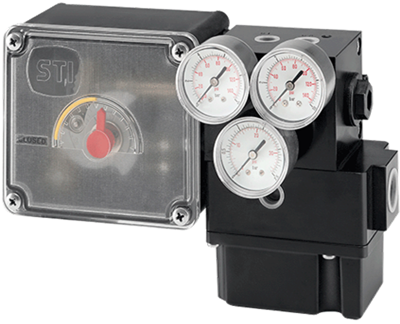
Working principle breakdown
- Input signal: The positioner receives a pneumatic control signal (3-15 psi) from a controller.
- Diaphragm movement: This signal is applied to a diaphragm, which moves due to the pressure difference.
- Spool valve control: The diaphragm's movement is linked to a double-acting spool valve. The spool valve controls the air supply to the actuator.
- Air distribution:
- To position the valve: When the input signal is greater than the feedback force, the spool valve directs compressed air into one chamber of the actuator, causing it to extend or rotate.
- To exhaust air: The spool valve also vents air from the other chamber of the actuator.
- Feedback mechanism: The actuator's movement is transmitted back to the positioner via a feedback lever and a CAM. This lever moves a spring that provides a counteracting force.
- Force balance: The positioner continues to adjust the air supply/exhaust until the force from the diaphragm (proportional to the input signal) is equal to the force from the feedback spring (proportional to the actual valve position).
- Precise positioning: Once the forces are balanced, the valve stem is held in a precise position that is directly proportional to the pneumatic input signal, regardless of factors like friction.
- CAM and stroke: The CAM is a crucial part that converts the linear or rotary motion of the actuator into a position-based force for the feedback spring. Different CAM profiles are available for different actuator stroke lengths
The STI Pneumatic Positioner FCRP-3M (likely referring to the CRP-3/M model) operates on the force balance principle. It works by comparing a pneumatic control signal with the actual position of the valve actuator and regulating the air supply to move the valve to the desired position.
Working Principle:
The core mechanism involves balancing forces from the control signal and a feedback spring:
- Control Signal Input: A pneumatic input signal (typically 3-15 psi or 0.2-1 bar) from a controller is applied to a signal diaphragm within the positioner. This signal creates a force proportional to the desired valve position.
- Position Feedback: The actuator's stem movement is linked via a lever and cam mechanism to a feedback spring. The compression or tension in this spring creates a counter-force representing the actual position of the valve.
- Force Balance and Spool Valve: The force from the control signal and the force from the feedback spring act on a flapper-connecting stem which controls a spool valve.
- Air Distribution:
- If the control signal force is greater than the feedback spring force (calling for a position change), the spool valve opens the air supply port, allowing compressed air into the actuator chamber.
- If the control signal force is less than the feedback spring force, the spool valve opens the exhaust port, releasing air from the actuator chamber.
- Actuator Movement: The change in air pressure in the actuator chamber causes the actuator (piston or diaphragm) to move, which in turn moves the valve stem.
- Equilibrium: The movement of the actuator changes the force of the feedback spring via the lever and cam. This process continues until the forces from the control signal and the feedback spring are balanced, at which point the spool valve closes both the supply and exhaust ports, and the actuator stops at the precise target position.
The FCRP-3M is a modular, heavy-duty analog positioner that can be configured for both single and double-acting linear or rotary actuators.
 Full Datasheet Full Datasheet
|