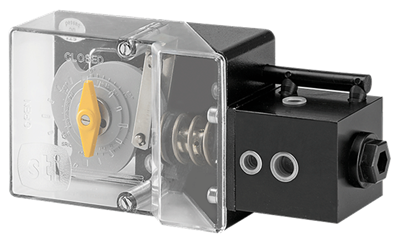
STI Pneumatic Positioner SR/CCK Series 

The STI positioner SR/CCK Series operates on the force-balancing principle. It balances the force from a pneumatic control signal against a spring force that is determined by the actuator's position. This balance controls a 4-way spool valve, which directs air to the actuator to move it to the correct position

2AAA

How it works:

  1. Signal input: A pneumatic signal (typically 3-15 psi) from a controller is sent to the positioner's diaphragm.
  2. Force generation:
  • The pneumatic signal creates a force on the diaphragm.
  • A cam, driven by the actuator's stem, applies a counteracting spring force based on the actuator's position.
  1. Balancing: The positioner continuously compares the two forces.
  2. Air distribution: The resultant force from the diaphragm and spring determines the position of the 4-way spool valve.
  • If the forces are unbalanced, the spool valve moves to either supply air to the actuator to move it, or exhaust air from it.
  • This action moves the actuator until the spring force (based on its new position) balances the diaphragm force (from the pneumatic signal).
  1. Control loop: This creates a continuous feedback loop, ensuring the actuator's position is always proportional to the pneumatic control signal.

The STI positioner SR/CCK Series operates on a balanced-forces principle to provide precise proportional control of pneumatic actuators. Its primary function is to ensure that the actuator's position precisely matches the input control signal, regardless of external disturbances like changing differential pressure or friction.


Working Principle:

The internal mechanism of the SR/CCK positioner involves a force-balance system with air distribution carried out by an internal spool valve.

  1. Input Signal: The positioner receives a pneumatic control signal (typically 3-15 psi or 0.2-1 bar) from a control system. In the electro-pneumatic version, a 4-20 mA electrical signal is first converted to a pneumatic signal by an internal I/P (current-to-pressure) transducer.
  2. Feedback Mechanism: The positioner is mechanically linked to the actuator stem or shaft, providing real-time feedback on the actuator's actual position. For rotary applications, a cam with specific profiles (e.g., linear, up to 270°) is used to translate the angular position into a mechanical feedback signal.
  3. Force Balance and Comparison: The input control signal and the mechanical feedback (via a spring and diaphragm assembly) create opposing forces within the positioner.
  4. Air Distribution (Spool Valve):
  • If the forces are unbalanced (meaning the actuator is not in the desired position), the internal spool valve moves.
  • The movement of the spool valve directs high-pressure supply air to one chamber of the double-acting actuator (to move the piston in one direction) and simultaneously exhausts air from the other chamber (to allow movement in that direction).
  1. Position Correction: Air is continuously fed or exhausted until the actuator reaches the commanded position, at which point the internal forces balance again and the spool valve centers, holding the position steady.

Key Features Related to the Principle

  • Proportional Control: The amount of air supplied/exhausted is proportional to the difference between the setpoint and actual position, ensuring smooth and accurate movement.
  • Double/Single Acting: The design inherently supports double-acting actuators but can be easily converted for single-acting operation.
  • Heavy-Duty Design: The robust construction ensures reliable operation in harsh industrial environments by overcoming valve friction and external disturbances.

pdf download Full Datasheet


favicon bacd

+(39) 347 051 5328

Italy - Kazakhstan

09.00am to 18.00pm

About

We offer the best and economical solutions, backed by 27+ years of experience and international standards knowledge, echnological changes, and industrial systems.

Marketing Materials

Spring Renovation
Industry
US Gas Company
Construct
Plus Project
Vam Drilling Service
X Project
X Project
Cabrrus Training

Marketing Materials1

Spring Renovation
Industry
US Gas Company
Construct
Plus Project
Vam Drilling Service
ultrasonic sensor
ultrasonic sensor
Cabrrus Training