|
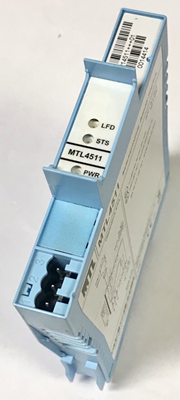
MTL Barries - MTL4511 - Switch Proximity Detector
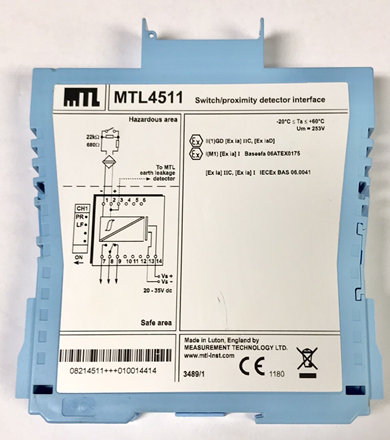
The MTL4511 module uses a galvanic isolator to translate a switch or proximity detector from a hazardous area into a safe area control signal via a changeover relay. It provides a 7 to 9V dc supply to a NAMUR sensor, which detects the input's state (open or closed) by monitoring the current. The module has a line-fault detection (LFD) feature to alert if the field wiring is open or short-circuited.
Working principle
- Signal from the hazardous area: The module is connected to a switch or NAMUR proximity detector in a hazardous area (e.g., Zone 0).
- Sensor power: It supplies a 7 to 9V dc power source to the sensor.
- Input detection: The module detects the switch or sensor's status by monitoring the current flowing through the input circuit.
- Closed/ON: A current greater than 2.1mA indicates the switch is closed or the proximity detector is in its "ON" state.
- Open/OFF: A current less than 1.2mA indicates the switch is open or the proximity detector is in its "OFF" state.
- Line-fault detection (LFD): When LFD is selected, the module continuously monitors the input circuit for fault conditions.
- An open circuit is detected if the input current is below 50.µ
- A short circuit is detected if the input resistance is below 100
- Isolation: The module uses galvanic isolation to prevent electrical noise and interference from the hazardous area from affecting the safe-area control system.
- Output to the safe area: The module uses a changeover relay to control a load in the safe area, transferring the status of the switch or detector to the control system.
- Alarm indication: A red LED on the module lights up to indicate a line fault has been detected
Working Principle
The core working principle involves the following steps:
- Power and Signal Transmission (Hazardous Area): The MTL4511 module provides a low-power, intrinsically safe DC voltage (between 7 and 9V dc) to the connected switch or proximity detector in the hazardous area. This low-energy circuit is intrinsically safe, meaning it cannot release enough electrical or thermal energy to ignite a flammable atmosphere.
- Input Signal Monitoring: The module continuously monitors the current drawn by the sensor circuit in the hazardous area. The input/output characteristics are based on specific current thresholds:
- Input > 2.1mA: The input is considered "on" (e.g., proximity detector detects a target, or switch is closed).
- Input < 1.2mA: The input is considered "off" (e.g., no target, or switch is open).
- A hysteresis of approximately 200µA ensures stable switching and prevents oscillation near the threshold.
- Galvanic Isolation: The MTL4511 uses galvanic isolation to completely separate the hazardous-area circuit from the safe-area control circuit. This prevents high or unsafe voltages/currents from the safe area from reaching the hazardous area, eliminating the need for high-integrity earthing often required by simple safety barriers.
- Output Control (Safe Area): Based on the current input status, the module energizes or de-energizes a single-pole changeover relay in the safe area. This relay then controls the connected safe-area load (e.g., a PLC input, an alarm, or a solenoid valve).
- Line Fault Detection (LFD): The module features user-selectable Line Fault Detection (LFD). When enabled, it detects open or short circuit conditions in the field wiring by monitoring current levels outside the normal operating range (e.g., < 50µA for an open circuit, or < 100Ω resistance for a short circuit). A dedicated red LED indicator on the module signals a fault, and the main output relay is de-energized (failsafe state).
In essence, the device acts as a robust, safe interface, converting a low-power signal from a potentially explosive environment into a standard relay output for use in a safe industrial control system.
Further technical information and specifications can be found on the Eaton website (Eaton owns the MTL brand).
 Full Datasheet Full Datasheet
|