|
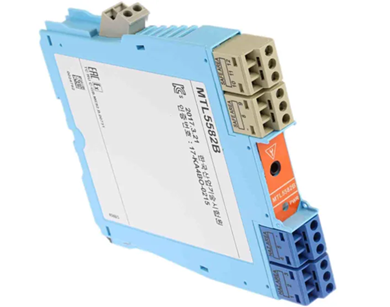
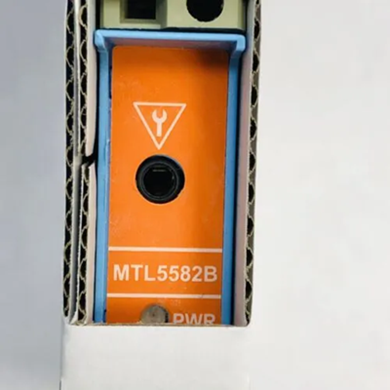
MTL Barries - MTL5582B - RESISTANCE ISOLATOR to repeat RTD signals
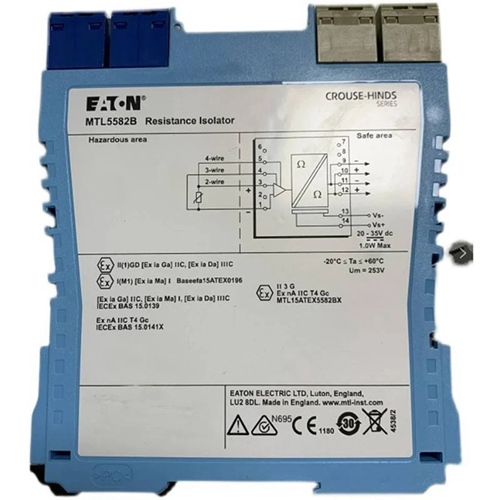
The MTL 5582B is a resistance isolator that connects to a resistance temperature device (RTD) in a hazardous area, isolates the signal, and repeats the resistance value to a monitoring system in a safe area. It uses intrinsic safety to protect against explosions, providing a reliable way to measure temperature by repeating the RTD's resistance with high accuracy and isolation from electrical noise. The isolator is designed to handle 2, 3, or 4-wire RTDs and is often used with Pt100 RTDs.
Working principle
- Connection: The isolator connects to an RTD (like a Pt100) in a hazardous location through its hazardous-area
- terminals.
- Isolation: It provides total AC and DC isolation between the hazardous and safe areas, preventing ground loop currents and electrical noise from interfering with the signal. This is a core principle of intrinsic safety, which prevents explosions by limiting the amount of electrical energy in a hazardous area.
- Resistance repetition: It repeats the RTD's resistance to a monitoring system in a safe area. The device can be configured via switches to work with 2-, 3-, or 4-wire RTDs, and it can output a resistance signal (10Ω to 400Ω).
- Open circuit detection: In case of an open circuit, the module is designed to drive the output scale up to a nominal value (e.g. 420Ω), which can be detected by the monitoring system.
- Powering: The isolator is powered by a separate power supply connection in the safe area, typically 20V to 35 VDC.
- Safety: The design also includes safety features, such as allowing the hazardous and safe areas to be earthed separately, which simplifies installation and prevents earth-loop problems. It is designed for use in safety instrumented systems up to SIL1 (Safety Integrity Level 1). etected
The MTL 5582B is a single-channel, DIN-rail mounted resistance isolator that provides an intrinsically safe interface for resistance temperature devices (RTDs) and other resistance sensors located in a hazardous area.
Working Principle
The primary function of the MTL 5582B is to connect a sensor in a hazardous location to a monitoring or control system in a safe area, while ensuring that no potentially explosive energy (voltage or current) can pass into the hazardous area.
It achieves this through the following steps:
- Signal Input (Hazardous Area): The module is connected to a 2-, 3-, or 4-wire RTD (typically a Pt100) or other variable resistance in the hazardous area. The device uses a small, limited excitation current (200μA nominal) to measure the resistance of the sensor. This current is kept at an intrinsically safe level to prevent ignition of the surrounding atmosphere.
- Isolation: The module incorporates galvanic isolation (total AC and DC isolation) between the input, output, and power supply circuits. This isolation prevents ground loops and stops high or unsafe voltages/currents from the safe area side from reaching the hazardous area, even in the event of a fault in the safe area.
- Signal Conditioning/Conversion: The isolator measures the resistance in the hazardous area and conditions this signal.
- Signal Output (Safe Area): The module then "repeats" or mirrors the measured resistance value to the monitoring system in the safe area. The safe area connections can be configured for 2, 3, or 4 wires, independently of the hazardous area configuration. The output range is typically 10Ω to 400Ω
Key Features Related to Principle
- Intrinsic Safety (IS): The core principle of the MTL 5582B is intrinsic safety, a protection technique that limits the electrical energy within the circuits in the hazardous area to a level below that which could cause ignition.
- Non-Configurable (Simple Operation): The design is notable for its ease of use and repeatability, with switches to select the 2, 3, or 4-wire RTD connection type.
- Open Circuit Detection: If the sensor connection in the hazardous area breaks (open circuit), the module safely drives its output upscale (to ~420Ω nominal) to indicate a fault to the monitoring system.
 Full Datasheet Full Datasheet
|