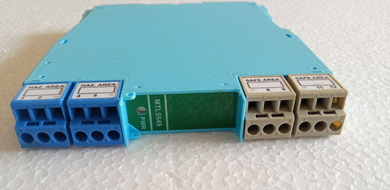
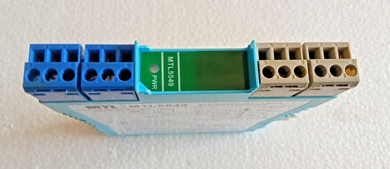
|
MTL Barries - MTL5549 - MTL5549/Y ISOLATING DRIVER
two-channel, for 4–20mA, HART® valve positioners with line fault detection
The MTL5549 is a two-channel, intrinsically safe isolating driver that works by accepting a 4-20mA signal from a safe area and passing it to a hazardous area, while also providing galvanic isolation between the two zones. It allows a signal to be sent to devices like current/pressure converters or smart valve positioners and includes features like line fault detection and bi-directional digital communication for HART signals. This design prevents explosions by limiting the energy entering the hazardous area.
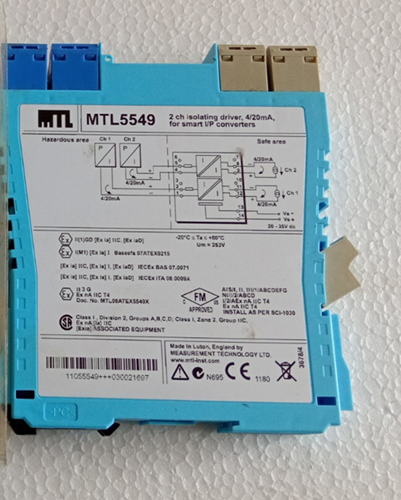
Difference between MTL5549C and MTL5549Y
The main difference is that the MTL5549Y model has the Line Fault Detection (LFD) facility disabled, while the standard MTL5549 includes this feature. This means the MTL5549Y only provides open-circuit detection, not both open- and short-circuit detection. Both models are otherwise identical in terms of intrinsic safety and are designed for DIN rail mounting.
| Feature |
MTL5549 |
MTL5549Y |
| Line Fault Detection (LFD) |
Enabled |
Disabled |
| Fault Detection |
Open-circuit and short-circuit |
Open-circuit only |
| Intrinsic Safety |
Identical to MTL5549Y |
Identical to MTL5549 |
| Mounting |
DIN rail |
DIN rail |
Working principle
- Isolation: The MTL5549 provides a galvanic barrier, which is a physical and electrical separation between the safe area and the hazardous area. This prevents any high-energy faults in the safe area from causing sparks in the hazardous area.
- Signal transmission: It takes a 4-20mA floating signal from a control system in the safe area and drives a corresponding signal to a load (like a current/pressure converter) in the hazardous area.
- Energy limitation: The device limits the current and voltage delivered to the hazardous area to a level that is not capable of igniting flammable materials, a principle known as intrinsic safety.
- HART communication: For smart valve positioners that use the HART protocol, the MTL5549 allows for bi-directional transmission of digital communication signals superimposed on the 4-20mA analog signal.
- Line fault detection: The module can detect open or short circuits in the field wiring. If a fault occurs, the current to the load drops to a preset level, which can be read back by the safe-area controller to indicate a problem.
Key Working Principles
- Galvanic Isolation: The core principle of the MTL5549 is galvanic isolation using innovative transformer construction. This physically and electrically separates the safe-area and hazardous-area circuits, which prevents ground loop problems and ensures that no fault in the safe area can create an unsafe condition (e.g., high voltage or excessive current) in the hazardous area.
- Signal Conversion/Driving: The module accepts a standard 4-20mA analog signal from a safe-area controller (like a DCS or PLC) and drives a corresponding current into a hazardous-area load, such as a current/pressure (I/P) converter or valve positioner.
- Intrinsic Safety (IS): It limits the energy (voltage and current) that can enter the hazardous area to below the ignition point of the surrounding flammable atmosphere, thus preventing explosions.
- HART Communication Pass-Through: For "smart" devices that use the HART protocol, the MTL5549 permits the bi-directional transmission of digital communication signals superimposed on the 4-20mA analog signal. This allows the hazardous-area device to be interrogated or configured from the control room or a handheld communicator.
- Line Fault Detection (LFD): The device includes line fault detection capabilities. The safe-area controller can detect open or short circuits in the field wiring because, in such conditions, the current drawn into the terminals drops to a preset level (typically <3.6mA for an open circuit, or a specific level for a short circuit).
Summary of Operation
In essence, the MTL5549 acts as a protective interface. It receives a control signal, transforms it across an isolation barrier to limit power, and sends the energy-limited signal to the field device, all while allowing digital communication and monitoring the integrity of the wiring.
 Full Datasheet Full Datasheet
|