|
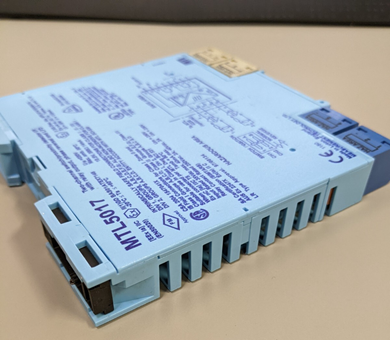
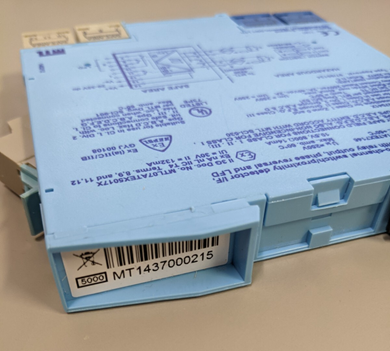
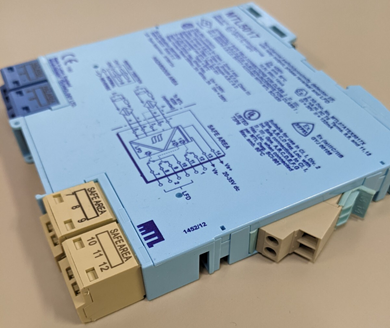
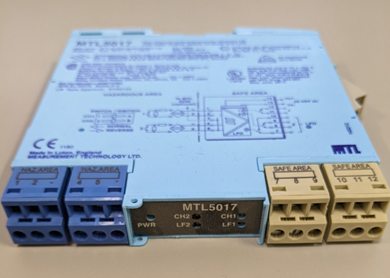
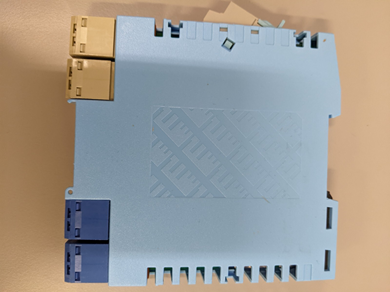
MTL Barries - MTL5017 SWITCH/ PROXIMITY DETECTOR INTERFACE (two-channel, with line fault detection and phase reversal)
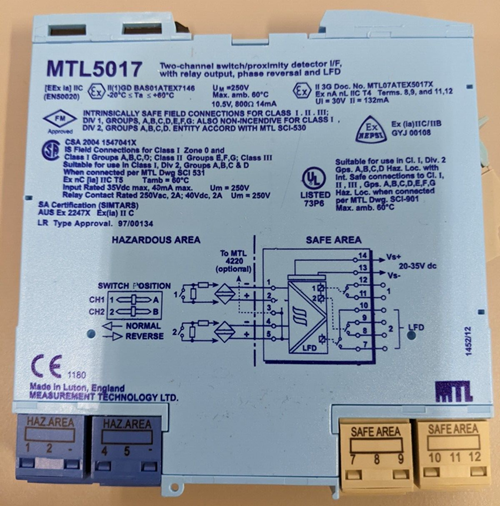
The MTL5017 is a two-channel switch/proximity detector interface that allows two hazardous-area field devices (switches or detectors) to control two safe-area loads, such as relays. It works by monitoring the state of the input switch or proximity detector in the hazardous area, which can be configured for normal or reversed phase operation, and then controlling a separate relay output in the safe area accordingly. The device also includes line fault detection (LFD) to automatically detect and signal open or short circuits in the field wiring.
Input and output
- Inputs: Supports two inputs, which can be conventional switches or NAMUR/DIN 19234 standard proximity detectors.
- Outputs: Provides two single-pole, normally-open relay outputs, one for each channel.
- Control: Each channel controls a separate safe-area load, and independent phase reversal control is available for each channel.
Key features
- Line Fault Detection (LFD): Detects open or short circuits in the field wiring for each channel. If a fault is detected, the corresponding relay opens, and a red LED indicator turns on.
- Phase reversal: The phase reversal control allows an alarm condition (output open) to be signaled based on the state of the sensor, which is useful for certain safety applications.
- Standard compatibility: Has inputs that conform to NAMUR/DIN 19234 standards for proximity detectors.
- Safety integrity: It is a Type A1 device with a hardware fault tolerance of 0, and it is designed for use in safety-related applications (e.g., IEC 61508).
How it works
- Monitoring: The unit monitors the status of the two inputs from the hazardous area. For switches, specific resistors must be fitted externally to the input for the device to operate correctly.
- Signal processing: The device processes the input signal, potentially inverting it based on the phase reversal setting.
- Output activation: When the input is active (e.g., switch closed or detector triggered), the corresponding output relay in the safe area closes, activating the safe-area load.
- Fault detection: In parallel, the line fault detection circuit constantly monitors the integrity of the field wiring. If a break or short is detected, the fault relay is activated and the fault LED lights up.
The MTL5017 is a two-channel switch/proximity detector interface that acts as an isolating barrier between a hazardous area field device (switch or proximity detector) and safe-area control equipment.
Working Principle
The core function of the MTL5017 is to receive signals from a sensor in a hazardous location and use them to control a load (e.g., an alarm or a solenoid) in a safe location, all while maintaining intrinsic safety.
- Hazardous Area Input: The unit provides a low-power, intrinsically safe voltage (7 to 9V DC) to the connected switch or NAMUR/DIN 19234 standard proximity detector located in the hazardous area. This low voltage and limited current ensure that not enough energy is present to ignite a potentially explosive atmosphere, even in fault conditions.
- Signal Detection:
- For a proximity detector, the device monitors the current drawn by the sensor. A change in current (typically above 2.1mA for "on" and below 1.2mA for "off") is detected as a change in status.
- For a switch (contact input), external resistors must be fitted. The MTL5017 measures the resistance to determine the switch's open or closed state.
- Isolation: The input circuitry on the hazardous side is galvanically isolated from the output circuitry on the safe side, typically using transformers or opto-isolators. This ensures that any high voltages or fault conditions in the safe area cannot be transmitted to the hazardous area, and vice-versa.
- Safe Area Output: Based on the input signal status, the unit controls a single-pole relay output in the safe area. The relay contacts can then switch a safe-area load, such as a PLC input or an alarm.
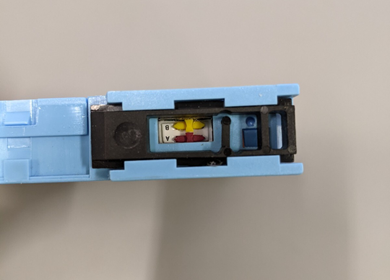
- Phase Reversal: The module features independent phase reversal control for each channel via switches on the unit's base. This allows the user to define whether the relay is energized (closed) when the input is "on" or "off", accommodating different alarm conditions (e.g., normally open or normally closed logic).
- Line Fault Detection (LFD): The MTL5017 automatically detects open or short circuits in the field wiring by monitoring the input current/resistance. A dedicated red LED indicator and a separate line fault relay signal this condition, ensuring system integrity.
In essence, the device functions as an intelligent, safety-approved signal conditioner and barrier, translating a low-power hazardous-area signal into a usable safe-area control action. For further technical details, you can consult the product datasheet available from authorized distributors like Eaton.
 Full Datasheet Full Datasheet
|