|
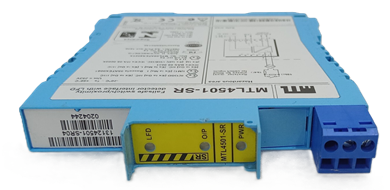
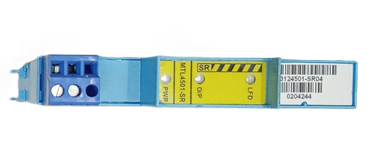
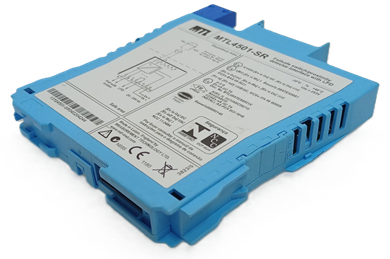
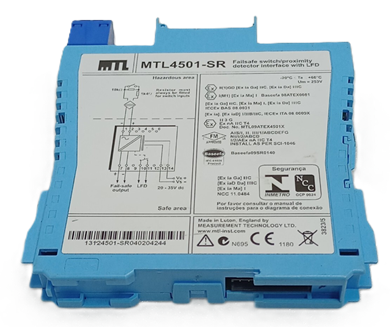
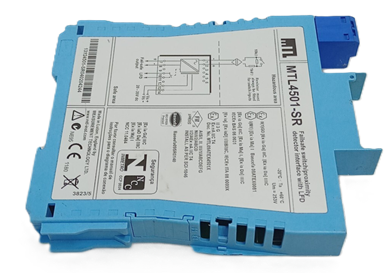
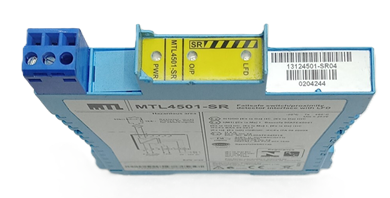
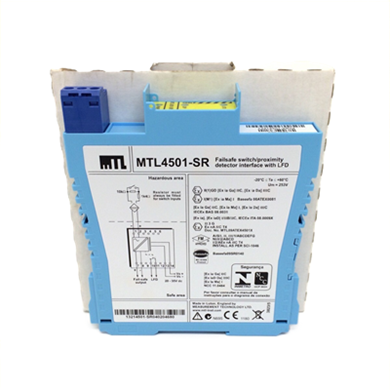
MTL Barries - MTL4501SR - FAIL-SAFE SWITCH/PROXIMITYDETECTOR INTERFACE
The MTL4501-SR works as a fail-safe interface between a hazardous area and a safe area, isolating the two to prevent explosions. It uses intrinsic safety techniques to monitor a switch or proximity detector in the hazardous area and, in a "closed" state, outputs a 24V signal to the safe area. If the hazardous area circuit opens, shorts, or a fault occurs, the output is de-energized to a safe state (0V), making it fail-safe and suitable for SIL3 safety systems.
Working principle
- Normal operation: When a fail-safe switch or proximity detector in the hazardous area is in its "closed" or "ON" state, the MTL4501-SR module receives a specific input current (e.g., \(2.9mA\) to \(3.9mA\)). It then provides a de-energized, but otherwise normal, voltage output (nominally \(24V\)) to the safe area.
- Fail-safe action: When the hazardous area sensor is in an "open" or "OFF" state, such as due to a broken or shorted wire, the module de-energizes the output to a safe state (below \(5V\)). This action is the core of the fail-safe principle, ensuring a predictable and safe state in the event of a fault.
- Line fault detection (LFD): The module includes a separate, non-safety-related line fault detection (LFD) system to alert operators to issues like open or short circuits in the hazardous area wiring. This is signaled by a separate relay contact.
- SIL3 certification: The unit is designed and certified for use in Safety Instrumented Systems up to Safety Integrity Level 3 (SIL3), which is necessary for critical processes where a high degree of reliability is required.
| FAIL-SAFE SWITCH/PROXIMITYDETECTOR INTERFACE |
 |
Key Features:
- Intrinsic safety: Prevents explosions by limiting the electrical energy in the hazardous area to a level that is insufficient to cause a spark that could ignite the atmosphere.
- Galvanic isolation: Separates the hazardous and safe areas, allowing each to be grounded independently and preventing earth loops.
- Backplane mounting: The MTL4501-SR is designed for backplane mounting, making it ideal for applications with Distributed Control Systems (DCS). The MTL5501-SR is the DIN-rail mounted equivalent
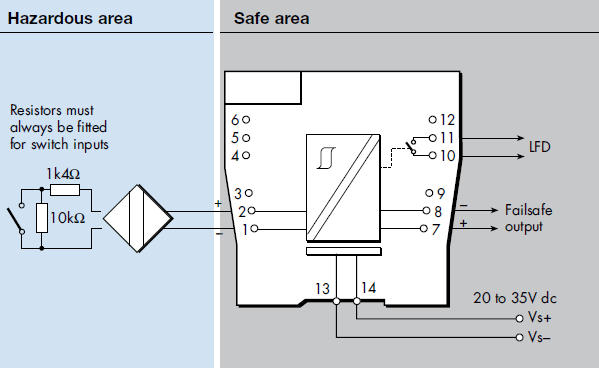
The MTL4501-SR is a fail-safe switch/proximity detector interface module (intrinsically safe galvanic isolator) that monitors a sensor in a hazardous area and controls a safe-area output based on the input current.
Its working principle is based on current threshold detection and galvanic isolation for safety:
Core Function
The module acts as a barrier, providing intrinsic safety (IS) by limiting the energy that can enter the hazardous area, thus preventing explosions. It connects to approved fail-safe sensors (like proximity detectors or switches equipped with specific resistors) and processes the signal to control an isolated voltage output in the safe area.
Operating Principle & Input/Output Characteristics
The MTL4501-SR monitors the input current (Is) from the field device in the hazardous area and determines the device's status, which in turn switches a nominal 24V DC output in the safe area. The operation can be summarized in the following table:
| Input Value (Is) in sensor circuit |
Input Line State |
Safety-related Voltage Output |
LFD Contacts |
| 2.9mA < Is < 3.9mA |
Healthy |
ON (~24V) |
CLOSED |
| Is < 1.9mA or Is > 5.1mA |
Healthy |
OFF (~0V) |
CLOSED |
| Is < 50µA |
Open Circuit Fault |
OFF |
OPEN |
| Rs < 100 Ohm (Short Cct) |
Open Circuit Fault |
OFF |
OPEN |
- Normal Operation (ON state): When the proximity detector is in its normal "ON" state, the input current is within the 2.9mA to 3.9mA range. This activates the safety-related voltage output in the safe area.
- Normal Operation (OFF state): When the detector is "OFF" (or the input current is outside the ON range but still healthy), the output deactivates.
- Failsafe Design: The "SR" in MTL4501-SR stands for "Safety Related". The design is "fail-safe," meaning that in the event of a fault (like power loss, open circuit, or short circuit), the output defaults to the "OFF" (de-energized) state, which is typically the safe state for the connected safety instrumented system (SIS).
Line Fault Detection (LFD)
A key feature is the integrated Line Fault Detection (LFD), which monitors for open or short circuits in the field wiring.
- If a fault occurs (e.g., current below 50µA for open circuit or resistance below 100 Ohm for short circuit), the module not only switches the main safety output OFF but also changes the state of separate LFD relay contacts, providing an alarm signal to a non-safety related control system.
- For switch inputs, specific resistors must be fitted across the contacts to enable this LFD function.
Safety Certification
The MTL4501-SR is certified for use in safety instrumented systems up to Safety Integrity Level (SIL) 3 in a single-channel configuration (1oo1 architecture), in accordance with the international standard IEC 61508. This makes it suitable for critical process and safety control applications.
For further technical details and installation guidelines, refer to the official Eaton MTL4501-SR Safety Manual or the product datasheet available on the Eaton website.
 Full Datasheet Full Datasheet
|