|
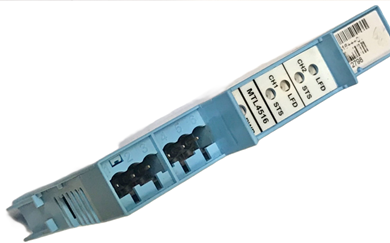
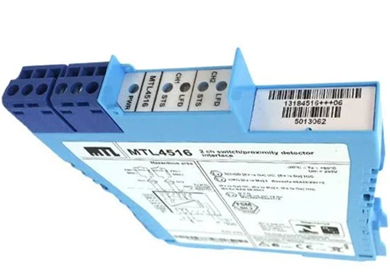
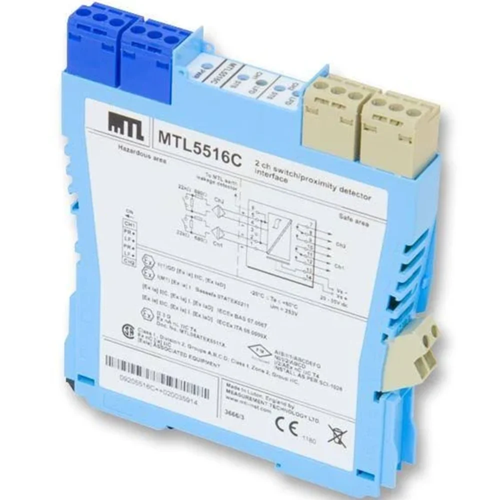
MTL Barries - MTL4516 - SWITCH/ PROXIMITY DETECTOR INTERFACE
The MTL4516 is a two-channel intrinsically safe (IS) relay module that allows hazardous-area switches (like proximity detectors) to control safe-area loads, using galvanic isolation to limit energy and prevent explosions. Its principle involves monitoring input current/resistance, detecting line faults (open/short circuits) with LEDs, and activating changeover relays to switch safe-area loads (e.g., alarms, lights) based on the hazardous-area device's status, providing safety and signal conversion..
Here's a breakdown of its working principle:
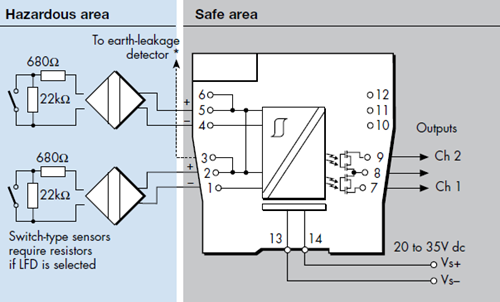
- Hazardous Area Input: It accepts inputs from 2-wire NAMUR proximity sensors or simple switches in Zone 0/Div 1 hazardous areas.
- Intrinsic Safety & Isolation: The module intrinsically limits the voltage and current entering the hazardous area, preventing sparks, and uses galvanic isolation (no direct electrical connection) to separate circuits.
- Line Fault Detection (LFD): When selected via switches, it monitors the input for open-circuit (broken wire) or short-circuit conditions, indicating these faults with LEDs and de-energizing the output relay.
- Signal Conversion: It converts the low-power sensor signal into a robust relay output for the safe area.
Relay Output: It provides two changeover (SPDT) relay contacts, allowing control of two separate safe-area devices (like solenoid valves, alarms, or lights).
- Phase Reversal: A side switch allows user-selectable phase reversal for each channel, adapting to different sensor or load requirements.
In essence: The MTL4516 acts as a safe, isolated bridge, taking signals from simple, potentially sparking devices in dangerous zones and reliably controlling equipment in safe control rooms, while also alerting operators to wiring problems.
The MTL4516 is a two-channel, intrinsically safe (IS) galvanic isolator that acts as an interface between switches or proximity detectors in a hazardous area and control equipment in a safe area. Its core working principle is to provide full galvanic isolation to safely limit the energy (voltage and current) flowing into the hazardous area, preventing sparks or arcs that could ignite a flammable atmosphere.
Working Principle
The module achieves safety and functionality through several key mechanisms:
- Galvanic Isolation: The primary principle is the complete electrical separation (isolation) of the safe-area and hazardous-area circuits. This means no direct electrical connection exists between the two sides, typically achieved internally using components like transformers or optical isolators. This separation ensures that faults or high voltages in the safe area cannot pass into the hazardous area.
- Energy Limiting: Circuitry within the MTL4516 actively limits the voltage and current that can enter the hazardous area to "intrinsically safe" levels, which are insufficient to ignite surrounding gases or dust, even under fault conditions.
- Signal Conversion/Relay: The device takes a low-power input signal from a switch or proximity detector in the hazardous area and controls a changeover relay contact output in the safe area. This relay can then control a safe-area load, such as a PLC input or alarm system.
- Line-Fault Detection (LFD): When this optional feature is selected via a switch on the side of the module, the MTL4516 can detect open or short circuit conditions in the field wiring located in the hazardous area. This is done by monitoring specific current levels (e.g., input current less than 50µA for an open circuit, or resistance less than 100Ω for a short circuit) and indicating the fault with an LED indicator.
- Phase Reversal: A user-selectable switch also allows for phase reversal for each channel, providing flexibility in how the input status affects the output relay.
The main benefit of using an isolator like the MTL4516 over a traditional shunt-diode barrier is that it eliminates the need for a high-integrity safety earth connection and avoids earth-loop problems in the system design.
For detailed technical specifications and application guidance, refer to the official Eaton MTL4516 Datasheet.
| SWITCH/ PROXIMITY DETECTOR INTERFACE |
 |
 Full Datasheet Full Datasheet
|