|
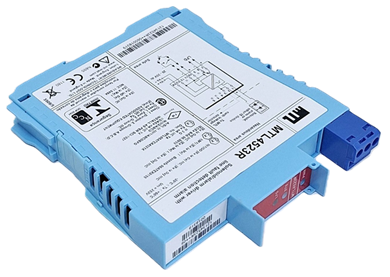
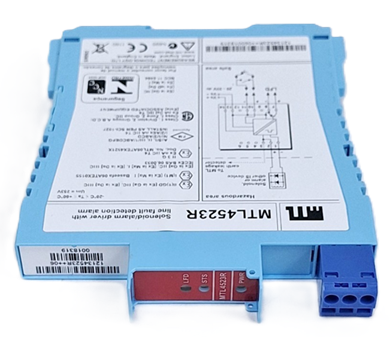
MTL Barries - MTL4523R - SOLENOID/ ALARM DRIVER loop-powered, IIC
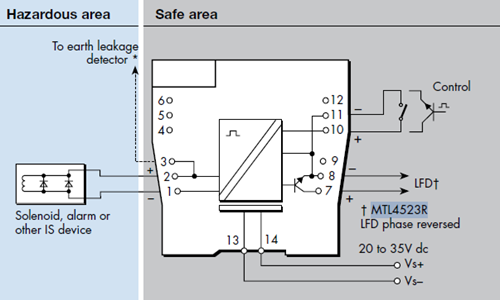
The MTL4523R is a fail-safe galvanic isolator that drives hazardous area loads (like solenoids) from safe area signals, using intrinsic safety principles to prevent explosions; its core function involves 3-port isolation, translating low-power safe-area signals into intrinsically safe currents for the field, with a key feature being Line Fault Detection (LFD), which energizes the module when a field-side open or short circuit occurs, ensuring system safety and diagnostics.

Working Principle Breakdown:
- Intrinsic Safety (IS): The device limits electrical energy (voltage/current) in the hazardous area to prevent ignition of flammable gases/dusts, allowing live maintenance.
- Galvanic Isolation: It separates the safe area (control room) circuit from the hazardous area (field) circuit with 3-port isolation (input, output, power), eliminating ground loops and simplifying earthing.
- Signal Translation: A low-power contact closure or logic signal from the safe area controls the module, which then provides power to drive a device (e.g., solenoid) in the hazardous area.
- Fail-Safe Action (MTL4523R): The 'R' signifies a reverse-acting or fail-safe mode; if a line fault (open/short) is detected on the field side, the module energizes its safe-area output (a solid-state switch) to signal the fault, ensuring a clear alarm state rather than just de-energizing.
- Line Fault Detection (LFD): Built-in monitoring detects open circuits (o/c) or short circuits (s/c) in the field wiring, signaling this condition to the safe area via its own output, providing vital diagnostic information.
In essence, the MTL4523R acts as a secure bridge, enabling safe control of field devices while constantly monitoring the integrity of the field wiring and alerting operators to any dangerous conditions.
The MTL4523R is a single-channel, backplane-mounted solenoid/alarm driver that acts as an isolated interface between a safe-area control system and an on/off device (load) in a hazardous area. Its primary working principle is galvanic isolation, which restricts electrical energy to a safe level within the hazardous area to prevent explosions.
| SOLENOID/ ALARM DRIVER loop-powered, IIC |
 |
Working Principle
The module operates as follows:
- Signal Input (Safe Area): The device is controlled by a volt-free contact or a logic signal from a safe-area control system (e.g., a PLC or DCS).
- Isolation: The input signal is passed through an isolation stage (typically using transformer construction) that prevents high or unsafe voltages/currents from the safe area from reaching the hazardous area. This ensures that the energy levels in the hazardous area remain below the ignition point of any potentially explosive atmosphere.
- Output (Hazardous Area): The module drives a load in the hazardous area, such as a solenoid valve, alarm, or LED, with an intrinsically safe output.
- Line Fault Detection (LFD): The unit includes a line fault detection feature that monitors the field wiring for open or short circuits.
- For the standard MTL4523, a line fault de-energises a safe-area solid-state switch.
- For the MTL4523R (the 'R' usually indicating a reversed operation or relay variant in the alarm circuit), a line fault causes the safe-area solid-state switch to energise. This reversed logic is often used to connect multiple alarms in parallel to provide a group alarm output.
- Functional Safety: The design adheres to standards like IEC 61508, allowing it to be used in safety-instrumented systems (SIL2 capable as a single device).
In summary, the MTL4523R's working principle is based on providing a safe, galvanically isolated power source to a hazardous area device, controllable by a safe-area signal, while actively monitoring the integrity of the field wiring. More detailed specifications and installation information can be found in the product's official datasheet.
 Full Datasheet Full Datasheet
|