|
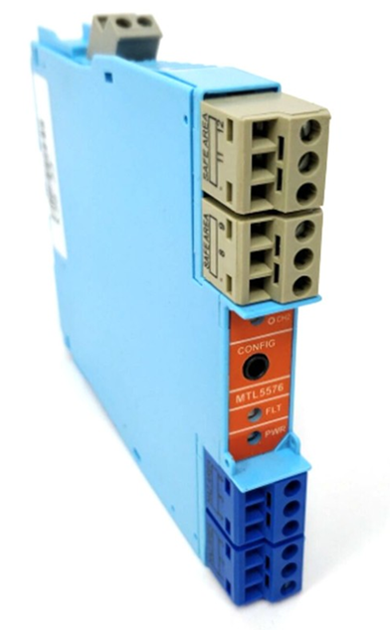
MTL Barries - MTL5576-THC - TEMPERATURE CONVERTER
(mV/THC input, 2-channel)
The MTL5576-THC is a DIN-rail mounted intrinsic safety isolator that converts low-level, hazardous-area thermocouple (THC) signals into a standard, isolated 4-20mA current for safe-area control systems, using advanced isolation technology to eliminate ground loops and interference, ensuring accuracy and compliance with ATEX/IECEx standards for critical process monitoring.

Working Principle
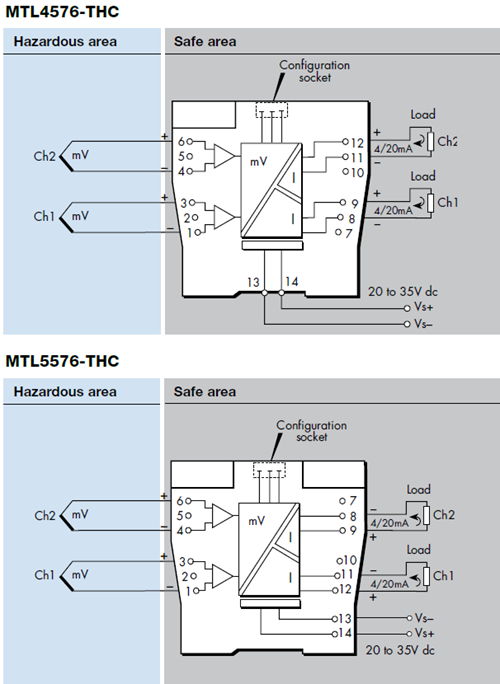
- Hazardous Area Input: A thermocouple sensor (like Type K, J, etc.) in a hazardous zone generates a tiny millivolt (mV) signal representing temperature.
- Signal Reception & Compensation: The MTL5576-THC receives this mV signal and automatically performs cold-junction compensation (CJC), a crucial step for accurate temperature measurement.
- Signal Conversion & Amplification: The device amplifies and linearizes the compensated mV signal, converting it into a proportional 4-20mA current.
- Galvanic Isolation: An internal transformer provides complete electrical separation (isolation) between the hazardous-area input and the safe-area output, preventing ground loops and interference from noisy plant wiring.
- Safe Area Output: The isolated 4-20mA signal is then sent to a control system (like a PLC or DCS) in the safe area, allowing for reliable temperature monitoring and control.
- Software Configuration: Features like input type (thermocouple type), range, and fault detection (open/short circuits) are set up via a PC using MTL software, making it highly flexible.
| TEMPERATURE CONVERTER - mV/THC input, 2-channel |
 |
Key Benefits:
- Safety: Enables intrinsically safe (IS) circuits for hazardous environments (explosive gases/dusts).
- Accuracy: High accuracy & noise immunity for reliable process control.
- Simplicity: Eliminates complex earthing requirements of older barrier systems.
- Versatility: Supports various thermocouple types and is configurable via PC
The MTL5576-THC is a two-channel, intrinsically safe temperature converter (galvanic isolator) that converts low-level DC signals from thermocouples located in a hazardous area into 4/20mA current signals for use in a safe area.
Its working principle involves several key functions:
- Signal Conversion: The module accepts low-level voltage signals (mV) produced by various standard thermocouple types (e.g., J, K, T, E) as input from the hazardous area.
- Intrinsic Safety (Galvanic Isolation): It uses galvanic isolation to create an energy-limited barrier between the hazardous-area circuits and the safe-area circuits. This prevents the transfer of dangerously high energy (voltage or current) from the safe area into the hazardous area, thus ensuring the connected instrumentation in the hazardous area remains intrinsically safe and cannot ignite a potentially explosive atmosphere.
- Cold Junction Compensation (CJC): Thermocouples require cold junction compensation to accurately measure temperature relative to a known reference point. The MTL5576-THC includes built-in CJC on the hazardous-area connections to ensure accurate temperature readings.
- Signal Linearization and Conditioning: The module linearizes the non-linear thermocouple input signal and converts it into a standardized, proportional 4 to 20mA analog current signal for driving safe-area loads, such as a Distributed Control System (DCS) or Programmable Logic Controller (PLC).
- Configuration and Monitoring: Features such as ranging, monitoring, testing, and tagging are software-selectable using a personal computer running MTL PCS45 software with a PCL45USB serial interface, allowing users to configure the module for specific application requirements.
In summary, the MTL5576-THC acts as a safety interface and signal conditioner, enabling reliable and safe temperature monitoring in industrial processes where hazardous atmospheres may be present.
More detailed technical specifications can be found in the official MTL4576-THC/MTL5576-THC Datasheet from Eaton.
 Full Datasheet Full Datasheet
|