|
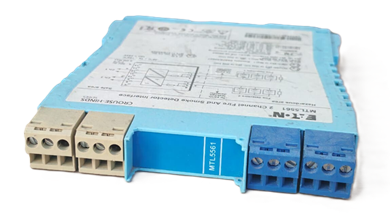
MTL Barries - MTL5561 - FIRE AND SMOKE DETECTOR INTERFACE (2-channel)
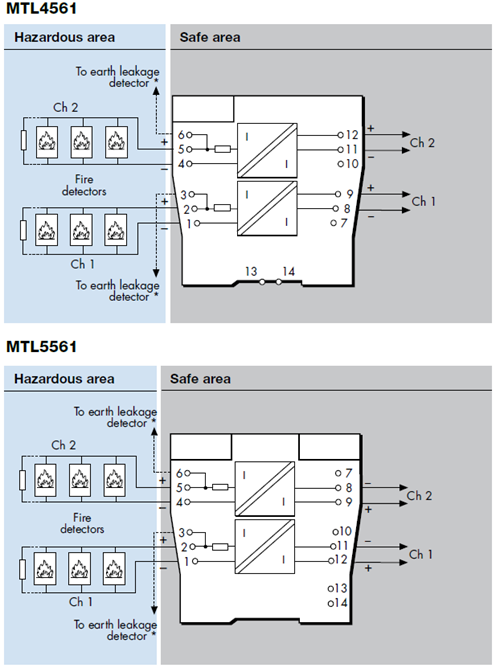
The MTL5561 is a two-channel, intrinsically safe barrier that allows conventional fire detectors (smoke/heat) and call points in hazardous areas to connect safely to a non-hazardous fire alarm panel (FACP) by converting hazardous-area signals to safe-area current changes, using galvanic isolation and current limitation to prevent sparks, with features like reverse polarity protection and end-of-line (EOL) monitoring for fault detection. Its core principle is to "isolate" the hazardous zone, limiting energy to prevent ignition, while translating the detector's simple ON/OFF (or varying current) state into a signal the safe-area control panel understands, often using an EOL resistor for loop supervision.
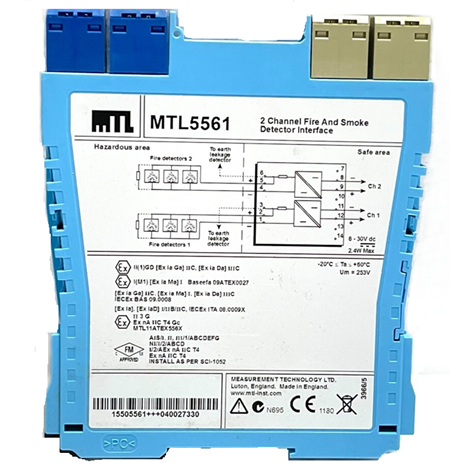
Key Working Principles
- Intrinsic Safety (IS): It provides energy limitation (voltage/current/power) and galvanic isolation, ensuring that the electrical energy in the hazardous area (Zone 0, 1, 2) is kept below the ignition level for flammable gases/dusts, even during fault conditions.
- Zone Powering: The unit is loop-powered, drawing power from the safe-area control panel, which powers the detectors in the hazardous area.
- Signal Conversion: When a detector triggers (e.g., smoke or heat), it changes the loop's current (often by connecting a resistor/shorting the loop), and the MTL5561 translates this change into a corresponding, safe current variation on the output side for the FACP.
- Galvanic Isolation: A transformer or optical isolator separates the hazardous-area circuit from the safe-area circuit, preventing any fault or energy from the hazardous side from crossing over.
- Line Fault Detection (LFD): It monitors the integrity of the wiring. An end-of-line resistor (EOLR) is placed at the far end of the loop. The barrier detects open circuits (break) or short circuits (faulty device), signaling faults to the panel.
- DIN Rail Mounting: It's designed for easy installation on standard 35mm DIN rails, simplifying wiring with plug-in connectors.
-
| FIRE AND SMOKE DETECTOR INTERFACE (2-channel) |
 |
In Simple Terms:
Think of it as a safe bridge. The fire detector in the dangerous area needs power and sends a signal. The MTL5561 sits at the boundary, limiting the power going to the detector and safely receiving the "alarm" signal, then sending a "safe" version of that alarm to the main fire panel in the safe zone, ensuring no explosion risk.
The MTL5561 is a 2-channel, loop-powered galvanic isolator (or intrinsically safe barrier) used to connect conventional fire and smoke detectors located in hazardous areas to safe-area control panels.
Its working principle involves isolating the safe-area control circuit from the hazardous-area field circuit while allowing control signals to pass through, thereby ensuring that excessive energy capable of igniting a flammable atmosphere cannot reach the hazardous zone.
Working Principle Explained
- Intrinsic Safety (IS) Principle: The primary function is to limit the voltage and current entering the hazardous area under both normal and fault conditions. This is achieved through the use of isolating transformers and carefully designed safety circuits within the module, ensuring that the energy levels in the hazardous area remain below the ignition point of the surrounding atmosphere.
- Signal Transmission: The unit acts as an interface. The conventional detectors in the hazardous area operate on a current loop principle:
- In standby mode, the detector draws a low quiescent current (typically 5-100µA).
- When a detector is triggered (e.g., by smoke, heat, or a manual call point), its current draw increases significantly (typically to 40-100mA).
- Current Change Detection: The MTL5561 detects this change in current within the hazardous-area loop and mirrors a corresponding, isolated change in the safe-area circuit. The fire alarm control panel in the safe area interprets this current change as an alarm condition.
- Galvanic Isolation: Crucially, because it is a galvanic isolator, it provides a complete electrical separation between the two circuits, which simplifies installation by avoiding earth-loop problems and removing the need for a dedicated high-integrity earth connection, unlike Zener barriers.
Protection Features:
- It features reverse input polarity protection.
- It offers optional "no-fail" earth fault detection capabilities, which can be enabled by connecting an earth leakage detector to specified terminals.
In essence, the MTL5561 safely translates current signals from a conventional detector loop into an actionable signal for a control panel, maintaining safety certification for Zone 0, 1, or 2 hazardous environments. More detailed specifications and wiring diagrams are available in the product's safety manuals, such as those provided by Eaton or Hochiki Australia.
 Full Datasheet Full Datasheet
|