|
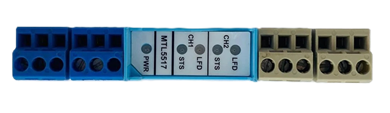
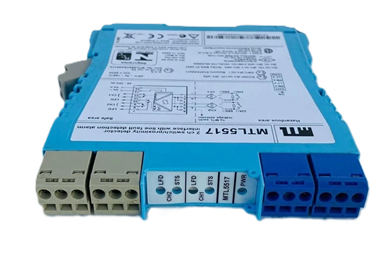
MTL Barries - MTL5517 - SWITCH/ PROXIMITY DETECTOR INTERFACE
(2-channel, line fault detection, phase reversal)
The MTL5517 is a two-channel intrinsically safe (IS) galvanic isolator that allows switches or proximity detectors in hazardous areas to control two separate loads in safe areas, using relay outputs, all while providing essential line fault detection (LFD) and phase reversal for each channel, preventing explosions by limiting energy and signaling faults for safety compliance. It works by galvanically isolating hazardous (Zone 0, 1, 2) and safe (Ex-safe) circuits, translating low-power hazardous inputs into higher-power safe-area outputs through relays, with built-in monitoring for open/short circuits in the field wiring.
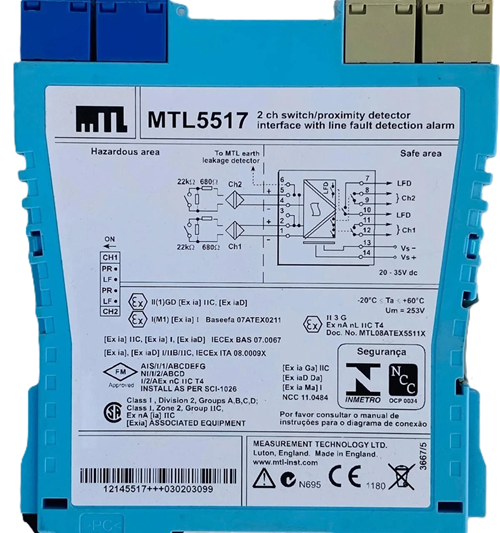
Working Principle Breakdown:
- Intrinsic Safety (IS) & Galvanic Isolation: The core principle is to keep the energy in the hazardous area (field sensors) below the ignition level for flammable atmospheres, while isolating it from the safe area (control system). The MTL5517 uses a transformer for 3-port isolation, separating the power, input, and output circuits.
- Input (Hazardous Area):
- It accepts signals from 2-wire proximity detectors or simple switches (e.g., limit switches).
- A 7-9VDC power is supplied to these sensors from the module.
- The switch or detector's state (open/closed) modulates this current/voltage.
- Signal Processing:
- The module detects the change in the input signal (e.g., current change when a switch closes).
- Phase Reversal: A switch allows selecting normal or reversed phase output, adapting to different sensor types.
- Line Fault Detection (LFD): It sends a small current through the field wiring to check for breaks (open circuit) or shorts, signaled by a separate LED and relay.
- Output (Safe Area):
- When the input is active (e.g., switch closed), the module energizes one of its two internal single-pole relays.
- These relays then switch the higher power (up to 250V AC/40V DC) for the safe-area loads (e.g., alarms, solenoids, PLCs).
- Indicators:
- Green LED: Power indication.
- Yellow LEDs: Show the status of each channel (output energized).
- Red LEDs: Indicate a line fault on each channel.
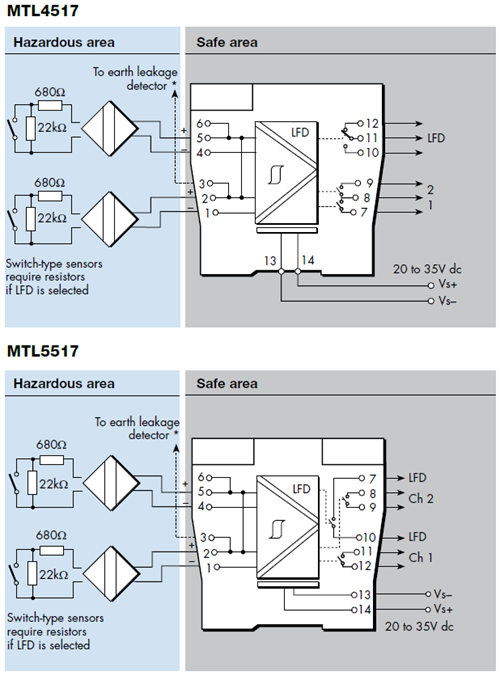
| SWITCH/ PROXIMITY DETECTOR INTERFACE - (2-channel, line fault detection, phase reversal) |
 |
In essence, it's a safety device that safely links low-power field sensors in explosive atmospheres to high-power control systems, ensuring safety and providing diagnostic feedback.
The MTL5517 is a two-channel galvanic isolating interface that enables safe-area loads to be controlled by switches or proximity detectors (NAMUR sensors) located in a hazardous area. Its working principle relies on intrinsic safety (IS) to protect personnel and prevent explosions in hazardous environments.
Working Principle
The module's operation can be broken down into three key areas: signal transmission, intrinsic safety isolation, and line fault detection:
- Signal Transmission:
- Input: The MTL5517 applies a low-power, intrinsically safe voltage (7 to 9V DC) to the proximity detector or switch in the hazardous area.
- Detection: The hazardous-area device changes the current flow based on its state (e.g., a switch closing or a proximity sensor detecting a target). The input characteristics define these states:
- An input current above 2.1mA (resistance below 2kΩ) is detected as an "ON" state.
- An input current below 1.2mA (resistance above 10kΩ) is detected as an "OFF" state.
- Output: The change in input current in the hazardous area causes a corresponding change in the state of a safe-area relay within the MTL5517 module. This relay can then control a safe-area load, such as an alarm or a control system input.
- Intrinsic Safety (Galvanic Isolation):
- The core function is to provide galvanic isolation between the hazardous-area circuit and the safe-area circuit. This is achieved using advanced circuit design and isolating transformers.
- This isolation ensures that no high-energy voltage or current from the safe-area (e.g., from the main power supply) can enter the hazardous area, even in the event of a fault, thus preventing ignition of flammable gases or dust. The module is certified to functional safety standards like IEC 61508.
- Line Fault Detection (LFD):
- The module includes user-selectable line fault detection (LFD).
- If enabled, the device monitors the input current for open-circuit (current below 50µA) or short-circuit conditions (resistance below 100Ω) in the field wiring.
- A detected line fault is indicated by a red LED on the module and signaled via a separate line-fault relay.
Summary of Operation
In essence, the MTL5517 acts as a safety barrier and signal translator. It converts a physical change in the hazardous area into a safe electrical signal in the control room while ensuring the integrity of the hazardous area's intrinsic safety. For more technical details, you can consult the official MTL5517 datasheet from Eaton.
 Full Datasheet Full Datasheet
|