|
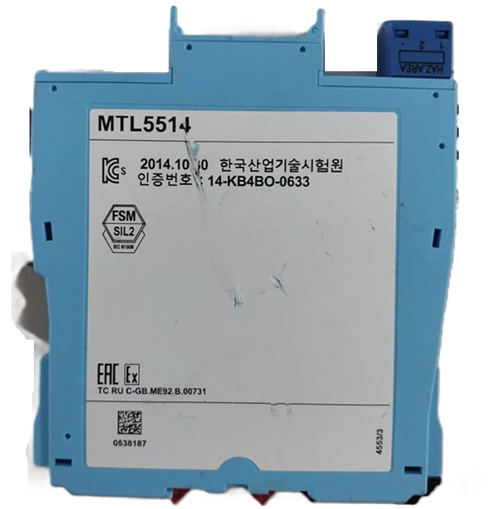
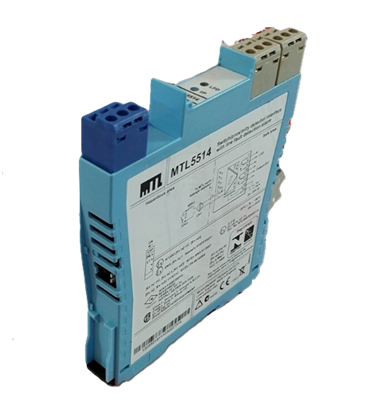
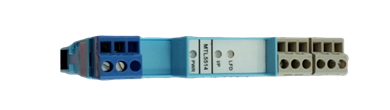
MTL Barries - MTL5514 - SWITCH/ PROXIMITY DETECTOR INTERFACE
(1-channel, line fault detection, phase reversal)
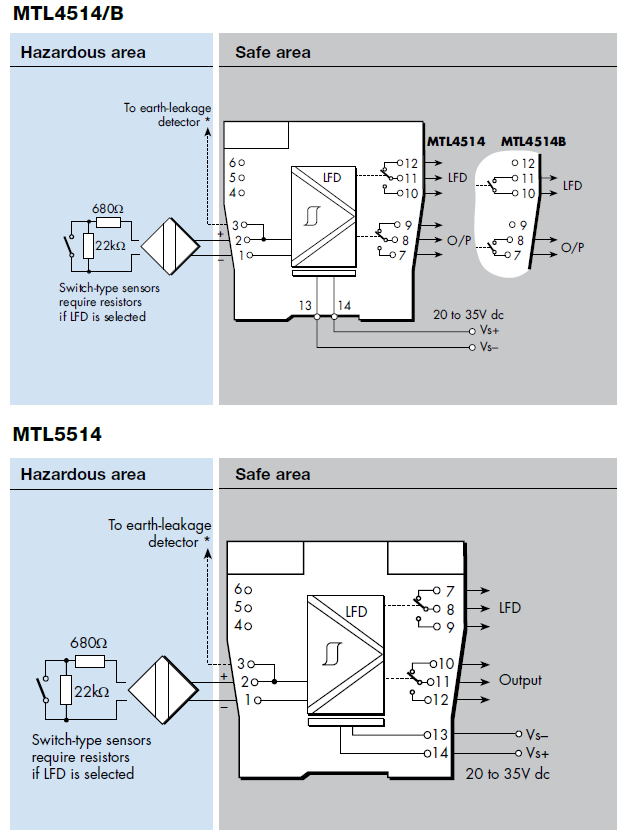
The MTL5514D is a DIN-rail mounted, single-channel isolating interface for proximity detectors or switches in hazardous areas, designed to safely control safe-area loads using intrinsic safety principles. Its working principle involves providing a controlled voltage (7-9V DC) to the NAMUR-type sensor in the hazardous zone, detecting its state (open/closed, or fault), and using galvanic isolation to mirror that state with a relay output in the safe area, featuring additional line fault detection (LFD) and phase reversal options for enhanced safety and signaling.
How it Works (Step-by-Step)
- Hazardous Area Input: A NAMUR-compliant proximity sensor or switch in a hazardous area (Zone 0/Div 1) detects a target or state change.
- Controlled Voltage Supply: The MTL5514 provides a stable 7-9V DC from its internal 1kΩ resistor to power the sensor.
- Current Detection:
- When the sensor is 'closed' (or near the target), it draws current (>2.1mA), indicating a normal state.
- When 'open' (or away from the target), the current drops (<1.2mA), signaling a different state.
- Galvanic Isolation: An isolating transformer separates the hazardous-area circuit from the safe-area circuit, preventing sparks or energy transfer.
- Relay Output: The input state (normal/fault/phase-reversed) is translated into the activation or deactivation of a single-pole relay with changeover contacts in the safe area, switching a load.
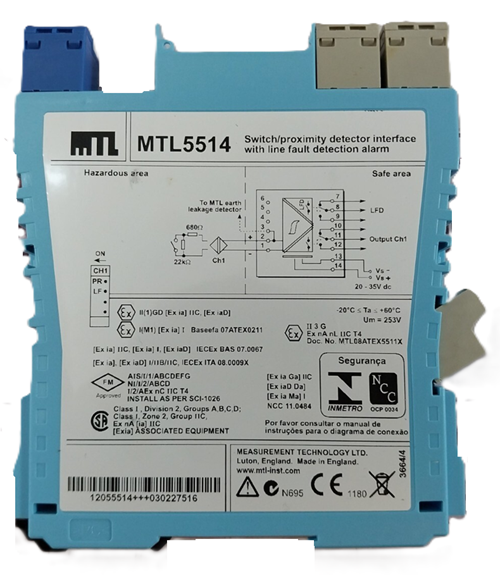
- Line Fault Detection (LFD): Switches on the unit allow you to enable LFD, which detects open circuits (<50µA) or short circuits (e.g., <100 Ohm), triggering a separate alarm relay and LED indicator.
- Phase Reversal: A switch lets you select if the output relay should energize for the 'open' or 'closed' input state, accommodating different sensor types.
-
| SWITCH/ PROXIMITY DETECTOR INTERFACE - (1-channel, line fault detection, phase reversal) |
 |
Key Features:
- Intrinsic Safety: Isolates hazardous and safe areas, requiring no separate safety barrier or high-integrity earth.
- Enhanced Monitoring: Dedicated LEDs (Green for Power, Yellow for Channel, Red for LFD) and separate relays for fault signaling.
- Compact Design: 16mm wide for high packing density on DIN rails.
In essence, the MTL5514 acts as a smart, safe bridge, translating simple switch/sensor actions from dangerous zones into reliable control signals for safe-area systems like PLCs or DCS.
The MTL5514 is a single-channel, isolating switch/proximity detector interface that enables a load in a safe area to be controlled by a switch or proximity detector (NAMUR sensor) located in a hazardous area.
Its working principle involves an intrinsic safety barrier that uses current thresholds to determine the status of the hazardous-area input, and then controls a safe-area output relay accordingly.
-
Key Operating Principles
- Intrinsic Safety Isolation: The module provides intrinsic safety (IS) isolation, which limits the electrical energy (voltage and current) that can enter the hazardous area. This prevents the ignition of a potentially explosive atmosphere, eliminating the need for a high-integrity earth connection.
- Input Monitoring (NAMUR Standard): The MTL5514 applies a specific voltage (7 to 9V DC) to the connected sensor/switch in the hazardous area and monitors the return current. It operates based on the BS EN60947-5-6:2001 standard for proximity detectors (NAMUR):
- Input > 2.1mA: The input circuit resistance is low (< 2kΩ), indicating a 'closed' or 'on' state (normal operation). The safe-area output relay is typically energized.
- Input < 1.2mA: The input circuit resistance is high (> 10kΩ), indicating an 'open' or 'off' state. The safe-area output relay de-energizes.
- Hysteresis: A built-in hysteresis of about 200µA (650Ω) nominal prevents relay chatter when the input signal is near the threshold.
- Output Control (Relay): The status detected in the hazardous area (open or closed) is signaled across the isolation barrier to a single-pole changeover relay in the safe area. This relay then controls the safe-area load (e.g., a pump, an alarm, or a PLC input).
- Line Fault Detection (LFD): The module includes user-selectable line fault detection. If selected, it can detect open circuits (current < 50µA) or short circuits (resistance < 100Ω) in the field wiring. A separate LFD relay is energised, and an indicator LED illuminates red when a fault is detected.
- Phase Reversal: Switches on the unit allow for the selection of phase reversal, changing whether the output relay energizes on a high or low input current.
In essence, the MTL5514 acts as an isolation and signal conditioning device, translating a simple switch status from a hazardous environment into a safe, controllable relay output for general-purpose use, while ensuring safety integrity and monitoring for potential wiring faults.
More detailed specifications can be found in the product's official datasheet on the Eaton website.
 Full Datasheet Full Datasheet
|