|
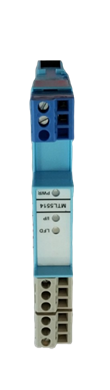
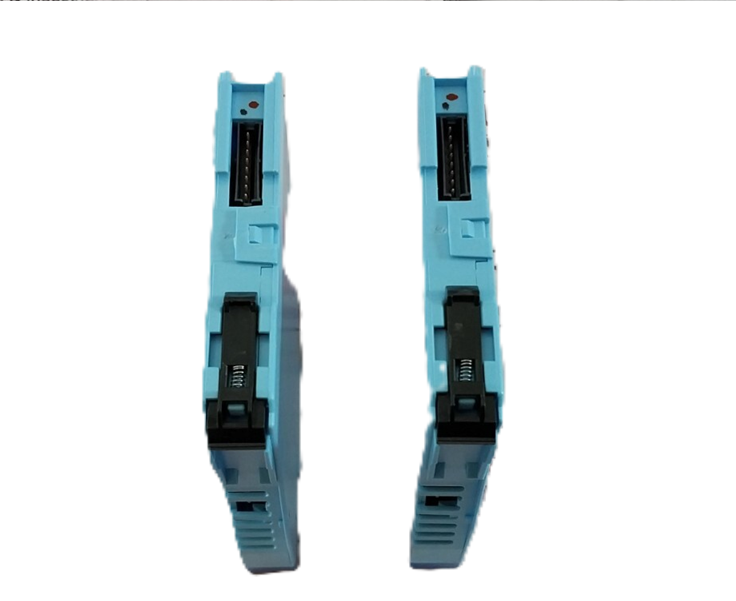
MTL Barries - MTL5514D - SWITCH/ PROXIMITY DETECTOR INTERFACE
(1-channel, dual output, LFD, phase reversal)
The MTL5514D is an Intrinsically Safe (IS) isolating interface that allows a switch or proximity detector in a hazardous area (Zone 0/1) to control two separate relays in a safe area, using Line Fault Detection (LFD) and phase reversal options for robust monitoring. Its core principle involves applying a safe, limited voltage (7-9VDC) to the field device, reading its open/closed state, and using internal switches to determine if the input is normal, open-circuit (fault), or short-circuit (fault) to trigger separate relay outputs for the process control and fault alarms, ensuring safety and clear diagnostics.
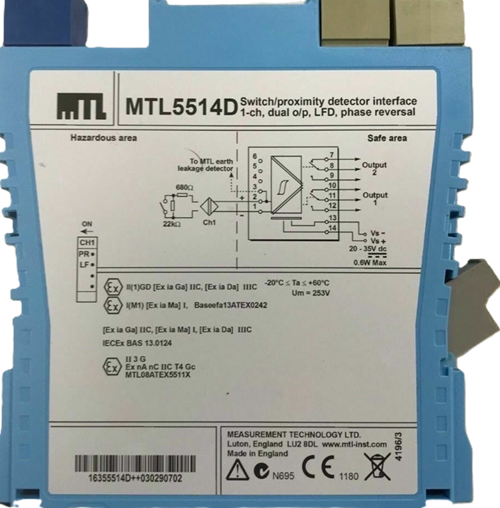
Working Principle Breakdown:
- Hazardous Area Input: A NAMUR-compliant switch or proximity detector in the hazardous area senses a physical event (e.g., presence/absence of metal).
- Intrinsic Safety: The MTL5514D provides a constant, low voltage (7-9VDC) to this sensor, limiting the energy to prevent sparks, making it safe for explosive atmospheres.
- Input Signal:
- Normal: If the switch is closed (or detector senses proximity), current flows (e.g., >2.1mA), keeping the output active.
- Open/Short: If the field wiring is broken (open circuit) or shorted (short circuit), the current changes significantly (e.g., <1.2mA for open), triggering the LFD.
- Line Fault Detection (LFD):
- User-selectable via switches, LFD detects open/short circuits in the field wiring.
- An LED indicates the fault status, and a dedicated LFD relay activates, separate from the main output.
- Phase Reversal: A switch allows inversion of the input logic, useful for fail-safe sensor configurations.
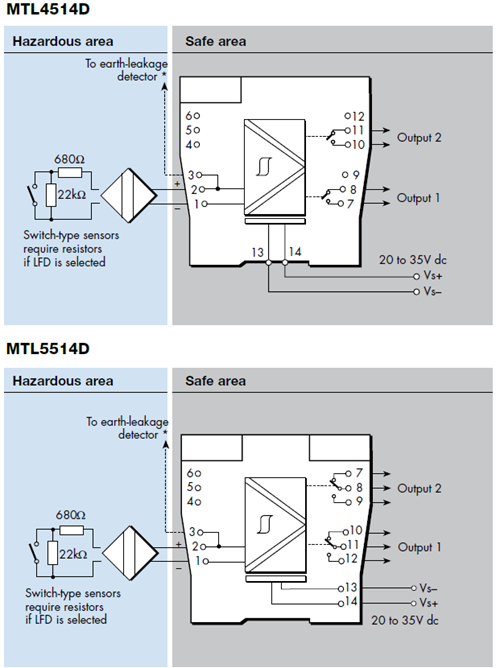
- Safe Area Output: The unit uses single-pole changeover relay contacts to provide isolated outputs in the safe area, controlled by the sensor's state or the LFD.
- Isolation: Galvanic isolation separates the hazardous (Zone 0/1) and safe areas, eliminating earth loops and simplifying grounding.
-
| SWITCH/ PROXIMITY DETECTOR INTERFACE - (1-channel, dual output, LFD, phase reversal) |
 |
Key Features:
- Two Relays: One for the main process control, one for fault indication.
- LEDs: Indicate power, output status, and line fault.
- DIN Rail Mountable: Easy installation in control panels.
- SIL-Rated: Capable for use in Functional Safety applications (up to SIL2/3).
-
In essence, the MTL5514D acts as a smart, isolated gateway, translating safe-area sensor signals into safe-area relay actions while continuously monitoring for wiring faults, ensuring both process control and safety.
The MTL5514D is a single-channel, intrinsically safe switch/proximity detector interface (galvanic isolator) that enables control of a safe-area load from a switch or proximity detector (NAMUR sensor) located in a hazardous area.
Its working principle involves the following key functions:
- Intrinsically Safe (IS) Isolation
The primary function is to provide galvanic isolation between the hazardous area (field side) and the safe area (control room side). This means there is no direct electrical connection, which limits the energy (voltage and current) that can enter the hazardous area, preventing the ignition of explosive gases or dust.
-
Signal Conversion
- Powering the Sensor: The module supplies a low-voltage DC power (7 to 9V dc from a 1kΩ resistor) to the proximity detector or switch in the hazardous area.
- Receiving the Signal: It monitors the current loop from the sensor.
- If the input current is greater than 2.1mA (input resistance < 2kΩ), the input is considered "on".
- If the input current is less than 1.2mA (input resistance > 10kΩ), the input is considered "off".
- The unit has a nominal hysteresis of 200µA to prevent chatter around the switching threshold.
- Output Control
The status change detected in the hazardous area is replicated in the safe area via a single-pole relay with changeover contacts. This relay can then be used to control a safe-area load, such as a PLC input, an alarm, or a control circuit.
- Line Fault Detection (LFD)
The "D" model includes user-selectable line fault detection (LFD). This feature monitors the field wiring for open-circuit or short-circuit faults:
- Open Circuit: An alarm is signaled if the input current is below 50µA.
- Short Circuit: An alarm is signaled if the input resistance is below 100Ω.
When a line fault is detected, a separate LFD relay is energised, a red LED indicator illuminates on the module, and the main channel output relay de-energizes to a fault condition (if configured for this behavior).
 Full Datasheet Full Datasheet
|