|
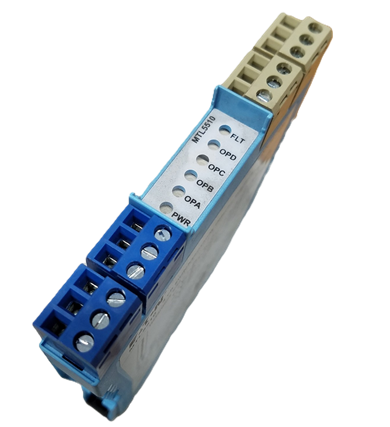
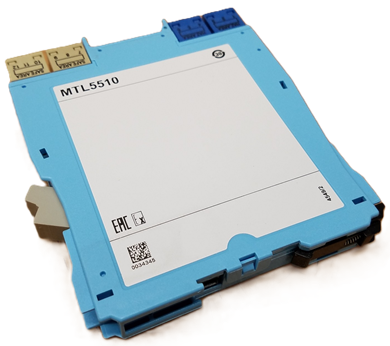
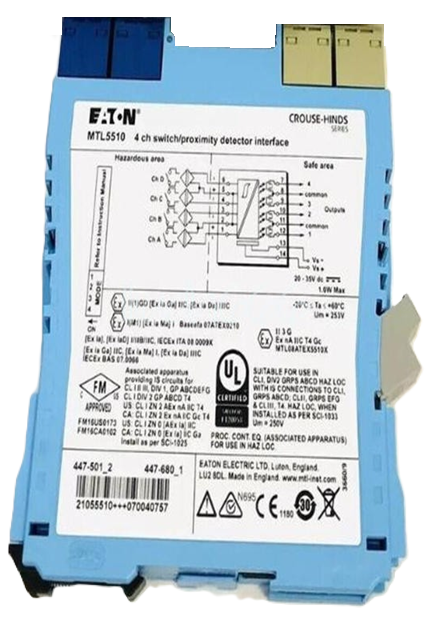
MTL Barries - MTL5510 - SWITCH/ PROXIMITY DETECTOR INTERFACE
(4-channel, digital input)
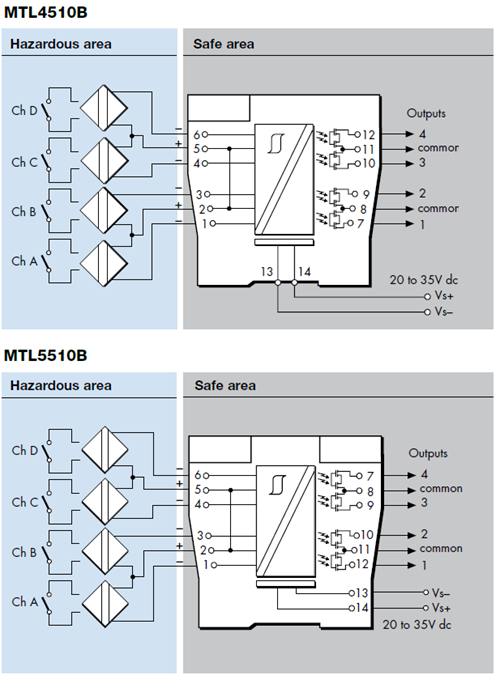
The MTL5510 is a four-channel intrinsically safe digital input isolator, working by galvanically isolating hazardous-area (Zone 0/Div 1) switches or proximity sensors from safe-area (control room) logic, allowing them to signal safely; it uses low power to the field device, senses the input current (e.g., NAMUR sensor standard), and provides four isolated solid-state outputs to the PLC/DCS, featuring selectable modes like Line Fault Detection (LFD) for enhanced safety, preventing explosions by keeping energy levels low in hazardous zones.
How it Works (Principle)
- Input Sensing (Hazardous Area): The module supplies a constant, low voltage (around 7-9V DC) to the hazardous-area sensors (switches or NAMUR proximity detectors).
- Current-Based Detection: When a sensor closes (switch ON) or detects metal (proximity ON), it pulls current (e.g., >2.1mA for NAMUR), signaling the input to the MTL5510.
- Galvanic Isolation: The core principle is intrinsic safety, achieved through galvanic isolation, separating the hazardous-area circuit from the safe-area circuit to prevent sparks, even with high-voltage transients.
- Output Switching (Safe Area): This input signal is then used to drive four isolated, solid-state outputs on the safe-area side, which can switch logic signals (positive or negative) for a control system.
- Line Fault Detection (LFD): When selected via switches, it monitors for open circuits (sensor failure) and switches the corresponding output OFF and/or activates an alarm, ensuring system integrity, especially for SIL-rated applications.
| SWITCH/ PROXIMITY DETECTOR INTERFACE - (4-channel, digital input) |
 |
Key Features
- Multi-Channel: Controls four independent inputs.
- DIN Rail Mount: Easy installation in standard panels.
- Plug-in Connectors: Simplifies wiring.
- Mode Selection: Uses switches for different input types (switch/proximity) and output configurations (e.g., phase reversal).
-
In essence, the MTL5510 acts as a secure, low-energy bridge, translating simple ON/OFF signals from dangerous environments into safe, usable signals for control systems, all while monitoring for faults.
The MTL5510 is a four-channel switch/proximity detector interface that acts as an intrinsically safe galvanic isolator. Its working principle is to transfer signals between a hazardous area (field side) and a safe area (control room side) while ensuring that no potentially explosive energy (voltage or current) can pass into the hazardous area.
Core Function and Principle
- Galvanic Isolation: The primary principle is galvanic isolation, typically achieved using transformers or optical isolators within the module. This creates a complete electrical separation between the input and output circuits, eliminating the need for a high-integrity earth connection which is required by shunt-diode barriers. This prevents earth-loop problems and simplifies installation.
- Signal Conversion and Control: The module accepts input from up to four switches or proximity detectors (NAMUR sensors) in the hazardous area. These inputs operate at a low, safe voltage (7 to 9V dc from the module). The MTL5510 then uses solid-state outputs in the safe area to replicate the status of the field device, controlling logic circuits, alarms, or other safe-area equipment.
- Energy Limiting (Intrinsic Safety): The circuitry is designed to strictly limit the voltage (Uo) and current (Io) that can enter the hazardous area to levels below what is required to ignite a flammable atmosphere, even under fault conditions.
Key Features of Operation
- Input/Output Characteristics:
- Input > 2.1mA: The safe-area output closes (on state).
- Input < 1.2mA: The safe-area output opens (off state).
- Line Fault Detection (LFD): The MTL5510 features user-selectable LFD. If a line fault (open circuit or short circuit in the field wiring) is detected, the output in the safe area switches to an OFF state, and a red LED indicator illuminates on the module, with the respective channel's yellow LED flashing.
- Configuration: The module offers a range of configurations (e.g., for different switch types, proximity detectors, or reverse operation) via selector switches on the side of the unit.
In essence, the MTL5510 acts as a safety barrier and signal conditioner, allowing standard control systems to interface safely and reliably with field devices located in environments with a risk of explosion. More detailed operational parameters are available in the official MTL5510 datasheet or the MTL5500 instruction manual from Eaton (MTL Instruments' manufacturer).
 Full Datasheet Full Datasheet
|