|
MTL Barries - MTL5510B - SWITCH/ PROXIMITY DETECTOR INTERFACE
(4-channel, multi-function, digital input)
The MTL5510B working principle involves galvanic isolation to separate hazardous (explosive) area signals from safe-area control systems, using solid-state outputs to translate up to four switch/proximity detector inputs into clean, logic-compatible signals for PLCs or control systems, featuring configurable modes (start/stop, pulse) and fault detection for enhanced reliability in industrial automation.
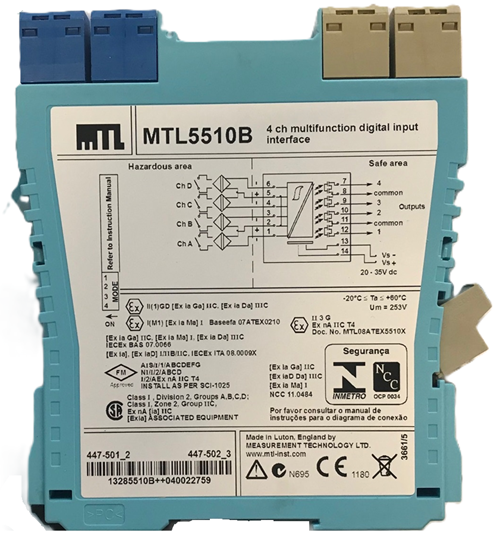
Here's a breakdown of its core principles
- Galvanic Isolation:
- It physically separates the hazardous area circuit from the safe area, preventing sparks or faults from crossing over, eliminating earth loop issues, and simplifying grounding.
- Signal Conversion:
- Input: Detects signals (on/off, proximity) from sensors in the hazardous zone.
- Processing: Internally converts these signals through its electronics.
- Output: Provides up to four independent, floating solid-state outputs (like transistors) that can switch positive or negative polarity signals for the safe area.
- Configurable Modes:
- Uses internal selector switches to set modes, allowing it to function as a standard digital input, or in modes like pulse output for counting, or start/stop functions.
-
- Line Fault Detection (LFD):
- Monitors for open-circuit (o/c) or short-circuit (s/c) conditions on the hazardous area loops, indicated by a flashing LED, providing diagnostic information.
- Installation & Mounting:
- It's DIN-rail mountable and uses plug-in connectors for quick, error-free wiring, connecting to a power bus for efficient distribution in the control panel.
In essence, the MTL5510B acts as a reliable, isolated bridge, taking simple switch/sensor data from dangerous areas and presenting it as clean, reliable digital signals to the safe-area controller, all while keeping circuits safely separated.
The MTL5510B is a 4-channel, multifunction intrinsically safe (IS) galvanic isolator that acts as an interface between devices in a hazardous area and control equipment in a safe area. Its working principle is based on providing isolation and limiting energy to prevent explosions in potentially explosive atmospheres.
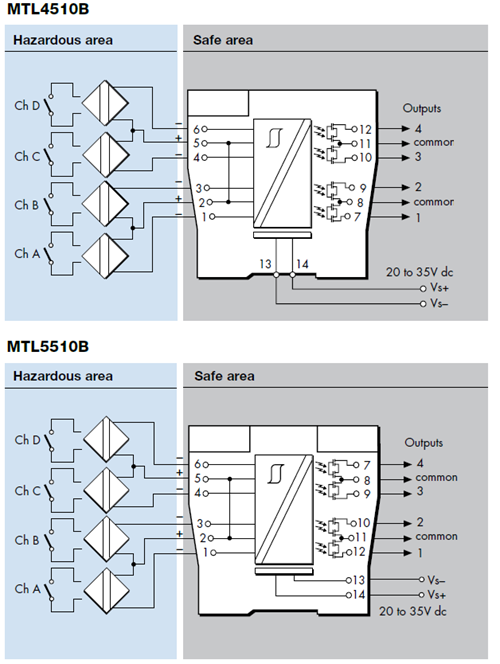
| SWITCH/ PROXIMITY DETECTOR INTERFACE - (4-channel, multi-function, digital input) |
 |
Working Principle
The primary function of the MTL5510B is to ensure that no amount of electrical energy (voltage or current) that could potentially ignite a flammable atmosphere is allowed to pass from the safe area to the hazardous area.
- Galvanic Isolation: The core principle is galvanic isolation, typically achieved using transformers or optical isolators within the module. This physically and electrically separates the input (hazardous area) and output (safe area) circuits. This separation means that earth loops are avoided and a high-integrity earth connection is not required, simplifying installation.
- Energy Limiting: The unit is designed to strictly limit the voltage (Uo) and current (Io) that can be delivered to the hazardous area under both normal and fault conditions. This prevents sparks or hot surfaces that could cause ignition.
- Signal Conversion and Control:
- Input: The module receives signals from switches or NAMUR proximity detectors located in the hazardous area.
- Output: It then controls up to four floating solid-state outputs in the safe area, which are compatible with logic circuits.
- Signal Characteristics:
- The unit applies a specific voltage (7 to 9V dc from a 1kΩ resistor) to the sensor in the hazardous area.
- It uses current levels to determine the input state: an input current above 2.1mA is considered "ON" (output closed), while a current below 1.2mA is "OFF" (output open).
- Line Fault Detection (LFD): The MTL5510B includes user-selectable line fault detection (LFD). If selected, the module continuously monitors the input circuit for open or short circuits.
- An open circuit is detected if the current is very low (< 50µA).
- A short circuit is detected if the resistance is very low (< 100Ω).
- Upon detecting a fault, the output switches to its OFF state, and a red LFD indicator lights up (the corresponding channel's yellow LED flashes).
In essence, the MTL5510B functions as a robust, safe gateway, replicating the status of hazardous-area switches or detectors in the safe area while ensuring that the hazardous area remains intrinsically safe, even in the event of a fault in the safe-area wiring or the unit itself.
For detailed technical specifications and configuration options, you can refer to the official MTL5510B datasheet from Eaton.
 Full Datasheet Full Datasheet
|