|
VFD (Variable Frequency Drive)
A VFD Motor Manager controls electric motor speed by converting fixed AC power to adjustable frequency/voltage, using three stages: Rectification (AC to DC), a DC Bus (smoothing/storing), and Inversion (DC to variable frequency/voltage AC via IGBTs and Pulse Width Modulation (PWM), allowing precise speed/torque control, smoother starts, and energy savings by matching power to load requirements.
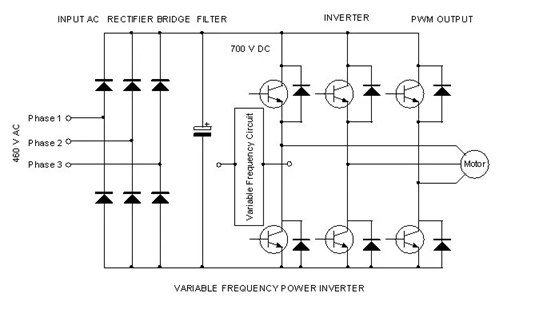
Here's a breakdown of the working principle
- Rectification (AC to DC)
- Incoming fixed-frequency, fixed-voltage AC power is fed into the VFD.
- A rectifier (diode bridge) converts this AC power into fluctuating DC power.
- DC Bus (Filtering & Storage)
- Capacitors in the DC bus smooth out the ripple from the rectified DC, creating a stable DC voltage.
- This acts as a reservoir of DC power for the next stage.
- Inversion (DC to Variable AC)
- The inverter section uses high-speed switches (IGBTs) to rapidly turn the DC power on and off.
- Pulse Width Modulation (PWM) rapidly changes the width of these pulses, creating a simulated, three-phase AC waveform with adjustable frequency and voltage.
- Motor Control
- By changing the PWM pulse timing, the VFD alters the output frequency, directly controlling the motor's speed (higher frequency = faster speed).
- The voltage is usually adjusted proportionally to the frequency (V/Hz control) to maintain constant torque for many applications.
Key Benefits
- Energy Savings: Runs motors only as fast as needed, reducing power consumption.
- Smooth Starts/Stops: Eliminates harsh jolts, reducing mechanical stress and wear.
- Precise Control: Offers accurate speed and torque adjustments for various industrial processes
A Variable Frequency Drive (VFD), also commonly known as a motor manager or motor controller, works by converting fixed-frequency utility power into variable-frequency and variable-voltage output to precisely control an AC motor's speed and torque.
Core Working Principle: The Three-Stage Journey
The VFD operates through three primary power conversion stages managed by a central microprocessor.
- Rectification (AC to DC): The VFD takes incoming AC power from the grid and passes it through a rectifier (typically a six-pulse diode bridge). This converts the alternating current into a pulsating direct current (DC).
- DC Bus (Smoothing): The raw DC power flows into a "DC Link" or bus where a bank of capacitors acts as a reservoir to filter out ripples and fluctuations. This creates a clean, stable DC voltage ready for the next stage.
- Inversion (DC to variable AC): Using high-speed semiconductor switches called IGBTs (Insulated Gate Bipolar Transistors), the VFD "chops" the smooth DC into a series of precisely timed pulses. This technique, called Pulse Width Modulation (PWM), reconstructs a simulated AC waveform at the specific frequency and voltage required by the load.
Key Control Parameters
To manage the motor effectively, the VFD maintains specific relationships between electrical signals:
- V/Hz Ratio (Volts per Hertz): To maintain constant motor torque, the VFD proportionally adjusts voltage alongside frequency. If the frequency is halved to slow the motor, the voltage is also reduced to prevent the motor from overheating or losing torque.
- Speed Formula: The motor's speed (N) is directly controlled by the output frequency (f) according to the formula N=(120 x f) / Poles.
Integrated Management Features
Modern VFD "Motor Managers" do more than just change speed; they provide comprehensive system protection and optimization:
- Soft Start/Stop: Gradually ramps motor speed up or down to eliminate mechanical shock and reduce high inrush currents.
- Protection Suite: Built-in safeguards monitor for overcurrent, overvoltage, ground faults, and overtemperature, often logging these events with timestamps for maintenance.
- Advanced Control Algorithms: Higher-end drives use Vector Control or Direct Torque Control (DTC) for extreme precision in demanding applications like cranes or elevators.
- Digital Connectivity: They often integrate with SCADA or PLC systems via protocols like Modbus or Ethernet for real-time remote monitoring.
How it works in three Step AC - DC- AC
- Rectification: The VFD takes incoming AC power (like 60Hz) and converts it to DC using a rectifier.
- Filtering: Capacitors smooth the pulsating DC output into a stable DC bus.
- Inversion: IGBTs rapidly switch the DC power, creating a new, simulated AC waveform with adjustable frequency and voltage, which then powers the moto
Key benefits
- Energy Savings: Reduces power consumption by slowing motors when full speed isn't needed, potentially cutting energy costs by up to 70%.
- Process Optimization: Provides precise control for tasks like conveyor belts, fans, and pumps.
- Extended Equipment Life: Soft starts reduce mechanical stress, and precise control lowers wear and tear.
- Improved Product Quality: Consistent speed leads to more uniform output
Also known as
- AC Drive, Adjustable Speed Drive (ASD), Variable Speed Drive (VSD)
- Frequency Inverter, AC Inverter
- Microdrive, Variable Frequency Inverter (VFI)
Common applications
- HVAC systems (fans, compressors)
- Pumps (water, chemical)
- Conveyors and material handling
- Manufacturing machinery
|