|
Phase Failure/Sequence Relays
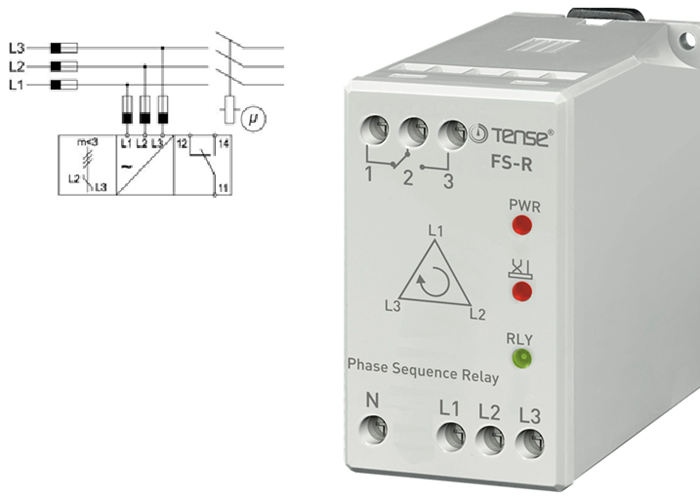
A Phase Sequence Relay (PSR) is a critical protective device for three-phase electrical systems, ensuring correct phase order (like R-Y-B) to prevent damage, reverse rotation, or malfunction in motors and industrial equipment, by monitoring phase sequence, failure, and imbalance and tripping the circuit if faults occur, protecting expensive machinery
How it works
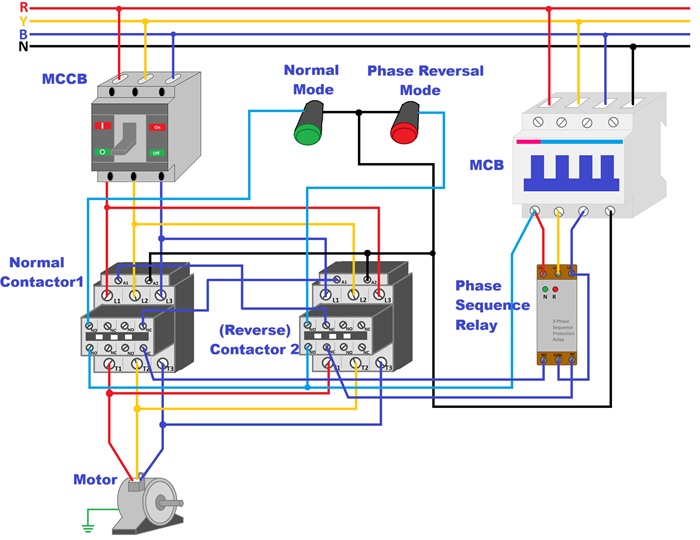
- Monitors supply: The relay connects to the three incoming phases (L1, L2, L3) and continuously checks their voltage, balance, and sequence.
- Normal operation: If the sequence is correct (e.g., L1-L2-L3) and voltages are balanced, its internal contacts close (NO/NC), allowing power to the connected load (motor, pump).
- Fault detection: If phases are reversed (wrong sequence), a phase fails (loss of voltage), or voltage becomes unbalanced, the relay detects the anomaly.
- Trips circuit: Upon fault detection, the relay opens its contacts, cutting power to the equipment to prevent damage, such as a motor running backward or overheating.
Key functions
- Phase Sequence Protection: Prevents motors from rotating in the wrong direction.
- Phase Failure Protection: Detects loss of one or more phases (single-phasing).
- Voltage Imbalance/Asymmetry: Protects against uneven voltage distribution between phases.
- Over/Under Voltage: Some advanced models also monitor for voltage levels outside set limits.
Applications
Elevators, escalators, conveyors, pumps, compressors, generators, and other critical industrial machinery.
A Phase Sequence Relay (also known as a phase monitoring or phase failure relay) is a protective electronic device used in three-phase electrical systems to ensure equipment operates only when the supply phases are in the correct order.
Core Functions
- Phase Sequence Detection: Ensures phases follow the correct order (e.g., L1-L2-L3). If two phases are swapped (reversal), the relay prevents the system from starting, which is critical for motors that would otherwise rotate backward and cause mechanical damage.
- Phase Loss Protection: Detects if one or more phases go missing (single-phasing). Running a three-phase motor on only two phases causes it to draw excessive current, leading to overheating and burnt windings.
- Phase Imbalance Monitoring: Monitors for voltage unbalance between phases. An imbalance exceeding 5% can significantly reduce a motor's life span and efficiency.
Working Principle
- Monitoring: The relay is connected to the three-phase lines (L1, L2, L3) and continuously measures the voltage and phase angles.
- Validation: If the sequence is correct and all phases are within voltage tolerances, the internal relay energizes (closes its contacts) to allow the main contactor to power the load.
- Tripping: If a fault (reversal, loss, or imbalance) is detected, the relay de-energizes and opens its contacts, immediately disconnecting the control circuit and stopping the motor.
Key Specifications & Features
- Voltage Range: Typically supports standard industrial ranges such as 208V to 480V AC.
- Output: Most use an SPDT (Single Pole Double Throw) relay output.
- Indicators: Integrated LEDs (green for power, yellow/red for fault) provide visual status of the supply.
- Mounting: Most modern units are designed for standard DIN rail mounting in electrical panels.
Common Applications
- HVAC Systems: Protects compressors and fans from reverse rotation.
- Elevators and Escalators: Essential for safety to ensure motors move in the commanded direction.
- Pumps & Conveyors: Prevents mechanical damage caused by reversed flow or movement.
- Industrial Generators: Monitors power quality before transferring loads.
|