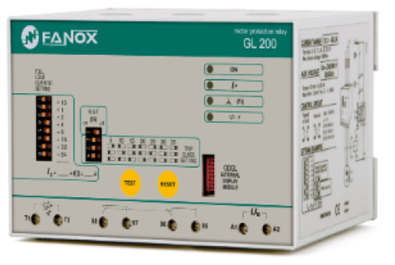
Motor and generator relays work on electromagnetic induction, using a low-power signal to control high-power circuits by creating a magnetic field in a coil that moves an armature, physically opening or closing contacts to switch the connected motor or generator circuit, often for protection (like against faults) or control. The basic principle involves energizing a coil, generating magnetism to pull an armature, changing contact states (like tripping a breaker), and then de-energizing to reset, often with a spring.
Working Principle (Electromagnetic Relay)
This video provides a detailed animation of how an electromagnetic relay works:
Sensing Input: The relay receives a signal (current/voltage) from the motor/generator's circuit, often indicating an abnormal condition like an overcurrent or fault.
Coil Energization: This input current flows through a coil wrapped around an iron core, turning it into an electromagnet.
Magnetic Force: The magnetic field attracts a movable iron piece called an armature.
Contact Switching: The armature's movement physically pushes or pulls electrical contacts, either closing normally open (NO) contacts or opening normally closed (NC) contacts.
Circuit Interruption/Completion: This action either completes a control circuit or, more commonly in protection, interrupts the main power circuit to the motor or generator.
Reset: When the fault clears and power to the coil is removed, a spring pulls the armature back to its original position, resetting the contacts.
Key Components
Coil: Wire wound around a core; creates the magnetic field.
Iron Core: Concentrates the magnetic field.
Armature: A movable iron plate attracted by the electromagnet.
Contacts: The actual switch points (NO, NC, Common).
Spring: Returns the armature to its rest position.
You can see the key components of a relay in this diagram:
Application in Motors & Generators
Protection Relays: Detect overcurrent, under-voltage, phase imbalance, or ground faults and trip circuit breakers to protect expensive equipment.
Control Relays: Allow a low-power signal (e.g., from a sensor) to switch the high-power contacts that start or stop a motor.
Differential Relays: Compare currents entering and leaving a machine to detect internal faults, as described by Schneider Electric.
Motor and generator relays operate primarily on the principles of electromagnetic induction and current balancing to control or protect high-power machinery using low-power signals.
General Motor Relay Principles
Relays in motor systems serve two main roles: starting the motor and protecting it during operation.
Motor Starting (Electromagnetic Attraction): A small control current (e.g., from an ignition switch) energizes a copper coil around an iron core. This creates a magnetic field that pulls a movable armature, closing high-current contacts to connect the battery directly to the starter motor.
Overload Protection (Thermal Principle): Thermal relays use a bimetallic strip made of two metals with different expansion rates. If the motor draws excessive current, the resulting heat causes the strip to bend, mechanically opening the circuit and stopping the motor to prevent burnout.
Generator Relay Principles
Generator relays are primarily "protective" and often operate on more complex differential logic to detect internal faults.
Differential Protection (Current Balancing): This is the core principle for protecting generator stator windings. The relay compares the current entering the generator with the current leaving it. Under normal conditions, these currents are equal. If a difference is detected (e.g., due to an internal short circuit), the relay immediately trips the circuit breaker to isolate the generator.
Reverse Power Protection: This relay monitors the direction of power flow. If a generator stops producing power (e.g., due to a prime mover failure) and begins drawing power from the grid—effectively acting like a motor—the relay detects this reversal and disconnects it to prevent mechanical damage.
Summary of Core Mechanisms
Type
Operating Principle
Common Use Case
Electromagnetic
Magnetic attraction pulls armature to close contacts.
Motor starting, general switching.
Thermal
Heat from high current bends a bimetallic strip to break the circuit.
Motor overload protection.
Differential
Compares current "In" vs. "Out" to detect internal faults.
Generator stator protection.
Reverse Power
Senses power flow direction to prevent "motoring".
Multi-generator grid protection.
Have a Questions?
+(39) 347 051 5328
Visit Our Company
Italy - Kazakhstan
Working Hours
09.00am to 18.00pm
About
We offer the best and economical solutions, backed by 27+ years of experience and international standards knowledge, echnological changes, and industrial systems.