|
Electromechanical relay
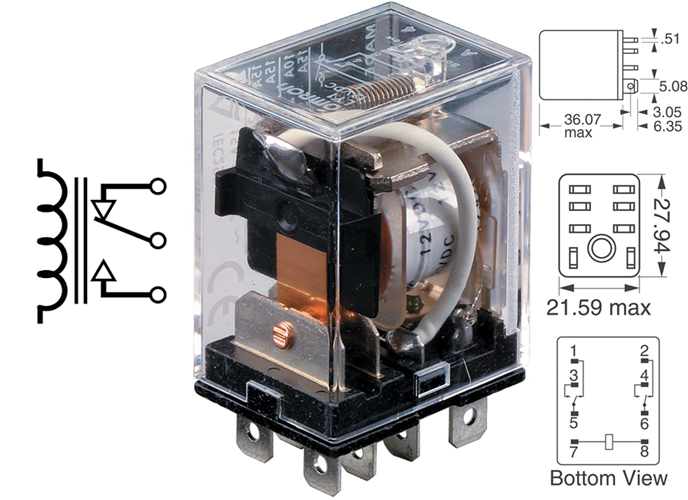
An electromechanical relay operates using an electromagnet to mechanically switch electrical contacts: when a small current energizes the relay's coil, it generates a magnetic field that attracts a movable armature, causing physical contact movement to open or close a separate power circuit. Once the coil is de-energized, a spring returns the armature to its original position, breaking the contact
Core Components
- Electromagnetic Coil: A wire coil that becomes a magnet when current flows through it.
- Armature: A movable metal part attracted by the magnetic field.
- Contacts: Electrical terminals (movable and stationary) that open or close circuits.
- Spring: Returns the armature to its resting position when the coil is de-energized.
Working Principle in Steps
- Input Signal: A low-power control voltage is applied to the relay's input terminals, passing through the coil.
- Magnetic Field Generation: Current in the coil creates a magnetic field, effectively turning the coil into an electromagnet.
- Armature Attraction: The magnetic field attracts the armature, pulling it towards the coil.
- Contact Switching: The armature's movement physically moves the electrical contacts, either closing a Normally Open (NO) circuit or opening a Normally Closed (NC) circuit, controlling the load.
- Reset: When the control signal is removed, the magnetic field collapses, and
Electromechanical relays (EMRs) operate as electrically controlled mechanical switches, using electromagnetic induction to physically open or close electrical contacts. This mechanism allows a low-power control signal to manage high-power load circuits safely by providing galvanic isolation between the two.
Core Components
- Coil: A wire wound around a ferromagnetic core that becomes an electromagnet when current passes through it.
- Armature: A movable iron lever that is physically attracted to the energized coil.
- Contacts: Metal points that make (close) or break (open) the load circuit. These are typically arranged as Normally Open (NO), Normally Closed (NC), and Common (COM).
- Spring: A reset mechanism that pulls the armature back to its default position when the coil is de-energized.
4-Step Working Sequence
- Coil Energization: A low-power electrical signal flows through the relay's coil, creating a magnetic field around the core.
- Armature Attraction: This magnetic field generates a force that pulls the movable armature toward the coil.
- Contact Switching: The movement of the armature physically pushes the contacts, changing their state—closing NO contacts and opening NC contacts.
- De-energization & Reset: When the control signal is removed, the magnetic field collapses. The internal spring then pulls the armature back to its resting position, returning the contacts to their original state.
Key Specifications for 2026
| Specification |
Description |
| Pull-in / Set Voltage |
The minimum voltage required to activate the relay. |
| Drop-out Voltage |
The voltage level below which the armature returns to its resting state. |
| Switching Speed |
Typically 5–15 milliseconds; mechanical inertia limits this speed compared to solid-state alternatives. |
| Operational Life |
Generally rated for 100,000 to 10 million operations, limited by mechanical wear and contact arcing. |
Comparison to Alternatives
Unlike Solid State Relays (SSRs), which use semiconductors (like MOSFETs) to switch current without moving parts, electromechanical relays are preferred for their complete electrical isolation, ability to handle high inrush currents, and lack of leakage current when open. For highly sensitive or fast-switching applications in 2026, SSRs are often chosen, while EMRs remain the standard for robust, high-voltage industrial protection.
|




