|
Solid-State/Digital Relays
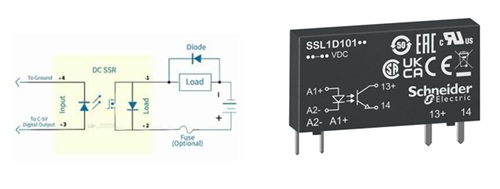
Solid-State Relays (SSRs) work by using a low-power input signal to activate an internal light source (like an LED) which triggers a photosensitive component, isolating the control circuit from the load circuit; this component then acts as a silent, fast-switching semiconductor (like a MOSFET or Triac) to switch high power to the load, offering durability, speed, and no moving parts, unlike traditional mechanical relays.
Working Principle Breakdown
- Input Signal: A low-voltage DC or AC signal is applied to the input terminals.
- Opto-Isolation (The "Messenger"):
- This input signal energizes an internal Light Emitting Diode (LED).
- The light from the LED crosses a gap to a photosensitive device (photodiode, phototransistor, or photo-Darlington), providing electrical isolation between the input and output.
- Output Switching (The "Worker"):
- The photosensitive device, activated by the light, turns on a power semiconductor (like a MOSFET for DC, or a Triac/SCR for AC).
- This semiconductor then allows current to flow to the connected load.
- Deactivation: When the input signal is removed, the LED turns off, the photosensitive part deactivates, and the output semiconductor switches off, cutting power to the load
Key Features & Types
- No Moving Parts: Replaces mechanical contacts with semiconductors, leading to silent operation, long life, and high shock resistance.
- Zero-Crossing/Random Turn-On: AC SSRs can synchronize switching to the AC waveform's zero-voltage point (reducing noise/spikes for resistive loads) or switch instantly (for motor control/phase angle control).
- Faster Switching: Allows for high-frequency cycling, ideal for precise temperature control.
- Load Types: Uses different semiconductors (MOSFET for DC, SCR/Triac for AC) to match the load requirements, making them versatile
Solid-State Relays (SSRs) and Digital/Numerical Relays operate on different principles suited to their respective roles in power switching and system protection.
- Solid-State Relays (SSR)
A Solid-State Relay is an electronic switching device that controls a high-power load using a low-power control signal without any moving parts. Its working principle is based on optical or magnetic coupling to achieve electrical isolation.
- Input Stage: A small control voltage (typically 3–32V DC) is applied to the input terminals. This energizes an internal Light Emitting Diode (LED) or an infrared diode.
- Isolation Barrier: The LED emits light across a physical gap to a photosensitive device (like a phototransistor or photodiode). This "opto-isolation" ensures that the control circuit is electrically separated from the high-voltage load circuit, preventing damage from power surges.
- Output Switching: The photosensitive device triggers a power semiconductor switch. The specific component depends on the load type:
- AC Loads: Use TRIACs or SCRs (Silicon Controlled Rectifiers).
- DC Loads: Use MOSFETs or IGBTs.
- Deactivation: When the control signal is removed, the LED turns off, the photosensor stops conducting, and the power semiconductor returns to its non-conducting state, disconnecting the load.
- Digital/Numerical Relays
Digital or Numerical Relays are microprocessor-based devices used for power system protection and monitoring rather than simple on/off switching.
- Sampling: They continuously sample analog signals (current and voltage) from the power line through instrument transformers.
- A/D Conversion: These analog signals are converted into digital data using an Analog-to-Digital Converter (ADC).
- Algorithmic Analysis: A microprocessor or Digital Signal Processor (DSP) applies mathematical algorithms to this data to detect faults (e.g., overcurrent, earth fault).
- Decision: If a fault is detected, the relay executes a pre-programmed logic to send a trip signal to a circuit breaker, often providing communication and fault recording as well.
Comparison Summary for 2026
| Feature |
Solid-State Relay (SSR) |
Digital/Numerical Relay |
| Primary Goal |
Switch high-power loads |
Protect power systems |
| Core Technology |
Optoisolators & Power Semiconductors |
Microprocessors & A/D Converters |
| Moving Parts |
None (Static) |
None (Static) |
| Operation |
Direct response to control signal |
Analytical decision based on data |
ds
|