|
Thermal relays protection
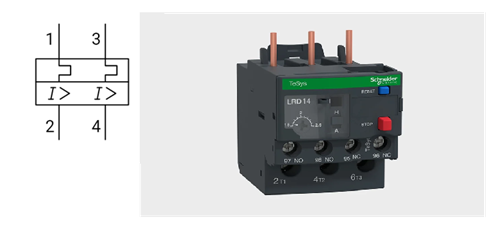
Thermal relays protect equipment from overheating by using a bimetallic strip that bends when heated by excessive current, triggering a trip mechanism to open contacts and cut power; the principle relies on two metals with different expansion rates bending the strip unevenly as current flows through its heating coil, with slower response times than magnetic relays but offering reliable overload protection for motors and circuits
Working Principle
- Heat Generation: When current flows through the relay's heating coil (often around the bimetallic strip), heat is produced, proportional to the current and time (Joule's Law).
- Thermal Expansion: The bimetallic strip, made of two metals with different coefficients of thermal expansion, heats up.
- Bending Action: The metal with the higher expansion rate expands more, causing the strip to bend towards the other metal.
- Trip Mechanism: This bending pushes a lever or shifter, which opens the relay's normally closed (NC) contacts and closes the normally open (NO) contacts.
- Power Interruption: The opening of the NC contacts breaks the control circuit, de-energizing the contactor and disconnecting power to the protected equipment (like a motor).
- Reset: After cooling down (either automatically or manually via a reset button), the strip returns to its original position, allowing the circuit to be re-energized.
Key Features & Purpose
- Protection: Primarily guards against overloads and prolonged overheating, not sudden short circuits.
- Application: Commonly used in motor control circuits with contactors.
- Response: Slower than magnetic relays, as it depends on sustained heat
Thermal relays are protective devices primarily used to safeguard electric motors and other electrical equipment from damage due to prolonged overloads
Core Working Principle
The fundamental principle of a thermal relay is the thermal expansion of metals. It utilizes the heat generated by electrical current to actuate a mechanical switching mechanism.
- Heat Generation: As current flows through the relay’s heating element (connected in series with the load), it generates heat proportional to the square of the current (I2 R).
- Bimetallic Strip Deformation: The relay contains a bimetallic strip made of two dissimilar metals with different coefficients of thermal expansion. When heated, one metal expands more than the other, causing the strip to bend.
- Tripping Mechanism: Under normal conditions, the current-induced heat is insufficient to cause significant bending. However, during a sustained overload, the strip bends far enough to push a lever or trip slide.
- Circuit Interruption: This mechanical movement forces the relay's normally closed (NC) contacts to open and its normally open (NO) contacts to close. This interrupts the power supply to the motor (usually by de-energizing a contactor coil) and may trigger an alarm.
Key Characteristics
- Time-Delayed Action: Unlike fuses or magnetic circuit breakers that react instantly to short circuits, thermal relays have an inherent time delay. This allows motors to draw a high "inrush" current during startup without tripping the circuit unnecessarily.
- Ambient Temperature Compensation: Many relays include a second bimetallic strip to offset changes in the surrounding environment's temperature, ensuring the device only trips based on the motor's actual load.
- Reset Function: Once the bimetallic strip cools down and returns to its original shape, the relay can be reset either manually (requiring an operator to press a button) or automatically.
Comparison of Thermal Relay Mechanisms
| Type |
Mechanism |
Key Advantage |
| Bimetallic |
Two dissimilar metals bend when heated. |
Simple, low-cost, and standard for motors. |
| Electronic |
Uses current transformers and microprocessors. |
Highly precise; no moving parts to wear out. |
| Melting Alloy |
Heat melts a solder (eutectic alloy) to release a ratchet. |
High resistance to shock and vibration. |
.
|