|
Monitoring Relays
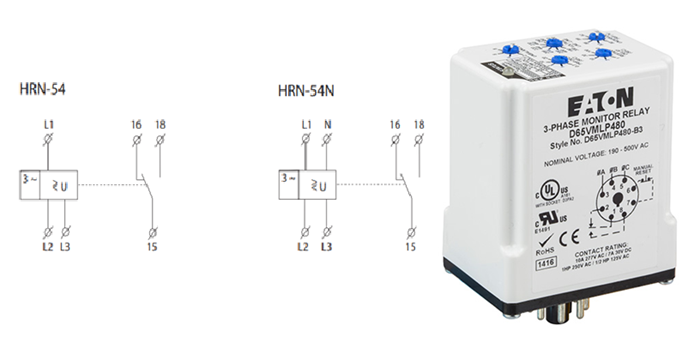
Monitoring relays work by continuously sensing an electrical parameter (like voltage or current) against user-set thresholds, and if a deviation occurs, they trigger a timed response, like opening contacts to shut down equipment, to prevent damage, using internal comparators and output switches to protect systems from over/under-voltage, current, phase loss, or sequence issues.
Core Working Principle
- Sensing: The relay connects to the electrical circuit and constantly measures the input parameter (e.g., voltage, current, temperature).
- Comparison: An internal circuit compares the real-time reading to user-defined upper and lower limits (thresholds).
- Time Delay (Optional): To prevent false trips from minor fluctuations, a set time delay is initiated if the value goes out of range.
- Output Action: If the fault persists past the delay, the relay changes the state of its internal output contacts.
- Protection: This contact change signals a connected device (like a circuit breaker) to disconnect the load, sound an alarm, or shut down the machine, preventing damage.
- Reset: Once the parameter returns to normal, the relay either automatically resets or requires manual intervention, depending on its setting.
Key Parameters Monitored
- Voltage: Detects over-voltage, under-voltage, or voltage loss.
- Current: Protects against overload (overcurrent) or undercurrent conditions.
- Phase: Monitors three-phase systems for phase loss, phase imbalance, or incorrect phase sequence (e.g., in elevators).
Example: Voltage Monitoring Relay
When voltage drops below the set minimum (e.g., due to a blown fuse), the relay detects the deviation, starts its timer, and after the delay, trips its contacts to stop the connected motor from running inefficiently or burning out, protecting it from damage.
Monitoring relays are automated sensing devices that continuously supervise electrical parameters—such as voltage, current, or phase—and trigger a response when conditions deviate from preset safe limits
Core Working Principle AI
The fundamental operation of a monitoring relay follows a four-step process:
- Sensing: An internal sensing circuit, often connected directly to the electrical line, measures real-time input values.
- Comparison: The relay compares these live measurements against user-defined thresholds (minimum/maximum limits) set via digital displays or potentiometers.
- Time Delay: If a value falls outside the set window, the relay initiates a trip delay. This prevents "nuisance tripping" caused by momentary fluctuations like motor start-up surges.
- Action: If the fault persists beyond the delay, the internal output contacts change state (e.g., opening a circuit to cut power or closing it to trigger an alarm).
Key Monitoring Types
Relays are categorized by the specific parameter they supervise:
- Voltage Relays: Detect overvoltage (spikes) or undervoltage (brownouts) to prevent sensitive electronic damage or motor burnout.
- Phase Relays: Critical for 3-phase systems; they monitor for phase loss (missing phase), phase reversal (wrong rotation), and phase imbalance.
- Current Relays: Measure flow to identify overload (excessive load) or underload (e.g., a pump running dry).
- Insulation Relays: Measure resistance between live conductors and earth to detect leakage faults and prevent electric shocks or fires.
- Temperature Relays: Use sensors like PTC resistors to monitor motor or transformer windings, protecting against thermal overload.
Advanced Features (2026 Standards)
Modern monitoring relays incorporate digital "smart" features for Industry 4.0 applications:
- Digital Interfaces: High-contrast OLED screens provide real-time diagnostic data and fault history logs.
- Hysteresis: A built-in "release" value that prevents the relay from rapidly toggling on and off when a parameter fluctuates right at the threshold limit.
- IIoT Integration: Many 2026-era relays support communication protocols like Modbus TCP or EtherNet/IP, enabling remote monitoring, predictive maintenance, and data exchange with SCADA systems.
.
|




