|
Regulating Relays
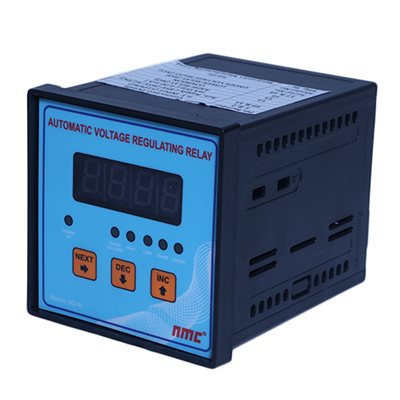
Regulating relays use a low-power control signal to operate an electromagnetic switch, allowing a small current to control a larger one by energizing a coil, creating a magnetic field that pulls an armature to open or close contacts in a separate, higher-power circuit, providing isolation and automatic switching for devices like voltage stabilizers or protection systems. The core principle is electromagnetic induction, where current creates magnetism, but "regulating" relays specifically adapt this for voltage control by sensing deviations and switching taps or windings to maintain a stable output.
Electromechanical Relay Principle (General)
- Input Signal: A small current flows into the relay's control circuit, energizing a coil.
- Electromagnetism: The current creates a magnetic field, attracting a metal armature.
- Switching Action: The armature's movement physically opens or closes contacts in the load circuit (the secondary circuit).
- De-energizing: When the control signal stops, the magnetic field collapses, and a spring returns the armature and contacts to their original state.
How it Applies to "Regulating"
- Voltage Sensing: In a regulating relay (like in a voltage stabilizer), internal circuitry monitors the input voltage.
- Tap Switching: When voltage fluctuates outside a set range, the relay activates to switch between different windings (taps) on a transformer, adding or removing turns to adjust the output voltage to a stable level.
- Automatic Adjustment: This allows for automatic voltage regulation, providing safety and stable power to connected equipment.
Key Concepts
- Isolation: Separates the low-power control circuit from the high-power load circuit, protecting sensitive components.
- Amplification: A small control signal controls a much larger load current.
- Types: While electromechanical relays use moving parts, Solid-State Relays (SSRs) use semiconductor components for faster, contact-free switching, often employing opto-coupling for isolation.
A regulating relay is a specialized protective relay that operates when a specific electrical parameter (such as voltage or current) deviates from predetermined limits. Unlike simple on/off switches, it acts to maintain a system parameter within a safe or functional "window".
Core Working Principle
The working principle varies based on the relay's technology:
- Detection of Deviations: The relay continuously monitors an input parameter. If this parameter exceeds or falls below a "set point," the relay initiates a control action.
- Electromagnetic Type:
- Sensing: Current or voltage flows through a coil, creating a magnetic field proportional to the signal strength.
- Actuation: If the signal is too high or low, the magnetic force overcomes a spring's tension, pulling an armature to change the state of electrical contacts.
- Regulation: These contacts trigger external devices—such as tap-changing transformers—to "boost" or "lower" the voltage back to the target range.
Solid-State (Electronic) Type: Uses semiconductors (like thyristors or triacs) to monitor and switch without moving parts. Microprocessors analyze the input data and trigger the semiconductor switch immediately when a deviation occurs.
Key Applications
- Voltage Stabilizers: Used in automatic voltage regulators to switch transformer taps, ensuring a balanced output despite input fluctuations.
- Liquid Level Control: Monitoring relays (often categorized with regulating functions) activate pumps to maintain specific fluid levels in tanks.
- Temperature Regulation: Thermal relays respond to heat changes, often used to prevent motor overheating by tripping the circuit when temperature limits are exceeded.
Comparison of Regulating vs. Protective Relays
| Feature |
Regulating Relay |
Protective Relay |
| Primary Goal |
Maintains a parameter within a range (e.g., stable voltage). |
Detects faults to isolate equipment and prevent damage. |
| Action |
Triggers small adjustments (like tap changes). |
Trips circuit breakers to shut down the system. |
| Example |
Automatic voltage regulator. |
Overcurrent or earth fault relay. |
|




