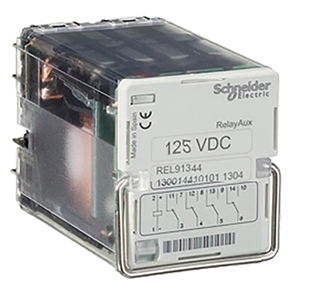
Auxiliary relays work by using a small electrical signal to control multiple circuits, acting as "helpers" for main protective relays by multiplying contacts, amplifying signals, and managing complex logic in electrical systems, often to initiate trips, provide interlocking, or lock out breakers after a fault, using an electromagnetic coil to switch contacts (like trip or lockout) when energized. Their principle involves a coil-driven mechanical action that translates one input into several outputs, essential for expanding control capabilities beyond what a primary relay offers
This video explains the basic concept of how an auxiliary relay works and its wiring:
Working Principle: Electromagnetic Action
Input Signal: A low-power signal from a protective relay (e.g., overcurrent, voltage anomaly) energizes the auxiliary relay's coil.
Coil Energization: Current flowing through the coil creates a magnetic field.
Mechanical Movement: This magnetic field attracts an armature, causing it to move.
Contact Switching: The armature movement opens or closes internal contacts, which can then control other circuits, such as tripping a circuit breaker or activating alarms.
Key Functions & Types
Contact Multiplication: Provides many contacts from a single input, allowing one protective relay to manage several devices (e.g., breaker trip coils, alarms, indicators).
Signal Amplification: Converts a weak signal into a stronger one for downstream operations.
Trip Relays (e.g., RXMS): Initiate the breaker opening upon receiving a trip signal, often high-speed.
Lockout Relays (e.g., RSMD): Latch (lock) the circuit in a tripped state after a fault, preventing immediate reclosing until manually reset, ensuring safety.
Role in Power Systems
Support Primary Relays: Digital protective relays often lack sufficient contacts, so auxiliary relays provide the necessary I/O for complex schemes.
Complex Control: Enable interlocking, blocking, and sequence control for substation automation.
Enhanced Reliability: Improve the security and reliability of protection systems by managing multiple operations from one fault detection
An auxiliary relay is an electromechanical or solid-state device used to supplement a primary protective or control relay . Its core function is to expand the reach and capability of a single control signal, often referred to as "slave" behavior following a "master" device.
Core Working Principle
Most auxiliary relays operate on the attracted armature principle:
Energization: When a low-power signal from a primary device (like a digital protection relay) flows through the auxiliary relay’s coil, it generates an electromagnetic field.
Magnetic Attraction: This field attracts a movable iron armature toward the coil.
Contact Actuation: The armature's movement physically shifts multiple sets of attached contacts (Normally Open or Normally Closed).
Signal Multiplication: This single input can simultaneously trigger multiple high-power or independent circuits, such as opening a circuit breaker, sounding an alarm, and signaling a SCADA system.
Key Functional Types
Instantaneous Trip Relays: Operate without delay for emergency signals or alarm activation.
Lockout Relays (ANSI Code 86): A specialized type that "latches" once triggered. It remains in its tripped state until manually or electrically reset, preventing equipment from being re-energized until a fault is investigated.
Time-Delay Relays: Introduce a deliberate lag (on-delay or off-delay) to allow for proper sequencing in automation.
Interposing Relays: Act as a buffer or adapter when the voltage or current of a control signal (e.g., from a PLC) differs from the device being controlled.
Why They Are Required
Contact Multiplication: Digital relays often lack enough output contacts for all required interlocking and protection functions.
Galvanic Isolation: They provide physical separation between sensitive control circuits and high-voltage power circuits.
Cost Efficiency: It is cheaper and safer to replace a damaged auxiliary relay than a complex primary digital relay.
Signal Adaptation: They can convert a DC signal into an AC switching action or adapt different voltage levels.
Have a Questions?
+(39) 347 051 5328
Visit Our Company
Italy - Kazakhstan
Working Hours
09.00am to 18.00pm
About
We offer the best and economical solutions, backed by 27+ years of experience and international standards knowledge, echnological changes, and industrial systems.