|
Electromagnetic Interaction
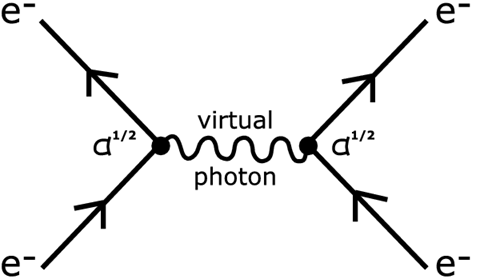
Electromagnetic interaction is one of the four fundamental forces of nature, governing interactions between electrically charged particles via electromagnetic fields and the exchange of massless photons. It is responsible for atomic structure, molecular bonds, electricity, magnetism, and light. This infinite-range force causes attraction between opposite charges and repulsion between similar charges.
Key Aspects of Electromagnetic Interaction
- Fundamental Role: It is the dominant force in daily life, dictating physical and chemical phenomena, including friction, tension, and structural rigidity.
- Components: The interaction combines electrostatic forces (stationary charges) and magnetic forces (moving charges).
- Quantum Mechanism: In Quantum Electrodynamics (QED), the interaction is described by the exchange of virtual photons between charged particles.
- Characteristics: The force has an infinite range but decreases in strength over distance. It is roughly 100 times weaker than the strong nuclear force.
- Unified Theory: Originally thought to be separate, electricity and magnetism were unified by James Clerk Maxwell, showing they are different manifestations of the same force.
- Applications: It is the basis for electric motors and generators, as well as various technologies involving electromagnetic radiation.
Electromagnetic interaction is one of the four fundamental forces of nature, occurring between all particles that possess an electric charge. As of 2026, it remains the dominant force governing the structure and behavior of atoms, molecules, and nearly all phenomena observed in daily life.
Core Principles
- Force Carrier: The interaction is mediated by the exchange of photons, which are massless gauge bosons.
- Dual Nature: It encompasses both electric forces (acting between all charges) and magnetic forces (acting only between charges in relative motion).
- Range and Strength: It has an infinite range, though its strength decreases with the square of the distance (inverse-square law). It is significantly stronger than gravity but roughly 100 times weaker than the strong nuclear force.
- Charge Dynamics: Unlike gravity, which is only attractive, electromagnetic interaction can be attractive (between opposite charges) or repulsive (between like charges).
Scientific Theories
- Classical Electrodynamics: Described by Maxwell's equations, which unify electricity, magnetism, and light into a single field theory.
- Quantum Electrodynamics (QED): The quantum field theory of electromagnetism, providing a microscopic description of how light and matter interact through photon exchange.
- Electroweak Unification: At very high energies, the electromagnetic force merges with the weak nuclear force into a single electroweak interaction.
Key Manifestations
- Atomic Stability: It holds negatively charged electrons in orbit around positively charged nuclei.
- Chemical Bonding: Electric forces allow atoms to combine into molecules, forming the basis of all chemistry and biology.
- Electromagnetic Radiation: Oscillating electric and magnetic fields propagate through space as waves, including radio, microwaves, visible light, X-rays, and gamma rays.
- Macroscopic Forces: Everyday forces like friction, tension, and the "solid" feel of objects (contact force) are primarily results of intermolecular electromagnetic interactions.
|




