|
Droop control enables two parallel generators
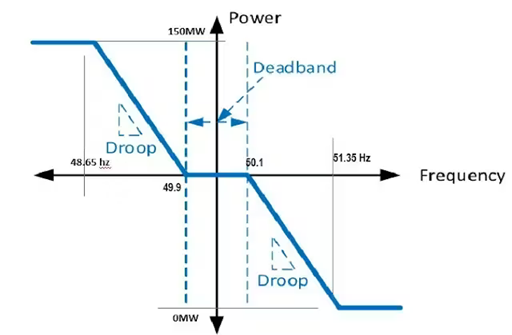
Droop control enables two parallel generators to share active (P) and reactive (Q) loads proportionally by allowing frequency (f) and voltage (V) to decrease slightly as load increases. This method eliminates "hunting" (fighting) between governors, where (f) and (V) are inversely proportional to load. Generators with equal droop settings share load equally; if unequal, the unit with the smaller droop provides a larger share.
Key Aspects of Droop Control Between Two Generators
- Mechanism: It operates by reducing speed/frequency as active power increases (P - f) droop) and reducing voltage as reactive power increases (Q - V) droop).
- Load Sharing: Without communication, generators automatically adjust their output based on their assigned droop curve.
- Parallel Operation: Allows two generators to run in parallel without the governors fighting each other.
- Typical Settings: Often set to 5%, meaning a 100% change in load causes a 5% change in frequency or voltage.
- Application: Commonly used in islanded microgrids and for synchronizing generators in industrial settings.
Droop Control vs. Isochronous Mode
- Droop Control: Frequency decreases with load, allowing for stable, parallel operation.
- Isochronous Mode: Maintains a constant frequency/voltage regardless of load, but can cause unstable, conflicting control when multiple generators are connected.
Droop control is a decentralized strategy used to balance load sharing between two or more parallel generators by allowing their frequency and voltage to decrease slightly as the load increases. It prevents generators from "fighting" each other by enabling them to operate at a common system frequency and voltage without the need for high-speed communication links.
Core Mechanisms
- Formula: f = f* - Kp (P - P*), where (f) is frequency, (P) is active power, and Kp is the droop coefficient.
- Reactive Power / Voltage (Q - V) Droop: To share reactive power, the Automatic Voltage Regulator (AVR) reduces the output voltage as the reactive load increases.
- Formula: (V = V*- Kq (Q - Q*).
How Load Sharing Works Between Two Units
- Synchronization: Once two generators are connected to the same bus, they are physically locked to the same frequency.
- Proportional Sharing: If both generators have the same percentage droop (typically 3–5%), they will share the total load in proportion to their rated capacities.
- Unequal Settings: A generator with a smaller droop value (a flatter curve) is more sensitive and will pick up a larger portion of any new load compared to a unit with a higher droop value.
- Steady State: When the load increases, the system frequency "droops" to a new, lower steady-state point where the total power output from both generators matches the demand.
Droop vs. Isochronous Mode
| Feature |
Droop Mode |
Isochronous (ISO) Mode |
| Frequency |
Decreases as load increases. |
Remains constant regardless of load. |
| Application |
Multiple generators in parallel. |
Typically a single unit or "master" unit. |
| Control |
Independent; no communication needed. |
Often requires Power Management Systems (PMS) for load sharing. |
Key Considerations for 2026
Digital Integration: Modern systems increasingly use digital controllers (e.g., Woodward, DEIF) to automate the transition between droop and isochronous modes during synchronization.
Microgrid Stability: In 2026, droop control remains foundational for microgrids, though enhanced "virtual impedance" or "adaptive droop" methods are now commonly used to improve power sharing accuracy when line resistance is high.
|