Resistor Earthing (NGR/NGR) - Working Principle
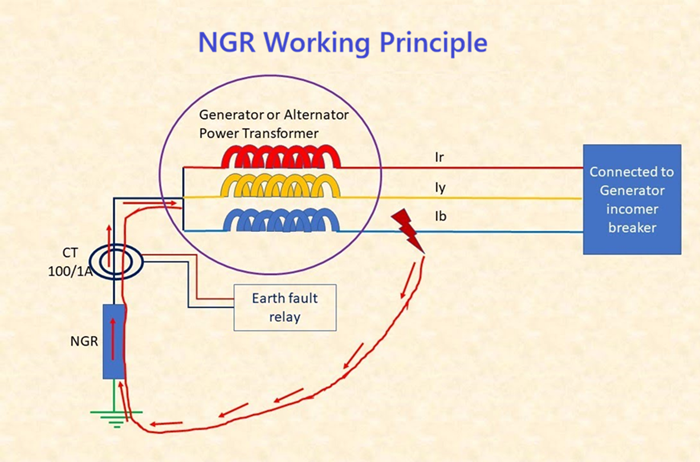
A Neutral Grounding Resistor (NGR) or Neutral Earthing Resistor (NER) protects power systems by limiting ground-fault current to safe, pre-determined levels. Connected between the transformer/generator neutral and ground, it uses resistance to restrict fault current, reducing equipment damage, preventing arc flash, and enabling protective relays to detect faults.
Core Working Principle
- Controlled Current Path: In normal, balanced operation, minimal current flows through the NGR. During a single line-to-ground fault, the NGR creates a deliberate, resistive path for the fault current to return to the source.
- Ohm’s Law Limitation: The resistor limits the fault current (If) based on the phase-to-neutral voltage (VLN) and resistance (R), acting as
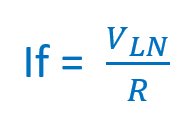
This ensures fault currents are kept well below the levels of solid grounding, protecting sensitive equipment.
- Energy Dissipation: The NGR absorbs and dissipates the generated fault energy as heat, ensuring that thermal stress on electrical components is minimized
Key Benefits
- Reduces Damages: Significantly lowers mechanical and thermal stress on transformers, generators, and cabling.
- Enhanced Safety: Reduces the magnitude of dangerous step and touch voltages.
- System Stability: Allows for continued operation during a fault while maintaining a stable neutral reference point.
Applications
NGRs are essential in medium-voltage and high-voltage systems, particularly in industrial facilities, mining, solar/wind farms, and power generation where limiting ground fault damage is critical.
The Neutral Grounding Resistor (NGR), also known as the Neutral Earthing Resistor (NER), is an electrical component used to limit ground fault current in three-phase power systems (transformers and generators).
Working Principle
The operating principle is based on Ohm's Law (I=V/R):
- Normal Conditions: In a balanced system, no current flows through the NGR because the neutral point of the transformer or generator is at the same potential as ground.
- Ground Fault Condition: If one phase goes to ground (single-phase ground fault), a potential difference is created between the neutral and ground. Without a NGR (solid ground), the fault current would be extremely high, risking destruction of the windings and causing dangerous electrical arcs.
- Resistor Action: The NGR introduces a specific resistance in the path to ground, limiting the fault current to a predetermined value, which is:
- Low enough to prevent immediate thermal and mechanical damage to equipment.
- High enough to be detected by protection relays and isolate the faulty section.
Main Types
| Type |
Typical Fault Current |
Application and Behavior |
| High Resistance (HRG) |
5 – 10 A |
Used where continuity of service is critical. The system can continue to operate temporarily during the first failure while an alarm is triggered. |
| Low Resistance (LRG) |
50 – 1000+ A |
Used in medium/high voltage networks. It allows for the selective and immediate disconnection of the faulty line via switches. |
Key Benefits
- Equipment Protection: Reduces thermal and mechanical stress on transformers and generators.
- Safety: Minimizes the risk of arc flash by limiting the energy released during a fault.
- System Stability: Controls transient overvoltages that may occur in ungrounded systems.
- Fault Location: Facilitates the work of protection relays by pinpointing the exact location of the problem.
Need details on thermal sizing (second ratings) or the difference between NGR and Zig-Zag Transformers for delta systems?
|