|
Offline/Standby UPS working principle
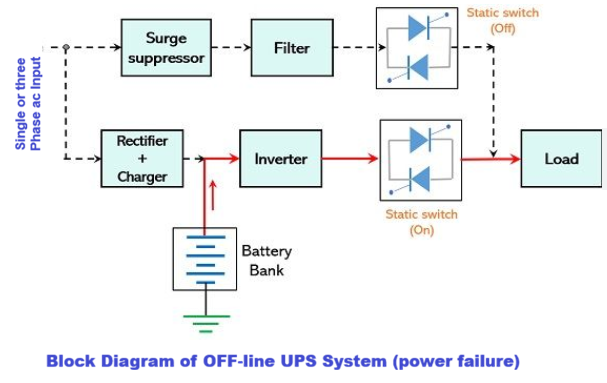
An offline/standby UPS (Uninterruptible Power Supply) works by feeding raw utility power directly to the connected load while charging its battery in the background. If the voltage fails or goes outside safe limits, a transfer switch engages the internal DC-AC inverter to supply battery power within 2-10 milliseconds
Key Operating Principles
- Normal Mode (Standby): The connected load is powered directly from the AC mains (utility power) through a simple filter that provides basic surge protection. The charger operates to keep the internal battery full, but the inverter remains off (or "offline").
- Battery Mode (Backup): When a power failure, sag, or surge exceeds acceptable limits, the control unit detects the issue and activates the transfer switch.
- Transfer Switch: The load is disconnected from the mains and connected to the inverter, which converts DC battery power to AC.
- Transfer Time: The switch occurs within a small, yet noticeable gap of roughly 4–10 milliseconds.
Components
- Transfer Switch: A relay or solid-state switch that toggles between mains power and inverter output.
- Battery Charger: Converts AC to DC to keep the battery charged.
- Inverter: Converts DC from the battery to AC power for the load.
- Battery: Stores energy for use during power outages (see also battery storage capacity here and battery capacity here)
Characteristics
- Efficiency: High efficiency because the main converter is not always running.
- Cost: Lowest cost among UPS types.
- Protection Level: Provides limited, basic protection, making it ideal for non-sensitive, low-power applications like office PCs, network equipment, and home security systems.
- Limitations: The output when on battery is often a simulated sine wave (square wave) rather than a pure sine wave, and the transfer time may cause sensitive equipment to reboot.
An Offline UPS (also known as a Standby UPS) is the most basic and cost-effective type of power protection. Its primary principle is that it remains "passive" or in standby mode during normal operation, only engaging when a power failure is detected.
Working Principle
The operation is divided into two main modes:
- Normal Mode (Line Mode):
- The utility AC power is passed directly from the wall outlet to the connected load via a transfer switch.
- While the load is running on raw mains power, a built-in charger simultaneously converts AC to DC to keep the internal battery topped up.
- The inverter—the component that converts DC back to AC—remains OFF or idle.
- Backup Mode (Battery Mode):
- When the UPS detects that the incoming voltage has failed or dropped below a safe threshold, the Transfer Switch physically disconnects the load from the utility line.
- The Inverter instantly turns on, drawing DC power from the battery and converting it into AC power to keep your devices running.
- This transition typically takes 5 to 10 milliseconds.
Key Characteristics
- Transfer Time: There is a tiny "break" in power (millisecond range) during the switch, which is acceptable for home PCs but may cause sensitive servers to reboot.
- Efficiency: Extremely high (95–99%) during normal operation because the inverter is not drawing power.
- Output Waveform: In battery mode, most offline units produce a stepped or simulated sine wave, which is fine for most electronics but not ideal for specific types of motors or medical equipment.
- Best Use Case: Ideal for home computers, printers, and non-critical office equipment in areas with stable power.
For more advanced needs, brands like Vertiv or Eaton provide detailed guides on comparing these to Line-Interactive or Online models.
Would you like to see a comparison table between Offline, Line-Interactive, and Online UPS systems to help you decide which one fits your specific hardware?
|