Line-Interactive (Mid-range) UPS

Line Interactive UPS

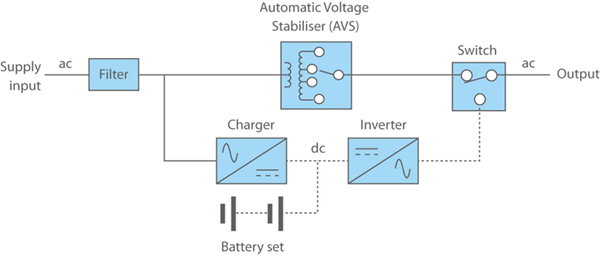
A line-interactive (mid-range) UPS works by utilizing an Automatic Voltage Regulator (AVR) to correct minor voltage sags or surges without switching to battery power, enhancing efficiency and component life. It keeps the inverter/converter connected to the output, allowing for fast transfer (2-6ms) to battery during blackouts while providing continuous, cleaner power compared to offline models.

Key Working Principles

  • Normal Mode (Input Filtering & Regulation): Utility AC power passes through a filter. The Automatic Voltage Regulator (AVR)—often an autotransformer—actively boosts (for low voltage) or reduces (for high voltage) the AC input, maintaining a stable output ±8 -15% without using the battery.
  • Charging Mode: The internal inverter operates in reverse to keep the battery charged while the utility power is active.
  • Battery Mode (Outage): If the input voltage fails or exceeds safe thresholds, a transfer switch opens, and the inverter instantly reverses to convert DC battery power to AC for the load within 2–6 milliseconds.
  • Applications: Ideal for servers, networking equipment, and gaming consoles where better power quality than standby, but not full double-conversion, is needed

Key Components

Line-interactive systems are more economical than online systems and better for fluctuating power environments than basic offline units.
A Line-Interactive UPS is a mid-range power protection system that bridges the gap between basic Standby (Offline) and premium Online (Double-Conversion) systems. It is the most common choice for small businesses, departmental servers, and networking equipment.
Core Working Principle
The fundamental differentiator of this technology is its Automatic Voltage Regulation (AVR) and a bidirectional inverter that is always connected to the output.
  1. Normal Operation (AVR Active):
  • Unlike a standby UPS that only passes raw power, a line-interactive unit continuously monitors the grid voltage.
  • If the voltage drops (sags/brownouts) or rises (surges), the UPS uses a multi-tap autotransformer to "boost" or "buck" (reduce) the voltage to a safe level.
  • Crucially, this correction happens without using the battery, which preserves its lifespan for total outages.
  1. Battery Mode (Outage):
  • When the grid power fails entirely or fluctuates beyond the AVR's correction range, a transfer switch opens.
  • The bidirectional inverter immediately reverses its flow. Instead of charging the battery, it draws DC power from it and converts it into AC for the connected devices.
  • The transfer time is typically 2–4 milliseconds, which is fast enough to prevent modern IT hardware from rebooting.
  1. Charging Mode:
  • When grid power is stable, the inverter works in "reverse" to act as a battery charger, ensuring the cells are always ready for the next emergency.

Key Components

Comparison at a Glance

Feature Standby (Offline) Line-Interactive Online (Double-Conv.)
Protection Basic (Blackouts) Moderate (Sags, Surges) Total (Noise, Harmonics)
Voltage Reg. None AVR (Buck/Boost) Continuous Regeneration
Transfer Time 5–10 ms 2–4 ms 0 ms (Seamless)
Common Uses Home PCs, TV Small Servers, Routers Data Centers, ICUs


Would you like to explore specific VA (Volt-Ampere) ratings needed for your equipment, or are you interested in the Pure vs. Simulated Sine Wave differences often found in mid-range models?


favicon bacd

+(39) 347 051 5328

Italy - Kazakhstan

09.00am to 18.00pm

About

We offer the best and economical solutions, backed by 27+ years of experience and international standards knowledge, echnological changes, and industrial systems.

Marketing Materials

Spring Renovation
Industry
US Gas Company
Construct
Plus Project
Vam Drilling Service
X Project
X Project
Cabrrus Training

Marketing Materials1

Spring Renovation
Industry
US Gas Company
Construct
Plus Project
Vam Drilling Service
ultrasonic sensor
ultrasonic sensor
Cabrrus Training