|
Online Double-Conversion UPS working principle
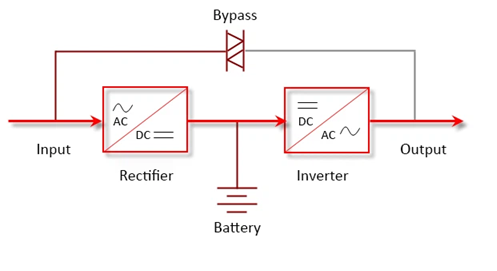
An Online Double-Conversion UPS provides maximum power protection by continuously converting incoming AC utility power into DC, and then back into clean, regulated AC output for sensitive equipment. This "always-on" process (AC ⇒ DC ⇒AC) ensures zero transfer time during power failures, as the inverter is always supplying power, isolating the load from all input anomalies.
Key Working Principle (Double-Conversion)
The system continuously operates through two main stages to ensure maximum power quality and zero interruption:
- Stage 1: Rectifier (AC to DC): The input AC power (even if noisy or unstable) is converted into DC power. This DC power charges the battery and provides power to the inverter, effectively isolating the load from utility issues like voltage sags, swells, or harmonics.
- Stage 2: Inverter (DC to AC): The inverter converts the stabilized DC power back into pure sine wave AC power. This provides a perfectly regulated, clean, and consistent voltage/frequency output, Regardless of the input quality.
Operation Modes
- Normal Mode: The rectifier supplies power to the inverter and charges the battery simultaneously.
- Battery Mode (No Utility Power): If the input AC fails, the rectifier stops, and the battery immediately provides DC power to the inverter. Because the inverter is always on, there is zero transfer time.
- Static Bypass Mode: If the inverter fails or overloads, the UPS automatically switches to the bypass, feeding utility power directly to the load to ensure continuity, though the power is not conditioned.
Core Components
This topology is ideal for mission-critical systems, servers, and sensitive lab equipment requiring constant, pristine power.
An Online Double-Conversion UPS works by continuously regenerating power through two distinct stages to provide a perfectly clean and uninterrupted output.
The Core Working Principle
Unlike other UPS types that only activate during power failure, an online UPS always powers the load through its internal inverter, creating an "electrical firewall" between the utility grid and your sensitive equipment.
- First Conversion: AC to DC (Rectification)
- The Process: Incoming AC power from the wall outlet—which may have noise, sags, or surges—is fed into a Rectifier.
- The Result: The rectifier converts this "dirty" AC into stable DC power. This DC power is then used for two purposes:
- To keep the Batteries charged.
- To feed the Inverter.
- Second Conversion: DC to AC (Inversion)
- The Process: The Inverter takes the DC power and converts it back into a perfect AC sine wave.
- The Result: Because the output is completely regenerated by the inverter, it is immune to any fluctuations in the original input power.
What Happens During a Power Outage?
- Zero Transfer Time: Since the inverter is already running and connected to the batteries (the DC link), there is zero delay when the mains power fails.
- Continuous Flow: The batteries simply continue supplying DC to the inverter without any mechanical switching, ensuring your equipment never sees a momentary "dip".
Key Components
- Rectifier/Charger: Converts AC to DC and charges the battery.
- Inverter: Continuously converts DC to clean AC for the load.
- Battery Bank: Stores energy to bridge outages.
- Static Bypass Switch: A safety feature that automatically connects the load directly to utility power if the UPS itself suffers an internal failure.
Why Use It?
- Ultimate Protection: Protects against all nine common power problems, including frequency variations and harmonic distortion.
- Precision: Typically maintains output voltage within ±1% and frequency within ±0.1%.
- Would you like to compare the efficiency of double-conversion systems against line-interactive models for a specific load size?
|