|
UPS Transfer Switch working principle
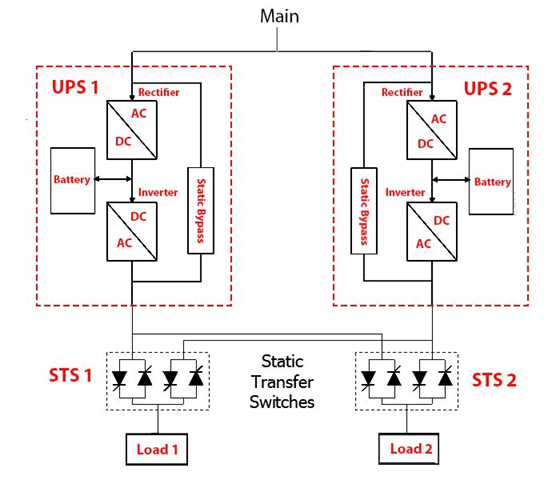
A Transfer Switch in a Uninterruptible Power Supply (UPS) works by continuously monitoring utility power, automatically disconnecting the load from the main grid, and switching to a backup source (battery/inverter or generator) within milliseconds when a failure, voltage drop, or frequency anomaly is detected. It ensures seamless, uninterrupted power to critical equipment.
Key Working Principles
- Constant Monitoring: The control unit (microprocessor-based) constantly checks incoming utility power for voltage, frequency, and stability.
- Detection & Activation: When the main power fails or fluctuates outside safe parameters, the switch detects this instantaneously and prepares the backup power source (e.g., battery/inverter or generator).
- Switching Process: The switch disconnects the load from the failed main line and connects it to the backup source.
- Static Transfer Switch (STS): Uses solid-state components for near-instantaneous switching (sub-cycle).
- Automatic Transfer Switch (ATS): Often uses mechanical contacts to transfer power within milliseconds to seconds.
- Return to Normal: Once utility power stabilizes, the switch automatically reconnects the load to the main supply and disconnects the backup source.
- Safety Features: Includes mechanical or electrical interlocks to prevent both sources from powering the load simultaneously, which could cause a short circuit.
Key Components
- Control Unit: Monitors power and initiates switching.
- Switching Mechanism: Mechanical breakers or static components (SCRs) that physically transfer the connection.
- Bypass Module: Allows maintenance on the UPS without interrupting power to the load.
In a UPS (Uninterruptible Power Supply) system, a transfer switch acts as the critical bridge that determines which power source feeds your equipment. Its working principle varies depending on the type of switch used: Automatic, Static, or Manual.
- Automatic Transfer Switch (ATS):
The Automatic Transfer Switch is an intelligent, self-acting device that governs power flow between a primary source (utility grid) and a backup source (UPS or generator).
- Monitoring: A microprocessor-based controller continuously tracks the voltage and frequency of the primary source.
- Detection: If the utility power fails or drops below safe thresholds (e.g., undervoltage or frequency shift), the ATS senses the anomaly.
- Transfer: The switch physically disconnects the load from the failed source and connects it to the backup source.
- Reversion: Once utility power stabilizes, the ATS automatically transitions the load back to the primary source and may shut down the backup source after a cool-down period.
- Static Transfer Switch (STS):
Standard in high-performance UPS systems, the Static Transfer Switch uses solid-state components like Silicon-Controlled Rectifiers (SCRs) instead of mechanical parts.
- Speed: It performs "seamless" transfers in under 4 milliseconds, faster than a human can perceive and quick enough to prevent server reboots.
- Function: It is often used as a Static Bypass. If the internal UPS inverter fails or is overloaded, the STS instantaneously shifts the load to raw utility power (bypass) to maintain continuity.
- Synchronization: For a safe "make-before-break" transfer, the STS ensures the inverter and bypass sources are perfectly synchronized in phase and voltage before overlapping them momentarily.
- Manual Transfer Switch (MTS):
An MTS requires a person to physically flip a lever or rotate a handle to change sources.
- Maintenance Bypass: In UPS systems, a manual switch is often used to isolate the entire UPS for repairs while keeping the equipment powered directly by the grid.
- Safety: It ensures "break-before-make" isolation, preventing dangerous back-feeding of power into the utility lines.
Key Transfer Modes
| Mode |
Action |
Interruption |
| Open Transition |
Breaks the first connection before making the second. |
100ms – 5 seconds (momentary blackout) |
| Closed Transition |
Connects to the second source before breaking the first. |
Zero (no flicker) |
|




