|
UPS battery charges
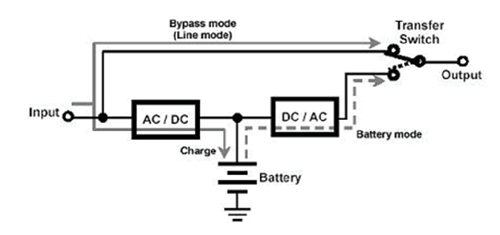
A UPS (Uninterruptible Power Supply) battery charges by converting incoming alternating current (AC) from the grid into direct current (DC) via a rectifier/charger. This DC power supplies the load and charges the battery bank, storing electrical energy chemically. When mains power fails, the battery reverses the process, discharging DC through an inverter to provide continuous AC power.
Core Working Principles of UPS Charging
- Rectification & Charging: During normal operation, the AC input is rectified into DC to charge the batteries.
- Float Charging: Once fully charged, the charger continues to provide a small "float charge" voltage to maintain capacity and counteract natural self-discharge.
- Boost/Fast Charging: Some systems use higher currents to quickly recharge batteries after a discharge cycle.
- Energy Conversion: The process involves changing electrical energy (AC) to chemical energy (inside the battery) and back to electrical energy (DC)
Key Components Involved
- Rectifier: Converts AC input to DC to charge the battery.
- Battery Bank: Stores energy for emergencies.
- Inverter: Converts battery DC back to AC for appliances during an outage
Charging Methods
In online (double-conversion) systems, the battery is constantly connected to the charger and inverter, ensuring zero transfer time during power failures
The working principle of an Uninterruptible Power Supply (UPS) battery involves a continuous cycle of energy conversion and storage to ensure equipment stays powered during electrical failures.
- Energy Storage (Charging)
When the main utility power is active, the UPS system performs two simultaneous tasks:
- Rectification: A component called a rectifier converts the incoming Alternating Current (AC) from the wall outlet into Direct Current (DC).
- Chemical Conversion: This DC power is sent to the battery, where it is stored as chemical energy through electrochemical reactions.
- Charging Modes: Most modern UPS systems use Constant Current (CC) to bulk-charge the battery quickly, followed by Constant Voltage (CV) or "Float Charging" to maintain it at 100% without overcharging.
- Immediate Response (Discharging)
As soon as the system detects a power outage or significant voltage drop (e.g., below 170V), it activates the backup mode:
- Instant Switch: The UPS switches to battery power within milliseconds (typically 0ms to 10ms depending on the UPS type.
- Inversion: Since batteries only output DC, an inverter converts the stored chemical energy back into the stable AC power required by your electronics.
- Key Components Involved
| Component |
Function |
| Rectifier/Charger |
Converts AC to DC to charge the battery and power the internal DC bus. |
| Battery Bank |
The "heart" of the system; stores energy (usually Lead-Acid or Lithium-Ion). |
| Inverter |
Converts DC back to AC for the connected devices during an outage. |
| Static Bypass |
A safety switch that connects the load directly to the mains if the UPS internal components fail. |
Summary of Operation by UPS Type
Would you like a more detailed comparison of Lead-Acid vs. Lithium-Ion UPS batteries or a guide on how to calculate the backup runtime for your specific devices?
|