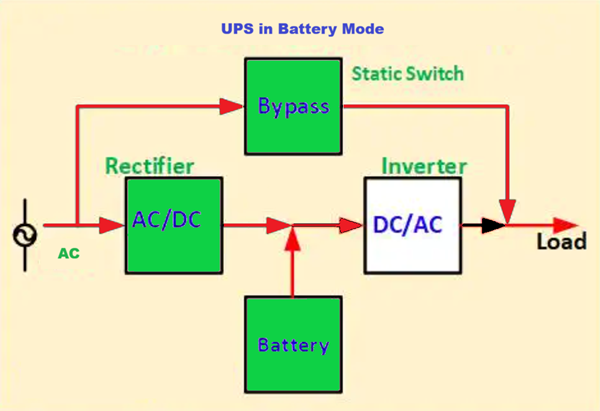
Normal Mode (Standby) UPS working principle

battery normal mode

 A Standby (Offline) UPS operates in normal mode by passing utility AC power directly to connected equipment through a surge suppressor, while simultaneously charging the battery via a charger. The inverter remains idle, switching on only when power fails or fluctuates outside set tolerances, with a typical 2–10 millisecond transfer time.

Key Aspects of Normal Mode Working

  • Direct Path: The AC input is connected directly to the load through a filter or surge protector.
  • Minimal Power Conditioning: The equipment receives raw utility power, meaning no voltage regulation (AVR) is performed in basic models.
  • Battery Charging: The internal battery charger works continuously to keep the battery fully charged while grid power is stable.
  • Standby Inverter: The inverter remains off or in a standby state, waiting to activate when a, surge, or failure is detected by the sensing circuits.
  • Efficiency: Because components like the inverter are not constantly active, these units are highly energy-efficient and cost-effective.

When the input voltage fails or falls outside, the transfer switch rapidly (typically 2-10ms) switches the load to the battery-powered inverter.

In Normal Mode (also known as Line Mode), a Standby (Offline) UPS operates by passing utility power directly from the wall outlet to the connected devices.

Working Principle in Normal Mode

Direct Path: The AC power from the grid flows through a transfer switch directly to your equipment.

  • Surge Protection: Most units include basic filtering or a surge suppressor to "clean" the power from minor spikes before it reaches your devices.
  • Battery Charging: While powering the load, a small portion of the input AC is converted to DC by an internal rectifier/charger to keep the batteries fully charged and ready.
  • Standby Inverter: Crucially, the inverter remains inactive or "on standby." It does not participate in powering the load as long as the incoming voltage is within acceptable limits.

Why "Standby"?

It is named "Standby" because the battery-to-AC conversion path is only engaged when a power failure or significant voltage drop is detected.

  • Efficiency: This mode is highly efficient (95-99%) because the UPS isn't constantly converting power back and forth.
  • Transfer Time: If the grid fails, the UPS detects the drop and uses a mechanical or solid-state relay to switch to battery power, a process that usually takes 5–10 milliseconds.


favicon bacd

+(39) 347 051 5328

Italy - Kazakhstan

09.00am to 18.00pm

About

We offer the best and economical solutions, backed by 27+ years of experience and international standards knowledge, echnological changes, and industrial systems.

Marketing Materials

Spring Renovation
Industry
US Gas Company
Construct
Plus Project
Vam Drilling Service
X Project
X Project
Cabrrus Training

Marketing Materials1

Spring Renovation
Industry
US Gas Company
Construct
Plus Project
Vam Drilling Service
ultrasonic sensor
ultrasonic sensor
Cabrrus Training