|
A bidirectional inverter UPS - Working Principle
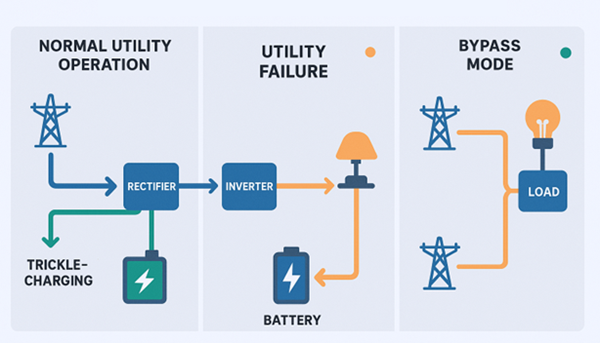
A bidirectional inverter UPS operates by using a single power converter for two-way energy flow, switching between grid-to-battery charging (AC-to-DC) and battery-to-load backup (DC-to-AC). It acts as a rectifier when mains power is present, converting grid AC to DC for charging, and instantly switches to an inverter mode using Pulse Width Modulation (PWM) to convert battery DC to stable AC during power outages.
Key Working Principles
- Grid Mode (AC to DC - Charging): When the grid is active, the bidirectional inverter functions as a rectifier. It converts 220V/110V AC power into direct current (DC) to charge the batteries. Many modern units use Power Factor Correction (PFC) to increase charging efficiency.
- Backup Mode (DC to AC - Inverting): During a power failure, the system detects the voltage drop and switches to inverter mode. It converts DC power stored in the batteries back into AC power, providing a pure sine wave output for household or industrial loads.
- Bidirectional Operation: Unlike traditional systems that use separate circuits, a bidirectional inverter uses the same circuit for both charging and inverting, allowing for rapid switching (often 2-4 ms) and improved efficiency.
- Solar Integration: In hybrid setups, the bidirectional inverter manages energy from the grid, solar panels, and batteries, prioritizing self-consumption of solar energy and storing excess power in the batteries.
Main Advantages
- High Efficiency: Lower conversion losses due to combined circuitry.
- Fast Response: Seamless switching from utility to battery power.
- Improved Battery Life: Often includes intelligent, multi-stage charging profiles.
- Grid Independence: Capable of feeding excess power back to the grid (in grid-tied models).
A bidirectional inverter UPS operates as a dual-purpose power converter, eliminating the need for separate charging and inverting circuits. It uses a single power stage to handle energy flow in both directions between the AC grid and a DC battery bank.
Core Working Principle
The system relies on advanced solid-state electronics—typically MOSFETs or IGBTs—controlled by Pulse Width Modulation (PWM). Its operation is divided into two primary modes:
- Grid-to-Battery Mode (AC to DC):
- When utility power is available, the inverter acts as a rectifier.
- It pulls AC power from the grid and converts it into regulated DC to charge the connected batteries.
- Sophisticated systems often include Power Factor Correction (PFC) to improve efficiency and reduce harmonic distortion during this stage.
- Battery-to-Load/Grid Mode (DC to AC):
- When the grid fails (or during peak demand hours), the system switches to inverting mode.
- It takes stored DC energy from the battery and converts it back into stable AC to power appliances or feed energy back into the grid.
- The transition is managed within milliseconds (typically <10ms) to ensure critical devices remain operational without resetting.
Key Components
- H-Bridge Inverter Stage: The central switching circuit that manages the actual conversion of current direction.
- Phase-Locked Loop (PLL): Ensures the inverter’s output is perfectly synchronized with the grid's voltage and frequency.
- Output Filters (LC/LCL): Smooth out switching pulses to produce a Pure Sine Wave output, which is safer for sensitive electronics like computers and medical equipment.
Benefits over Traditional UPS
Higher Efficiency: Using the same circuit for both functions reduces component count and internal power losses.
Cost-Effective: Fewer hardware parts lead to a more compact and affordable design compared to separate chargers and inverters.
Smart Energy Management: These units can support Vehicle-to-Grid (V2G) and solar integration, allowing you to sell excess energy back to the utility.
|