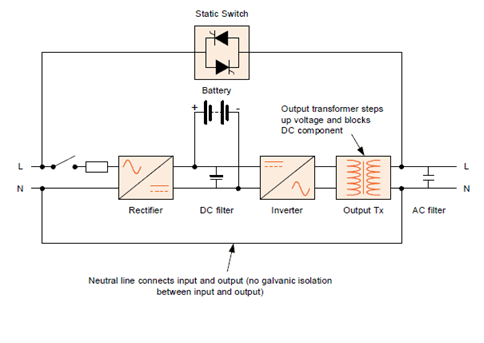
Rectifier (AC to DC) UPS working principle

Rectifier

In Stage 1 of an online UPS, the rectifier (or converter) transforms incoming AC utility power into DC power. This DC power serves two simultaneous purposes: feeding the inverter to produce a stable AC output and charging the battery bank. It acts as the primary, steady source of energy for the inverter

Working Principle in Detail

  • Rectification Process: The rectifier receives AC from the mains and uses a bridge rectifier (four diodes) to convert the alternating polarity to a single-direction DC voltage.
  • Filtering: Capacitors are used in parallel with the rectifier to smooth the pulsating DC output into a cleaner, flatter DC signal.
  • Battery Charging: In normal mode, the rectifier converts AC to DC to continuously charge the battery and power the inverter.
  • Normal vs. Failure Operation: When AC is stable, the rectifier feeds the inverter. If the AC input fails, the rectifier stops, and the battery directly powers the inverter to provide seamless, uninterrupted power.
  • Control and Regulation: Advanced UPS systems use IGBT-based rectifiers to control power flow and manage input quality.

This process ensures that sensitive equipment receives a stable, clean AC supply, free from surges or sags

In an Uninterruptible Power Supply (UPS), the rectifier is the primary component that converts incoming Alternating Current (AC) from the power grid into Direct Current (DC). This conversion is essential for two reasons: it recharges the internal batteries and provides the stable DC power required by the inverter to regenerate a clean AC output for your devices.

Core Working Principle

The rectifier uses semiconductor devices, typically diodes or thyristors (SCRs), to allow current to flow in only one direction.

  1. Rectification Stage: Incoming AC power, which constantly reverses direction, enters the rectifier. The Bridge Rectifier configuration (using four diodes) is the most common, as it "flips" the negative part of the AC wave to be positive, creating a pulsating DC signal.
  2. Filtration Stage: The resulting "pulsating" DC is not stable enough for electronics. The UPS uses Capacitor Filters to smooth out these ripples, resulting in a steady DC voltage.
  3. Dual Purpose

Why it Matters

  • Power Conditioning: Rectifiers help remove electrical noise and harmonics from the utility line.
  • Battery Protection: Modern Controlled Rectifiers can adjust the charging voltage to prolong battery life and prevent overcharging.
  • No Interruption: Because the rectifier and battery are always "on-line" in high-end systems, there is zero transfer time when the main power fails.


favicon bacd

+(39) 347 051 5328

Italy - Kazakhstan

09.00am to 18.00pm

About

We offer the best and economical solutions, backed by 27+ years of experience and international standards knowledge, echnological changes, and industrial systems.

Marketing Materials

Spring Renovation
Industry
US Gas Company
Construct
Plus Project
Vam Drilling Service
X Project
X Project
Cabrrus Training

Marketing Materials1

Spring Renovation
Industry
US Gas Company
Construct
Plus Project
Vam Drilling Service
ultrasonic sensor
ultrasonic sensor
Cabrrus Training